turkey · Destination Guide
The Land That Remembers: A Turkey Wedding Photography Guide
Cappadocia's volcanic fairy chimneys at first light, Pamukkale's white travertine terraces, Istanbul's Bosphorus at blue hour, the Lycian coast cliffs, and Uchisar castle — five Turkish locations where ancient geology meets cinematic wedding portraiture.
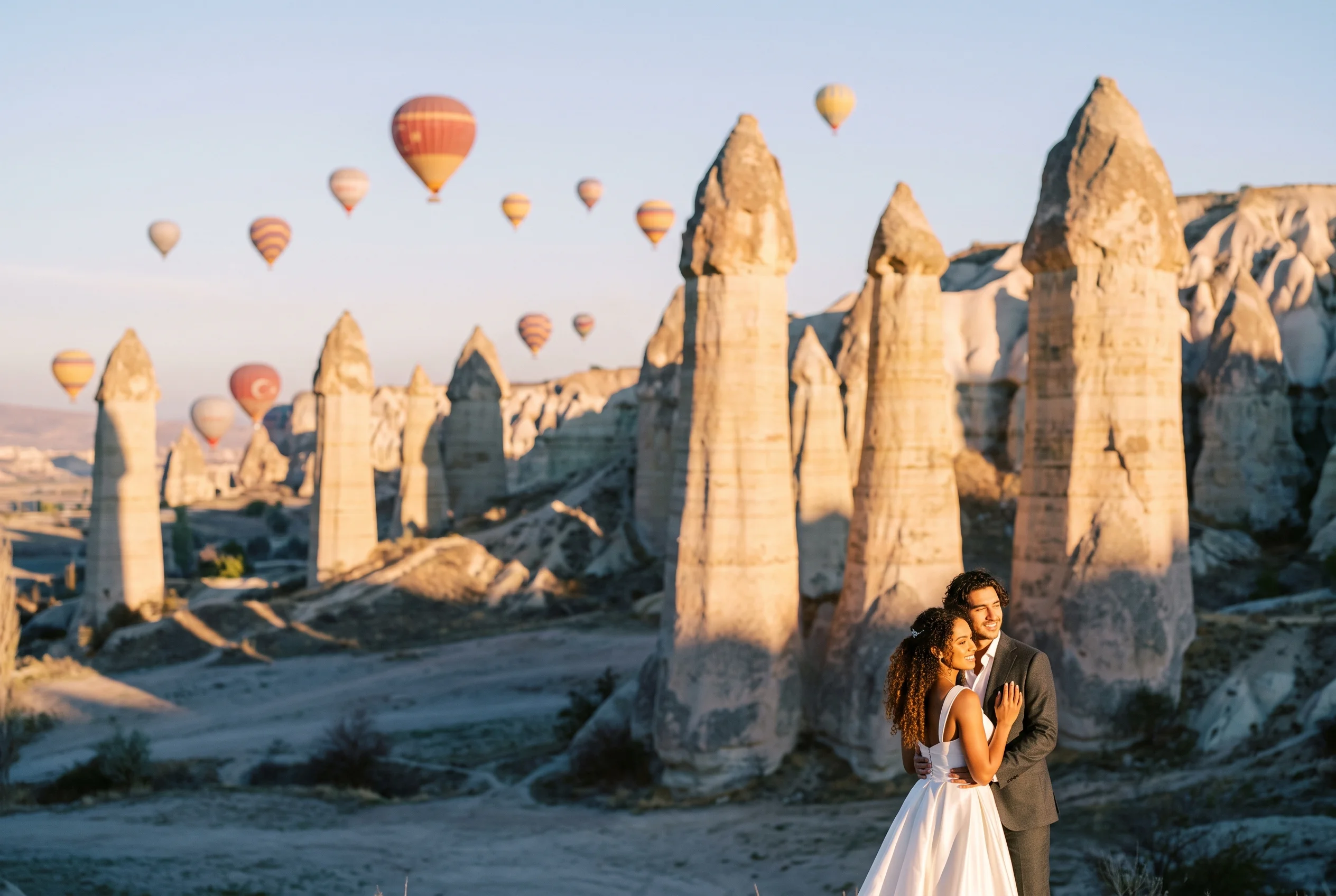
Cappadocia is a landscape that does not look like it belongs on this planet. Volcanic eruptions 30 million years ago left a soft tuff stone that wind and water carved into fairy chimneys — towers of rock with caps of harder basalt balanced on top, standing in valleys that stretch for kilometres between mesas of pale volcanic stone. The first time you see it from the air, in a hot-air balloon at dawn, the landscape reads as a geological sculpture park, and the impulse to make a portrait in it is immediate. But Turkey's cinematic potential does not begin and end in Cappadocia. The country spans two continents, and its light shifts from the dry, high-altitude clarity of the interior to the humid, silver-blue quality of the Bosphorus to the saturated Mediterranean glare of the southern coast. Each of these five locations is chosen for an hour when that specific light does something the others cannot.
Cappadocia — The Fairy Chimney Valleys at First Light
The valleys of Cappadocia — Goreme, Love Valley, Red Valley — are corridors between walls of carved tuff stone, dotted with fairy chimneys that rise 10 to 40 metres. The stone is pale, almost white at dawn, shifting to honey-gold as the sun climbs. The floors of the valleys are flat and dusty, and the walls rise vertically on both sides, creating a natural canyon that channels the first light into a shaft that travels along the valley floor.
The move is to be in the valley, not above it, at the moment the sun clears the eastern ridge. The light enters the valley as a horizontal beam — warm, directional, and low enough to light the fairy chimneys from the side, giving them a dimensional quality that the flat overhead light of midday destroys. The couple, placed in the valley floor with the chimneys rising behind them, reads as a portrait set in a landscape that feels prehistoric. The hot-air balloons that Cappadocia is famous for are visible above the valley walls, adding colour and scale, but the portrait itself is made in the valley — grounded, intimate, and lit by a quality of light that exists for about 20 minutes.
The hour that matters: The first 25 minutes after sunrise, approximately 5:45 AM in summer. The balloons launch at sunrise, so if you want them in the background, you must be in position before launch. By 7 AM, the light is too high and the valleys are filling with tour groups. Hire a local guide who knows which valleys are accessible at dawn — some are restricted.
Pamukkale — The White Travertine Terraces
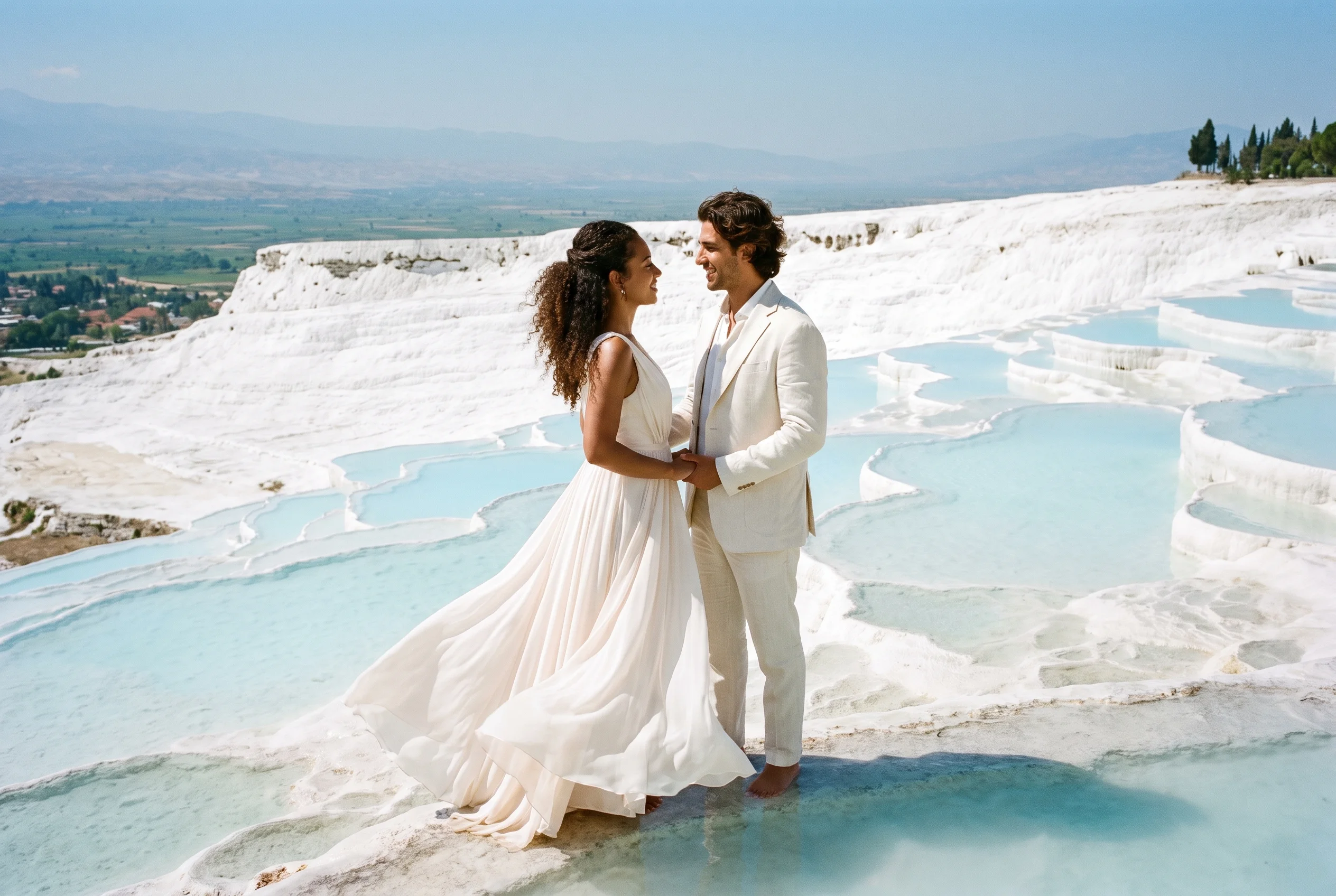
Pamukkale is a cascade of white limestone terraces on a hillside in southwestern Turkey, formed by calcium-rich thermal springs that have been depositing stone for millennia. The terraces are shallow pools of turquoise water on white stone, stepping down the hillside in a formation that looks like a frozen waterfall. The white stone reflects light in every direction, and the effect is like standing on a landscape made of snow in 35-degree heat.
The portrait move is to work the upper terraces at mid-morning, when the sun is high enough to illuminate the white stone directly and the turquoise pools are at their most saturated. The light here is unlike any other location because the white stone acts as a reflector from below — every shadow on the couple's face is filled by the reflected light off the travertine, producing a quality of light that is soft and omnidirectional despite the direct sun. The couple, placed on the edge of a terrace with the cascade of white stone falling away below them, reads as a portrait on a surface that looks otherworldly. The contrast between the white stone and the turquoise water creates a colour frame that no other location produces.
Istanbul — The Bosphorus at Blue Hour
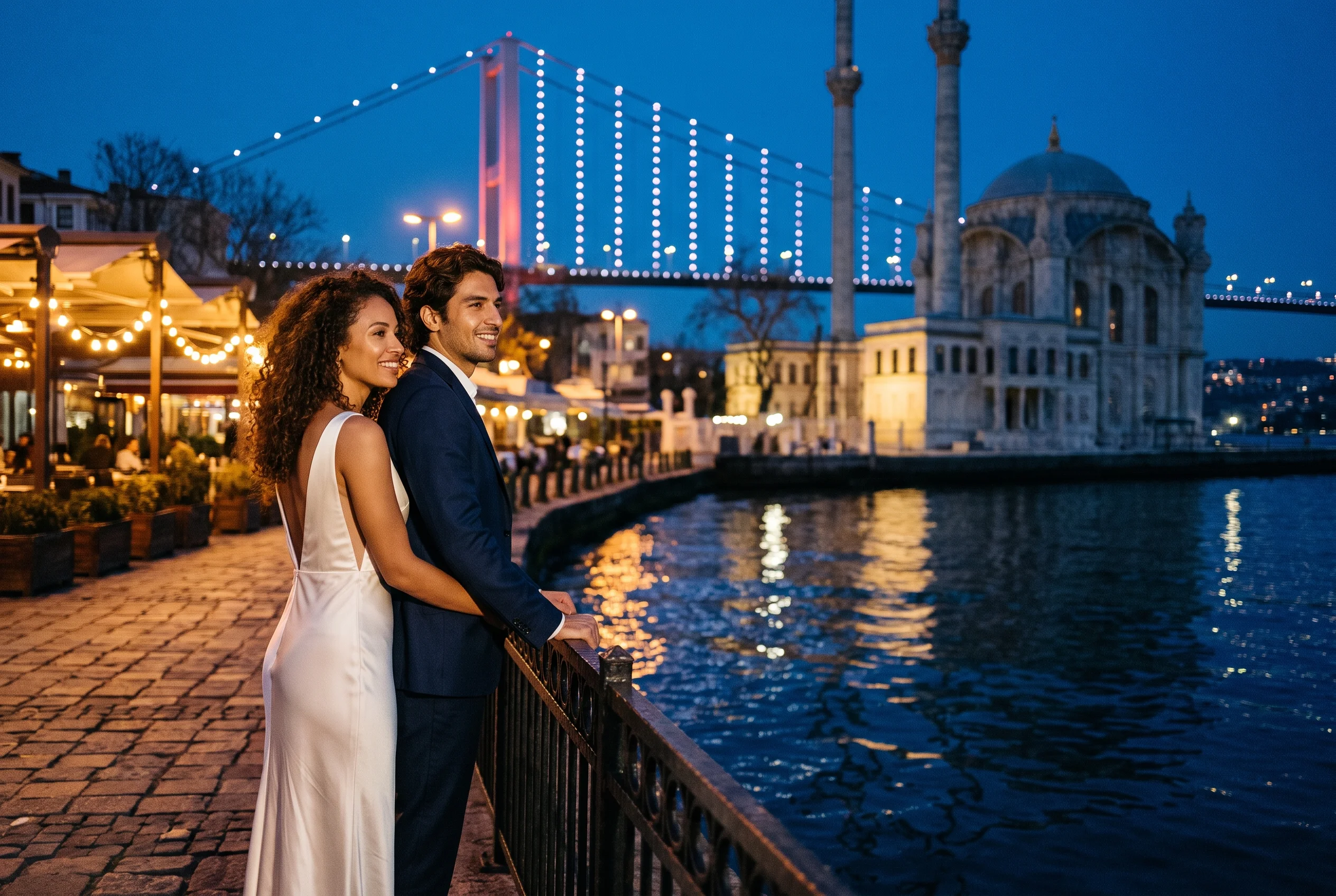
The Bosphorus is the strait that divides Istanbul between Europe and Asia, and its shoreline is the most layered urban landscape in Turkey — Ottoman palaces, modern glass towers, waterfront mansions, and fortresses from three empires stacked along both sides of the water. The light at blue hour turns the strait into a mirror that doubles every building, every light, and every colour.
The portrait move is to work the Ortakoy waterfront, where the Bosphorus bridge rises directly behind the shoreline and the mosque's baroque silhouette provides an architectural anchor. The blue-hour sky holds cobalt for about 20 minutes, and during that window the bridge lights, the mosque's warm interior glow, and the waterfront restaurant lights create a layered colour-temperature contrast that is the most cinematic urban light in Turkey. A couple on the waterfront railing, the bridge and the mosque behind them reflected in the strait, reads as a portrait of a city that exists on two continents.
The Lycian Coast — Cliffs Above the Mediterranean
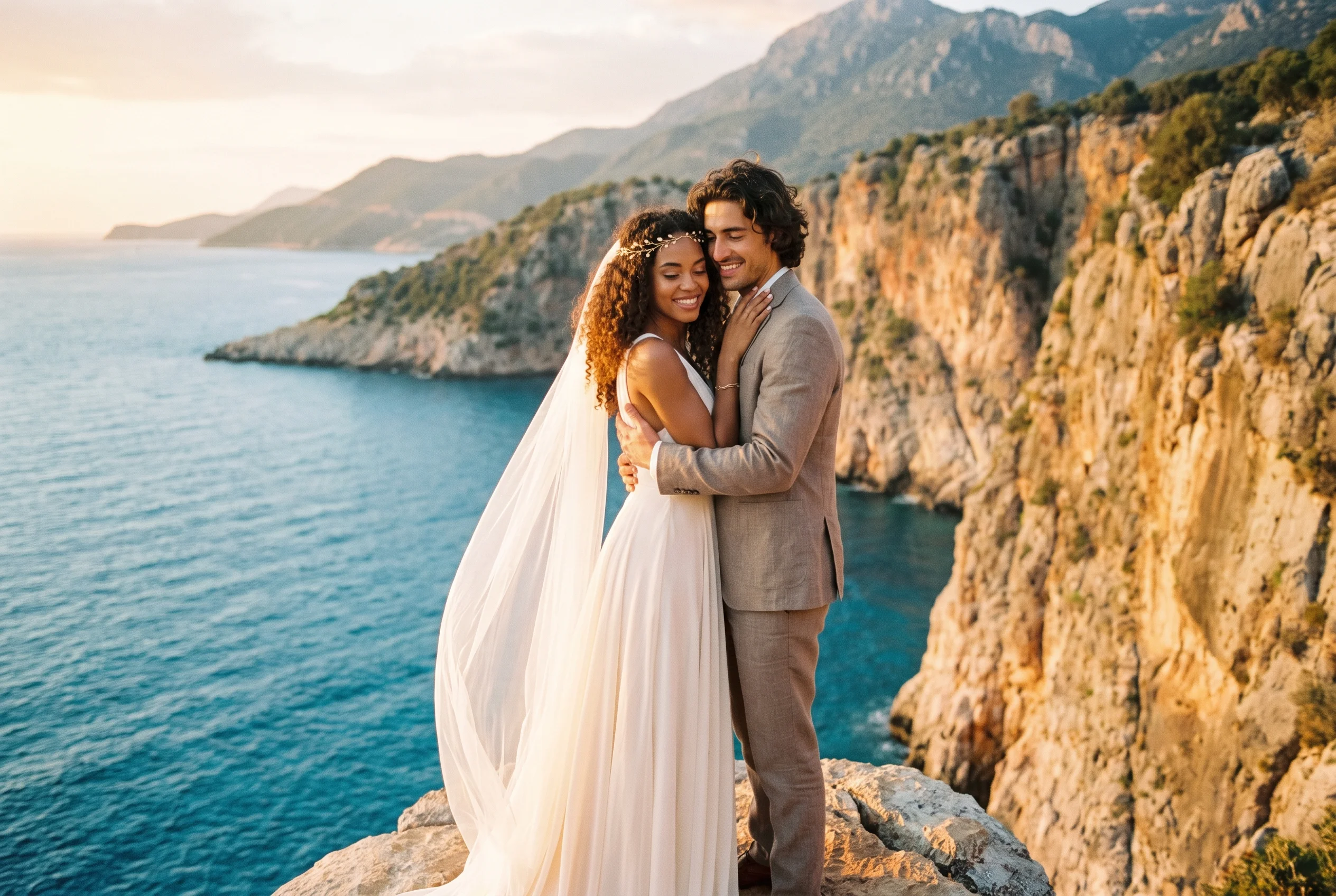
The Lycian coast is the stretch of southwestern Turkey between Fethiye and Antalya, where the Taurus Mountains drop directly into the Mediterranean in cliffs of grey limestone that rise 200 metres above turquoise water. The Lycian Way, a 500-kilometre hiking trail, runs along the clifftops, and the views from the trail are the most dramatic coastal landscape in Turkey — vertical rock, blue sea, and a sky that is clear 300 days a year.
The portrait move is to work the clifftop sections near Faralya or Kabak Bay at the last hour before sunset, when the western sun drops toward the Mediterranean and the light rakes across the cliff faces from the sea side. The limestone catches warm light while the water below holds its deep blue, and the contrast — warm rock, cool sea — gives the frame a depth that a single-temperature landscape cannot produce. The couple, placed on the cliff edge with the coastline curving away below, reads as a portrait on the edge of a landscape that feels both Mediterranean and geological.
Uchisar Castle — The Highest Point in Cappadocia
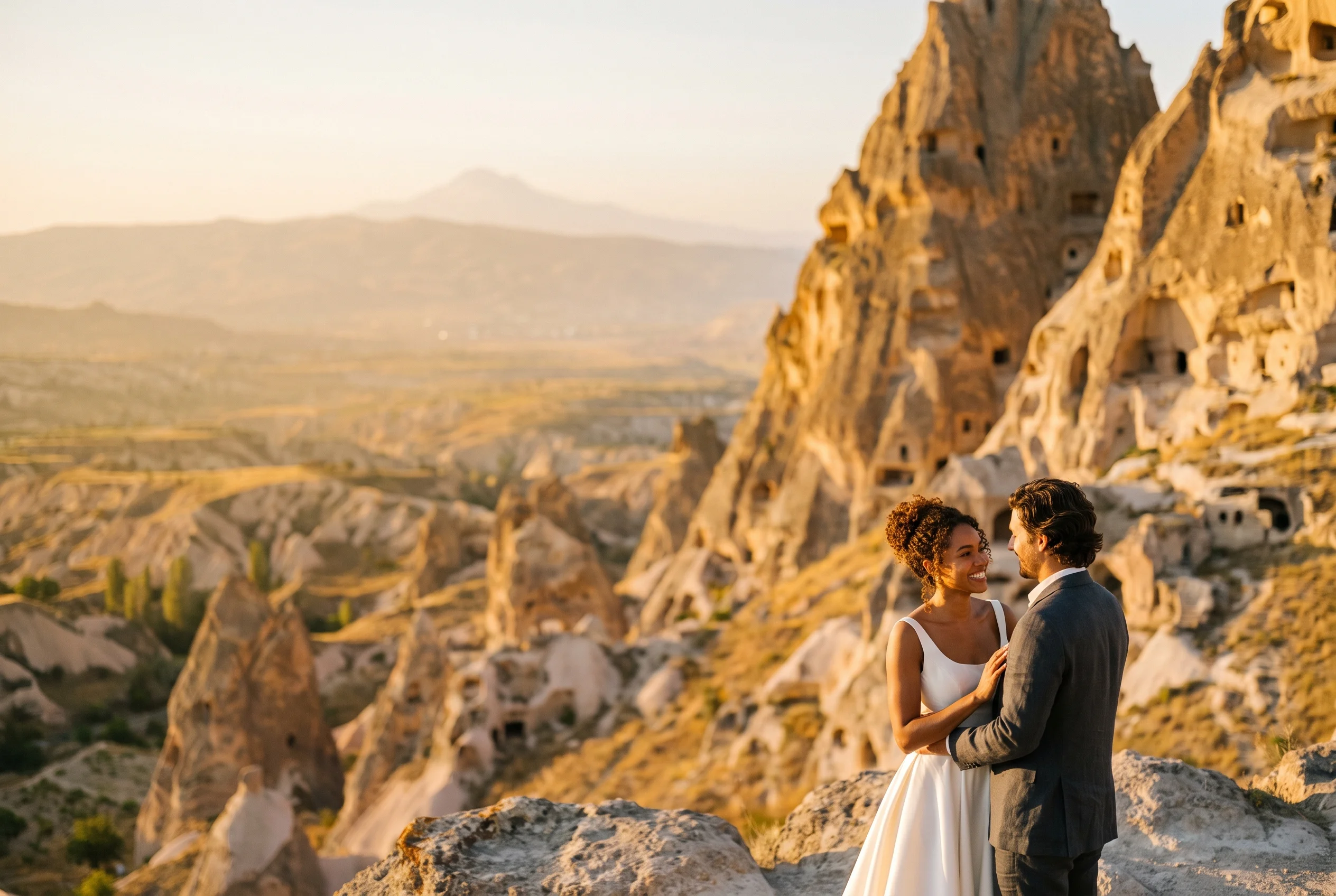
Uchisar is the tallest fairy chimney in Cappadocia — a 60-metre peak of carved tuff stone with tunnels and rooms hollowed out over centuries, sitting at the highest point in the region. From the summit, the entire Cappadocian valley system is visible: Goreme to the north, the Red Valley to the west, and Mount Erciyes, the extinct volcano that created the tuff, on the southern horizon.
The portrait move is to work the rock terraces below the castle peak at the last hour of daylight. The western sun turns the tuff stone a deep honey-gold, and the valleys below fill with a warm haze that softens the landscape into layers of gold and amber. The couple, placed on the rock terrace with the valley system stretching behind them and the castle peak rising above, reads as a portrait set at the top of a landscape that feels like a map of another planet. The light here is warmer than the dawn light — the stone absorbs heat all day and radiates it back in the evening, giving the air a quality that is almost tactile.
Frequently Asked Questions
Is a hot-air balloon ride necessary for Cappadocia wedding photos?
Not for the portraits — the best frames are made in the valleys, not from the balloons. But the balloons are essential as a background element, and they only fly at sunrise. If you want balloons in the frame, you must be in the valley before 6 AM in summer. The balloon ride itself is not suitable for formal wear or photography equipment; book it as a separate experience.
Can you visit Pamukkale and Cappadocia in the same trip?
Yes, but they are 600 kilometres apart. The most efficient route is to fly Istanbul to Nevsehir (Cappadocia), shoot for two days, then drive or fly to Denizli (Pamukkale). Most couples allocate 3 days in Cappadocia and 1 day at Pamukkale. The Lycian coast is a separate trip — it is 4 hours from Antalya airport and requires a full day of travel from the interior.
What is the best season for the Lycian coast?
May and October offer the best combination of clear light, comfortable hiking temperatures, and uncrowded trails. June through September is hot — 35°C or higher on the clifftop sections — but the light is reliable and the sea is at its bluest. Avoid November through March; the trail is muddy and the light is flat.
You don't need a sunrise balloon flight to stand in these frames. Pictaway's atelier crafts cinematic wedding portraits set in Turkey's most iconic locations — from Cappadocia's fairy chimneys to the Bosphorus at blue hour — uploaded in moments, delivered in 24 hours. Explore Turkey wedding portraits.
Your Turkey wedding portraits — delivered in 24 hours
Get started