hongkong · Destination Guide
Where the City Meets the Sea: A Hong Kong Wedding Photography Guide
Victoria Harbour at blue hour, the Mid-Levels streets where the city stacks vertically, Sai Kung's volcanic geopark, the Dragon's Back ridge above the ocean, and a Lantau beach at sunset — five Hong Kong locations where density meets nature.
Hong Kong is a city built on the principle that if you run out of flat land, you build vertically. The result is a place where 7 million people live in a landscape that is 70 per cent mountain and 30 per cent city — where a glass tower can rise 80 floors next to a subtropical forest, where a beach can sit twenty minutes from a financial district, and where the harbour that divides the city in two reflects both the skyline and the mountains behind it. No other city in the world offers this density of contrast: you can make a neon street portrait and a mountain ridge portrait in the same afternoon, and both will be authentically Hong Kong.
This is a guide to five locations that capture Hong Kong's defining quality — the collision of density and nature, of vertical city and horizontal sea. Each is chosen for an hour when the location produces light that could not exist anywhere else, because no other city has this particular geometry of glass, stone, water, and ridge.
Victoria Harbour — Blue Hour on the Tsim Sha Tsui Promenade
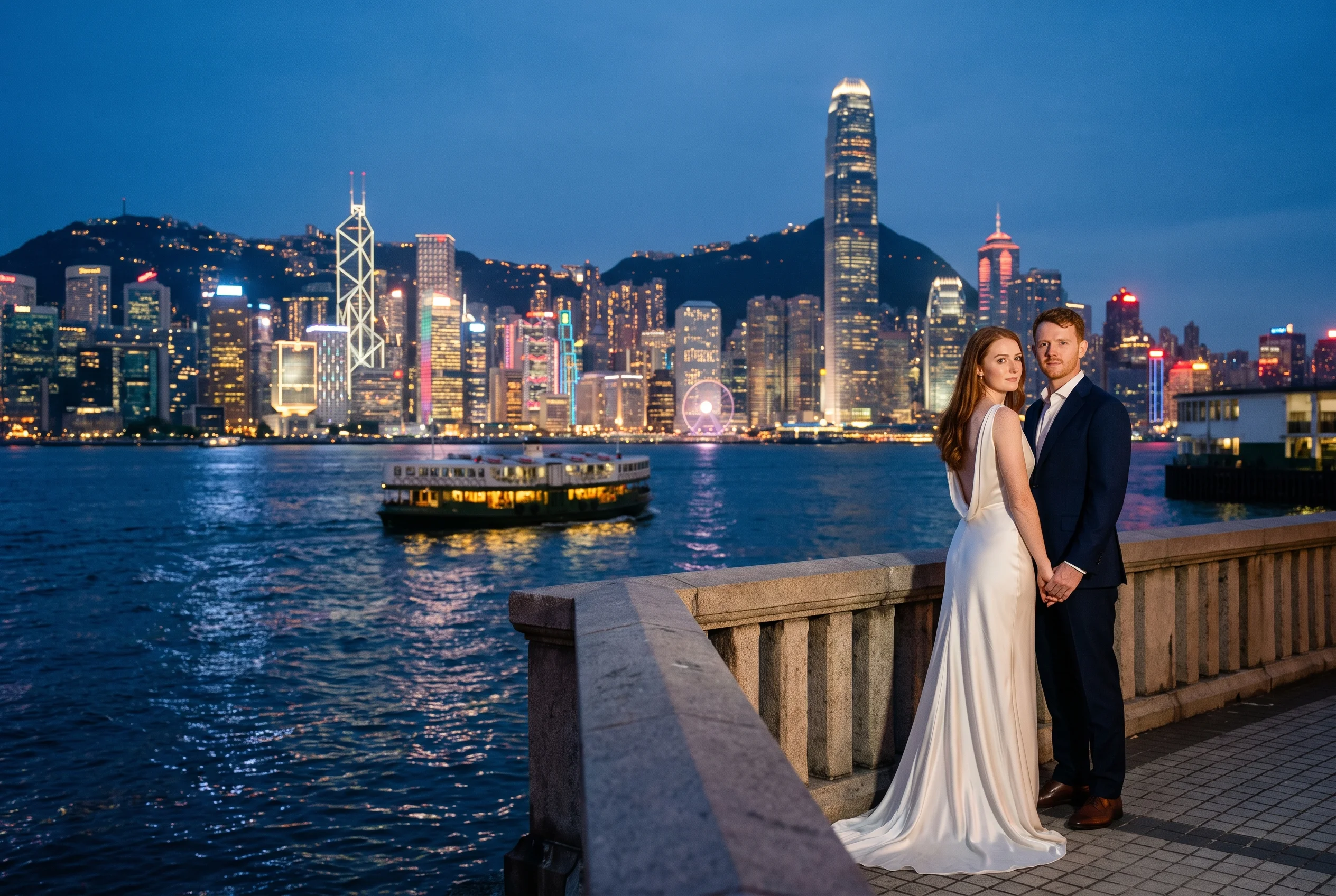
Victoria Harbour is the frame that defines Hong Kong: the skyline of Central and Wan Chai on one side, the Kowloon peninsula on the other, and between them a channel of water so busy with ferries and cargo ships that the surface never fully calms. The Tsim Sha Tsui promenade on the Kowloon side is the camera position — the Central skyline rises directly across the water, and at blue hour the frame is one of the most photographed in Asia.
The light at blue hour is what makes this frame more than a postcard. The sky holds a deep cobalt for about twenty minutes after sunset, and during that window the skyline towers — the ICC, Two IFC, the Bank of China — are lit from within and reflect their warm interior light off the harbour water below. The colour-temperature contrast between the cool sky and the warm building lights is the cinematic quality that makes the frame feel like a film still rather than a travel photograph. A couple on the promenade railing, the skyline behind them reflected in the harbour, reads as a portrait of a city that is more beautiful at night than during the day. The Avenue of Stars railings provide a graphic foreground, and the Star Ferry crossing the harbour adds a moving element that gives the frame a sense of life.
The hour that matters: 25 to 45 minutes after sunset. The skyline lights are on by dusk, but the sky needs to reach full cobalt. The harbour is never mirror-still — the ferry traffic ensures a constant gentle chop — but the reflections are sharp enough to double the skyline. A light evening haze is an advantage; it softens the building lights into a glow that a clear night does not produce.
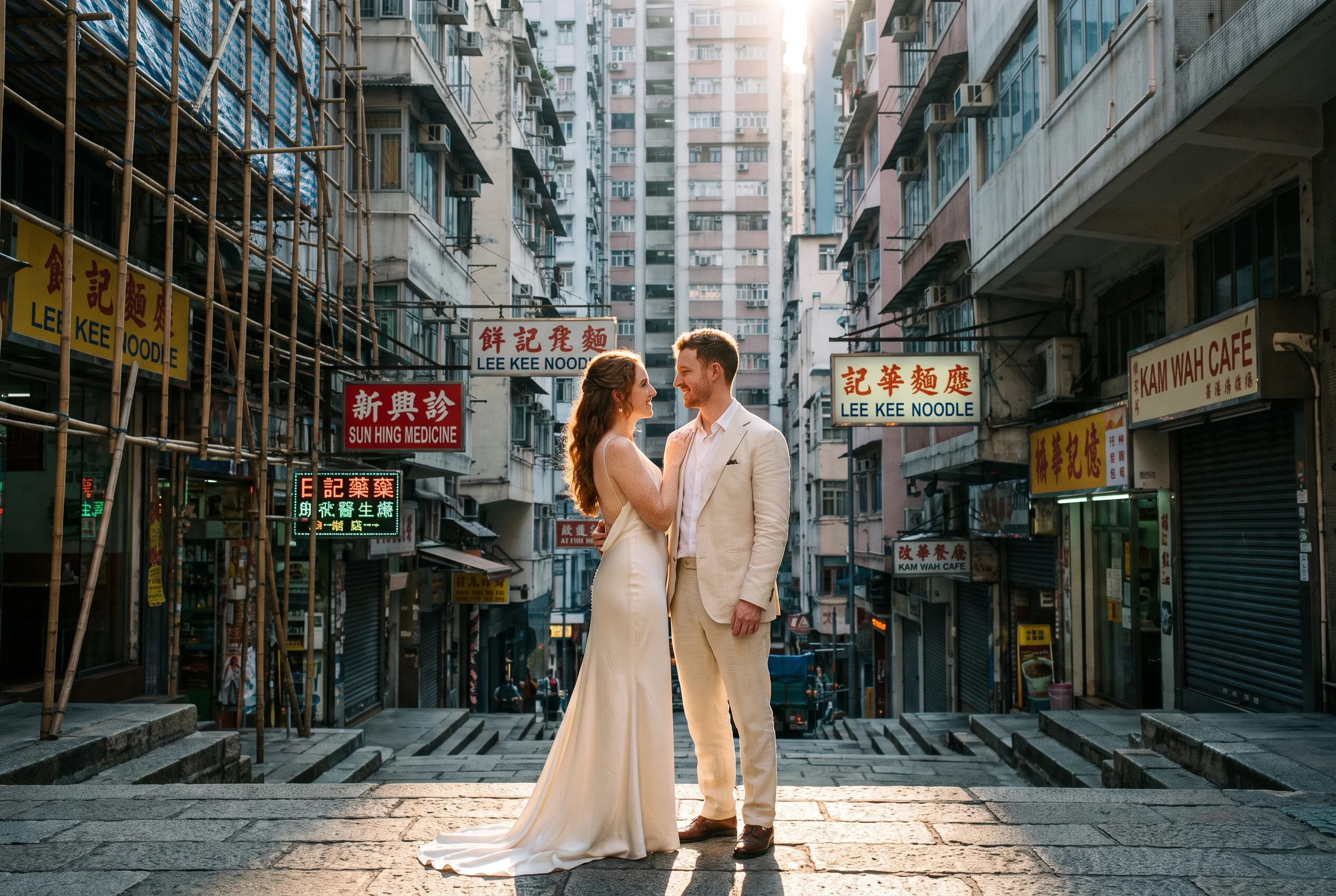
Central Mid-Levels — The City That Stacks
The Mid-Levels is the residential district that climbs the hill above Central, and its defining feature is the Mid-Levels Escalator — the longest outdoor covered escalator system in the world, rising 800 metres through a neighbourhood of shopfronts, wet markets, and high-rise apartment blocks. The streets here are so steep that the escalator is the primary transportation, and the visual result is a city that reads vertically: shop signs stacked above shop signs, balconies above balconies, the whole hillside a wall of urban texture that catches light differently at every level.
The portrait move is to work the steep side streets off the escalator in the late afternoon, when the western sun sends shafts of light between the towers and the narrow streets create dramatic shadow corridors. The light here is the opposite of the harbour — intimate, enclosed, directional, and fast-changing. A couple on a steep stone step street, the towers rising behind them and a shaft of sun cutting through the urban canyon, makes a frame that no other city can produce because no other city stacks at this density on this gradient. The wet market awnings, the neon signage, and the bamboo scaffolding that wraps half the buildings provide texture that the harbour's clean glass towers cannot.
The hour that matters: 4 to 5:30 PM, when the western sun is low enough to send light shafts between the buildings. The Mid-Levels streets face various directions, so the light hits different streets at different times — a local guide who knows which street catches light at which hour is essential. The escalator runs downhill before 10 AM and uphill after 10 AM, which matters for logistics.
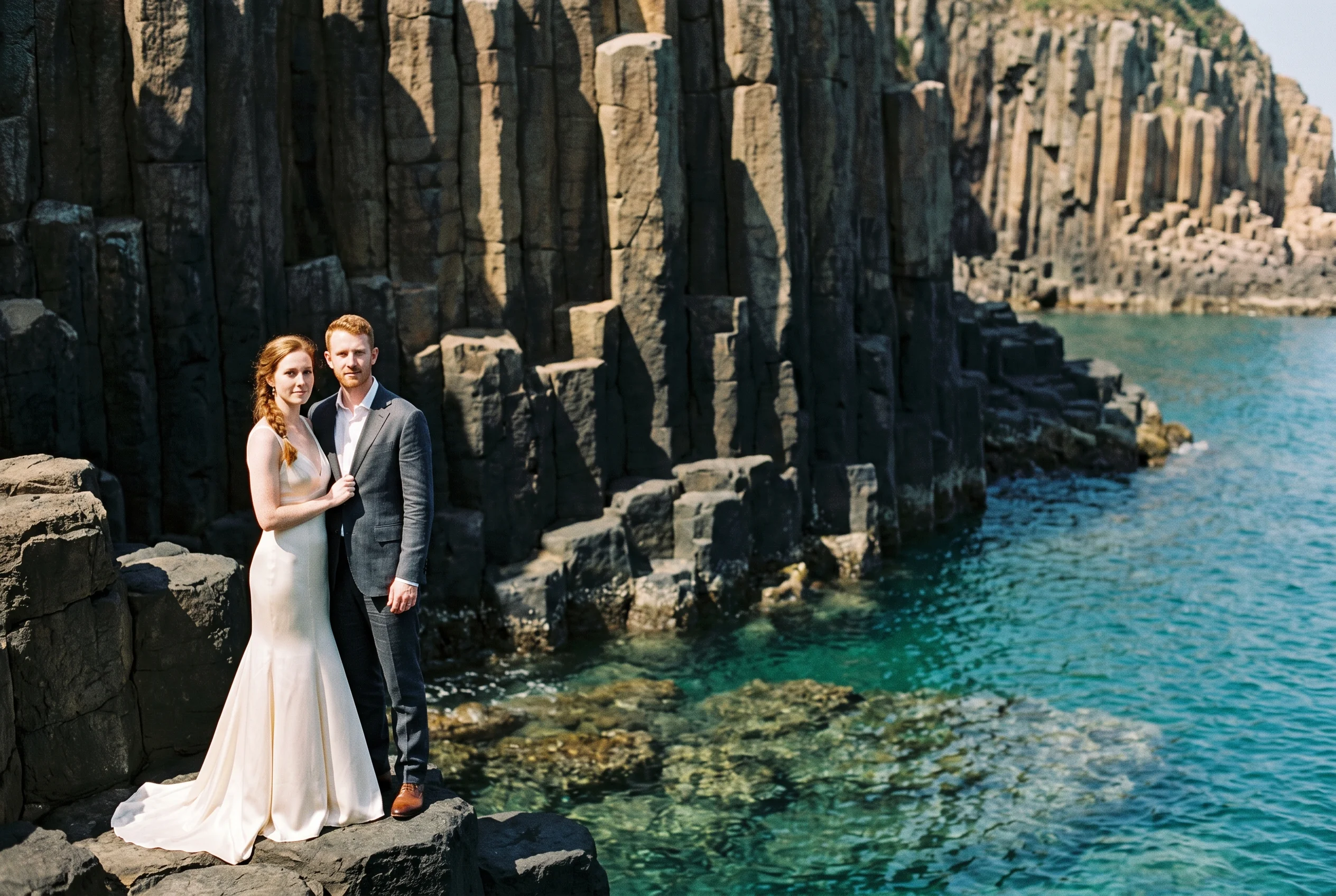
Sai Kung Geopark — Volcanic Rock and Clear Water
Sai Kung, in the eastern New Territories, is the part of Hong Kong that most visitors never see — a peninsula of volcanic hexagonal columnar jointing, clear turquoise water, and white sand beaches accessible only by boat or hiking trail. The geopark's defining feature is the columnar rock: hexagonal basalt columns, formed 140 million years ago, that drop into the sea in vertical walls of geometric stone. The rock is dark, the water is clear, and the combination is the most graphic natural landscape in Hong Kong.
The portrait move is to take a speedboat from Sai Kung town to the columnar formations and shoot from the water's edge at the base of the cliffs. The light at mid-morning — when the sun is high enough to illuminate the rock face but not so high that the water has gone flat — gives the columns a dimensional quality that low-angle light cannot. The couple on the rock platform at the cliff base, the hexagonal columns rising behind them and the clear water in front, makes a frame that reads as geological rather than scenic. The dark stone and the turquoise water create a colour palette that no beach or harbour location in Hong Kong can match.
The hour that matters: 9 to 11 AM. The columnar formations face east, so they catch morning light directly. By afternoon, the cliffs are in shadow and the colour goes flat. The water is clearest in October and November, after the summer rains have washed sediment out of the channels. Hire a boat from Sai Kung pier that knows the geopark — the formations are in restricted waters.
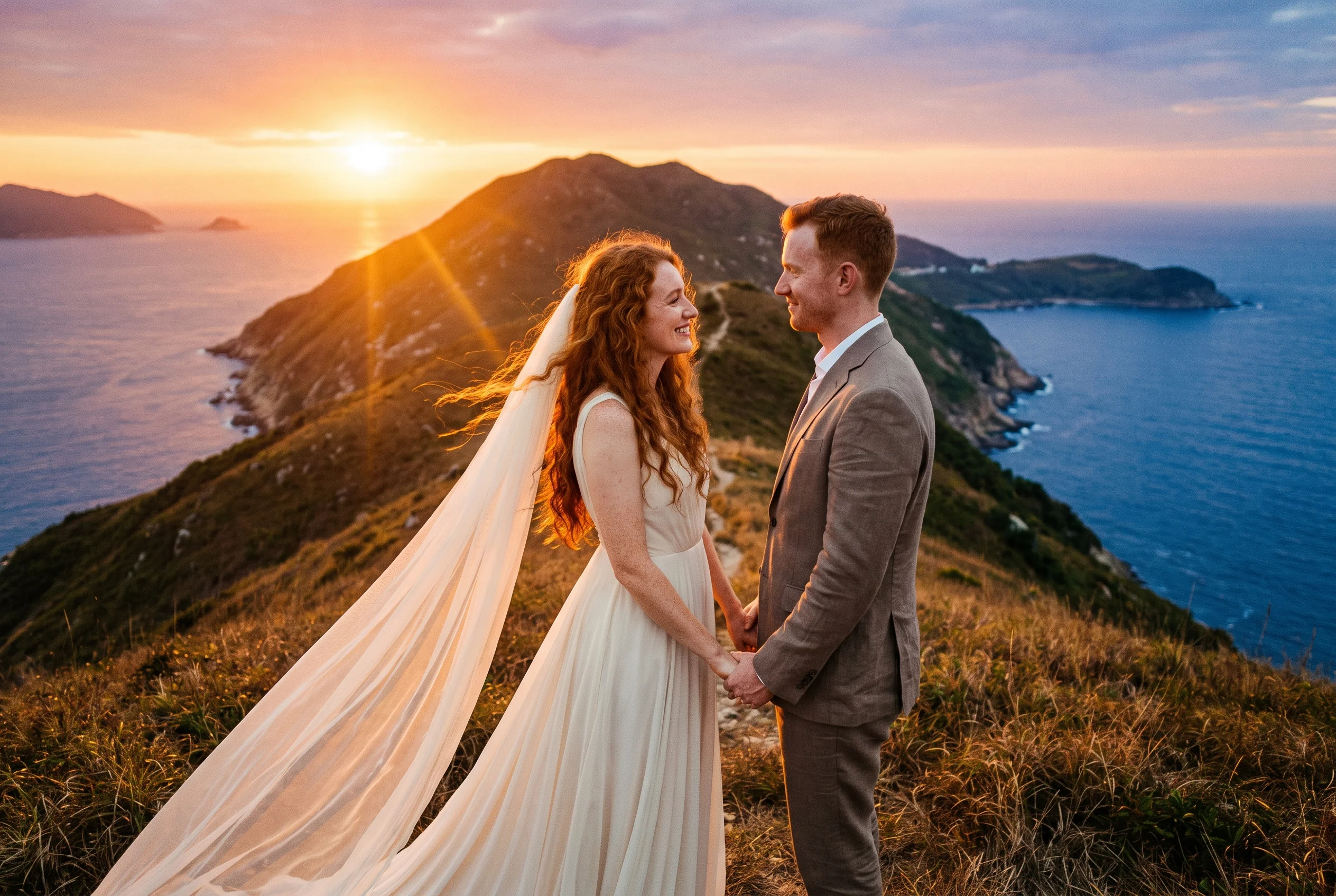
The Dragon's Back — Ridge Above the Ocean
The Dragon's Back is the ridge trail on the southeastern corner of Hong Kong Island, running between Shek O and Big Wave Bay. The trail follows a narrow spine of hill that drops to the ocean on both sides, and the view from the ridge is 360 degrees: the South China Sea to the east, the Shek O peninsula to the south, and the city's eastern districts behind. It is the most dramatic natural landscape within forty minutes of Central, and at golden hour it produces light that the city cannot.
The portrait move is to hike to the ridge summit — about 45 minutes from the trailhead at To Tei Wan — and shoot along the spine as the western sun drops behind the ridge. The light rakes along the hill's spine, giving the grass a dimensional texture, and the ocean on both sides reflects the sky in two different shades of blue. The couple placed on the ridge, the spine dropping away on both sides and the ocean stretching to the horizon, makes a frame that feels like a portrait set on the edge of the world — which, from the ridge, it looks like. The South China Sea is deep cobalt here, not the grey of the harbour, and the contrast between the warm ridge grass and the cool ocean is what gives the frame its depth.
The hour that matters: The last hour before sunset, October through March, when the western light rakes along the ridge and the air is clear enough to see the horizon. Summer humidity creates haze that kills the ocean colour. The hike up is exposed — bring water and do not attempt in a gown. Change at the summit; the trail is too rough for formal wear.
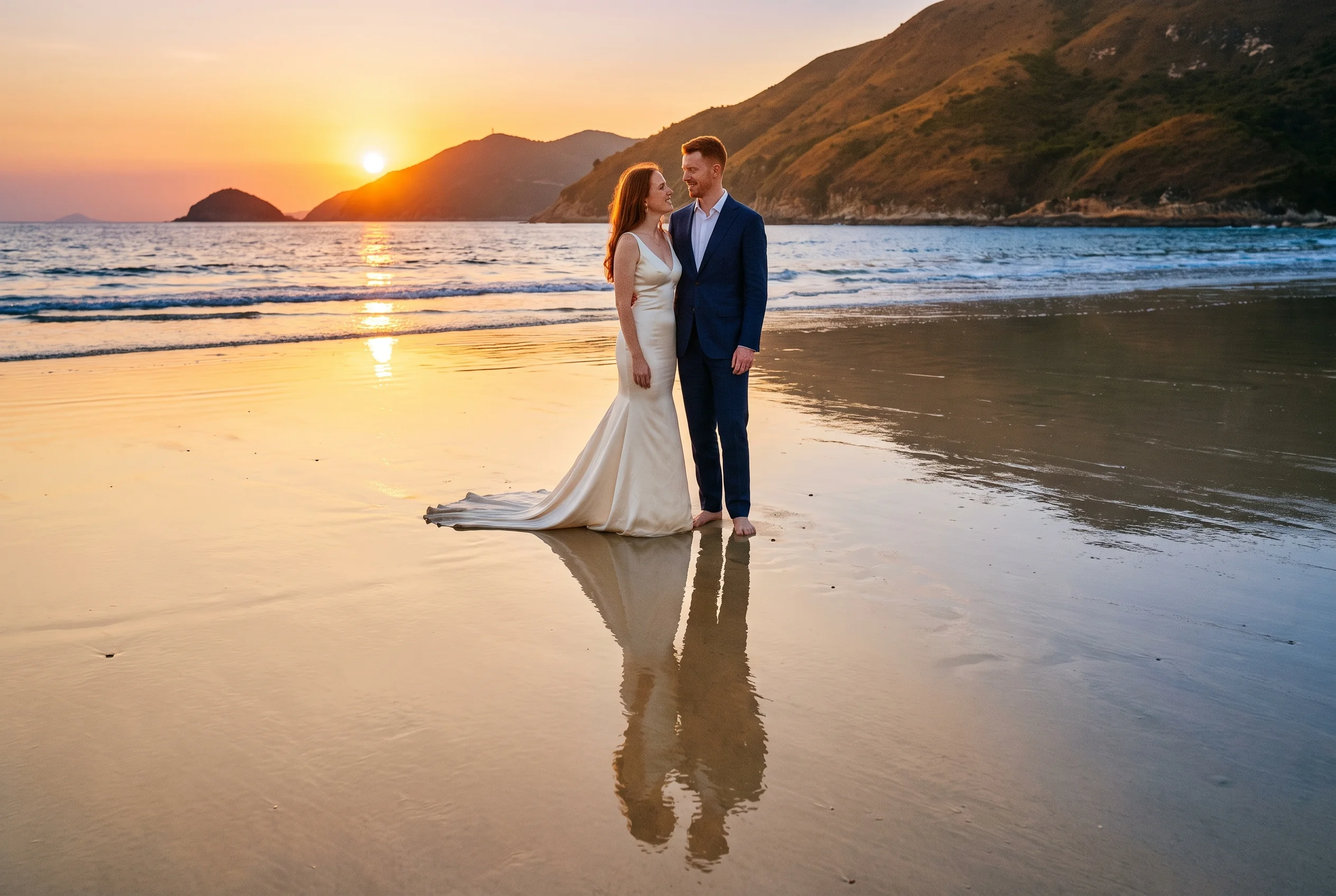
Cheung Sha Beach, Lantau — Sunset at the Waterline
Cheung Sha is the longest beach on Lantau Island, and at low tide the sand stretches 2 kilometres along the South China Sea coast. Unlike the harbour beaches, Cheung Sha faces south-southwest, which means the sunset drops into the ocean rather than behind the city — a condition that almost no other Hong Kong beach offers. The sand is pale gold, the water is warm, and the backdrop is not a skyline but the hills of Lantau's southern coast rising behind the beach.
The light at sunset is what makes this location work. The western sun drops into the sea, and the last light rakes across the wet sand at the waterline, turning the receding tide into a mirror that doubles the couple and the sunset. The sand is so wide at low tide that the couple can stand at the waterline with no one in frame for hundreds of metres in any direction — a condition that no urban beach in Hong Kong can offer. The hills behind catch the last warm light and the ocean in front holds the cool blue of the dying day, and the wet sand between them is a third surface that reflects both.
The hour that matters: The last 30 minutes before sunset, at low tide. Check the tide chart — at high tide, the beach is narrow and the wet-sand mirror is gone. The ferry from Central to Mui Wo takes 30 minutes, and Cheung Sha is 10 minutes by bus from Mui Wo pier. The beach faces open ocean, so the sunset is visible from late October through March; in summer, the sun sets further north and is partially obscured by the Lantau hills.
Frequently Asked Questions
Is the Dragon's Back hike safe in formal wear?
No. The trail is unpaved, exposed, and steep in sections. The correct approach is to hike up in appropriate footwear with the gown packed, change at the summit ridge, and shoot for 30-45 minutes before changing back for the descent. Most couples hire a guide who carries the garment bag and assists with the change. The summit is exposed — bring water regardless of the season.
Do I need a boat for Sai Kung Geopark photography?
Yes. The columnar rock formations are in restricted geopark waters accessible only by licensed vessel. Speedboats depart from Sai Kung town pier and can be hired for 2-3 hour sessions. The boat captain knows which formations are accessible at which tide, and the best locations require water access — there is no hiking route to the cliff base.
When is Victoria Harbour at its clearest?
October through January, when the northeast monsoon brings dry air from the mainland and the harbour haze clears. Summer — June through August — brings humidity and haze that softens the skyline into a grey wash. The blue hour is most vivid on nights with a light haze, which catches the building lights and turns the sky into a gradient rather than a flat dark field.
You don't need to take the Star Ferry to stand in these frames. Pictaway's atelier crafts cinematic wedding portraits set in Hong Kong's most iconic locations — from Victoria Harbour's blue-hour skyline to the Dragon's Back ridge above the ocean — uploaded in moments, delivered in 24 hours. Explore Hong Kong wedding portraits.
Your Hong Kong wedding portraits — delivered in 24 hours
Get started