korea · Destination Guide
The Stillness Between the Neon: A Korea Wedding Photography Guide
Bukchon's hanok rooftops at dawn, Myeongdong's neon canyons at blue hour, Jeju's volcanic coast, a cherry blossom tunnel that exists for six days a year, and Busan's beach at sunset — five Korean locations where tradition and future collide.
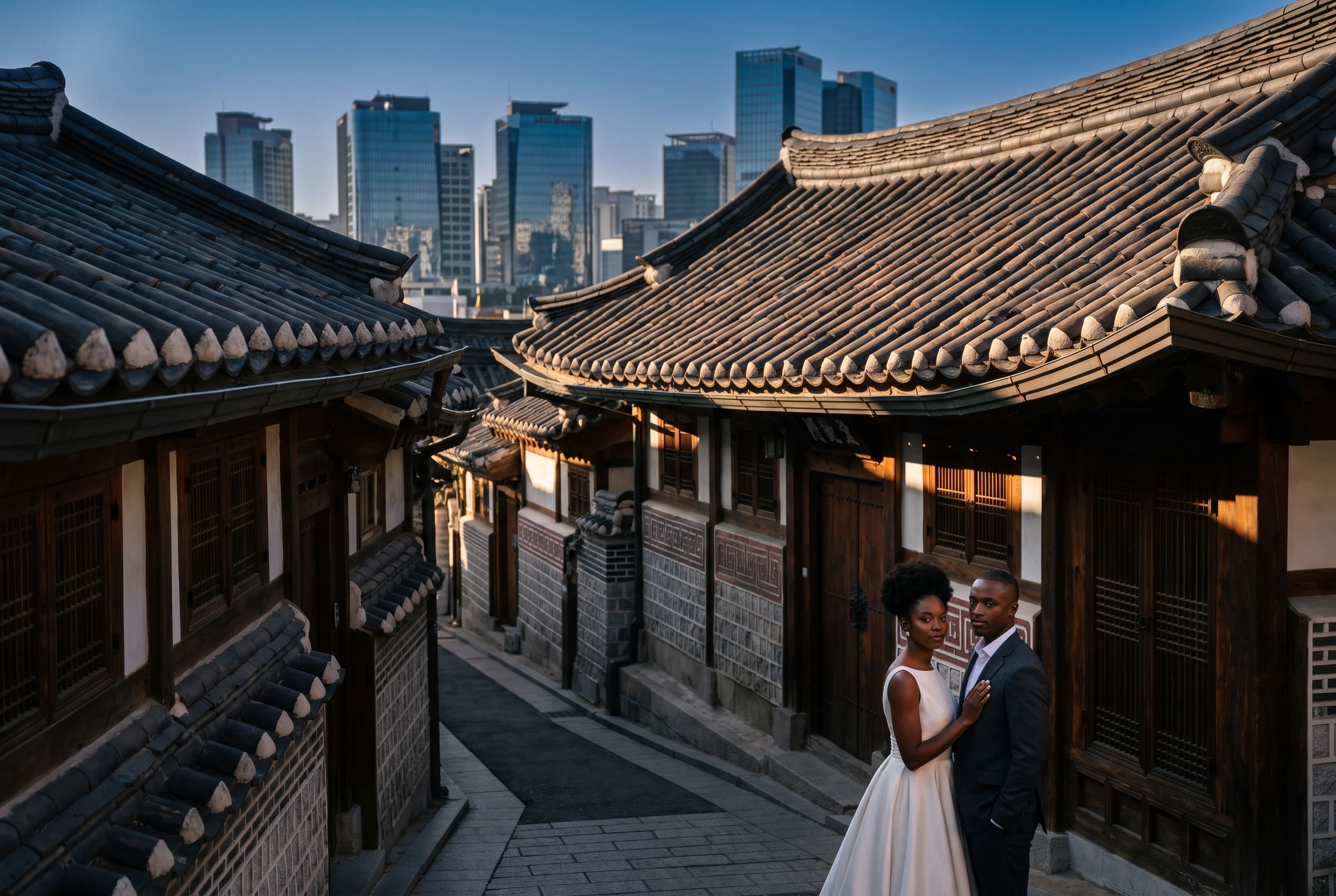
Seoul is a city that runs at two speeds simultaneously. In Bukchon, the morning is so quiet you can hear the tile roofs shedding frost. Twenty minutes south in Myeongdong, the evening is so loud with neon that the light itself feels like sound. Korea is one of the few countries where you can make a wedding portrait in a 600-year-old village in the morning and a second one in a canyon of electric signage by nightfall — and both will feel authentically, unmistakably Korean.
This is a guide to five locations that capture the dual nature of Korean light: the ancient and the electric, the still and the kinetic. Each is chosen for an hour when the location transforms from merely beautiful into something that makes a portrait feel like a still from a Korean film.
Bukchon Hanok Village — Rooftops at First Light
Bukchon is a residential neighbourhood of 900 traditional hanok houses that has survived six centuries of Seoul's reinvention. The narrow stone alleys wind between tiled roofs and dark-wood facades, and the village sits on a slope between two palaces with the modern city's glass towers rising behind it — a collision of centuries that no other city manages with such grace.
The move is to arrive before 7 AM, when the alleys are empty and the light is low enough to rake across the tile roofs. At this hour, the light does two things: it catches the curved ceramic roof tiles from the side, giving them a dimensional texture that flat midday light never reveals, and it sends long shadows down the stone alleys that create natural leading lines toward the couple. The dark-wood facades read warm, the tile roofs read cool, and the glass towers in the background hold the blue of the dawn sky. A couple in the alley, framed by hanok walls, reads as a portrait that could have been made in 1824 or 2024 — and the ambiguity is the point.
The hour that matters: 6:30 to 8:00 AM, April through October. By 9 AM, tourists arrive in numbers that make portraiture impossible. The light also goes flat once the sun clears the roofline. This location rewards early rising more than any other in Seoul.
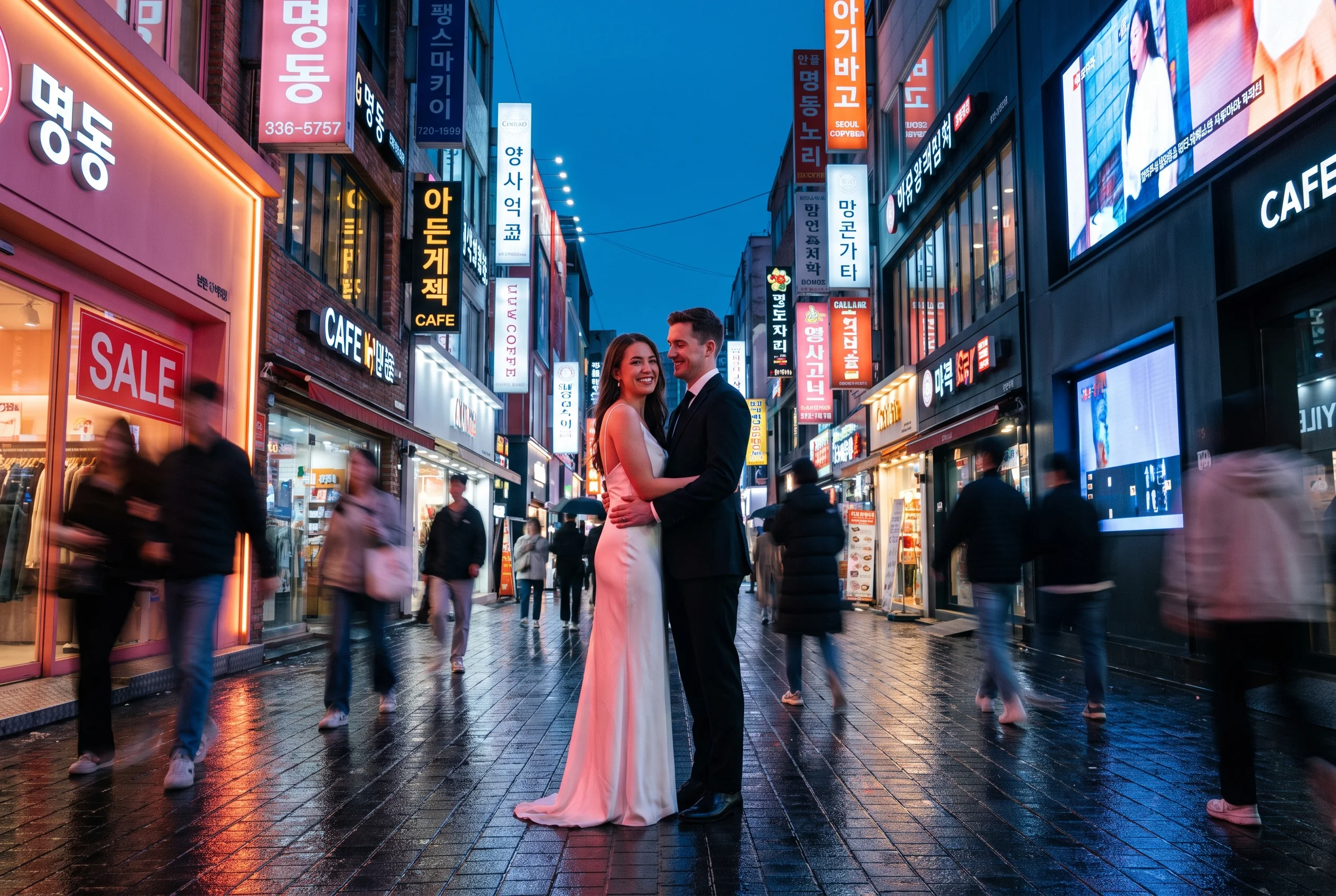
Myeongdong — Neon Canyons at Blue Hour
Myeongdong is Seoul's shopping district, but at blue hour it becomes something else entirely: a canyon of electric signage so dense that the light has physical presence. The streets are lined with cosmetic shops, food stalls, and fashion retailers whose signage — in Korean, English, and the universal language of LED — stacks vertically up the building facades until the sky is barely visible. The wet pavement after a light rain doubles every sign into a second set of reflections below.
The light here is unlike any natural location. It is warm where the neon is warm, cool where the signage uses blue, and it shifts every few seconds as animated displays cycle through their loops. The portrait move is to use this as a continuous, shifting coloured-gel setup that no studio can replicate. A couple standing still in the moving crowd — the pedestrians blurred at 1/30 shutter, the couple sharp and luminous — makes a frame that feels like a Korean cinema still. The blue hour sky above provides the cool counterpoint to the warm neon below, and the colour-temperature contrast is what gives the frame its cinematic quality.
The hour that matters: 30 to 50 minutes after sunset, when the sky is deep cobalt and the signage is at full brightness. A light rain earlier in the day helps — the wet pavement is essential for the reflection. If the streets are dry, the shot loses half its impact.
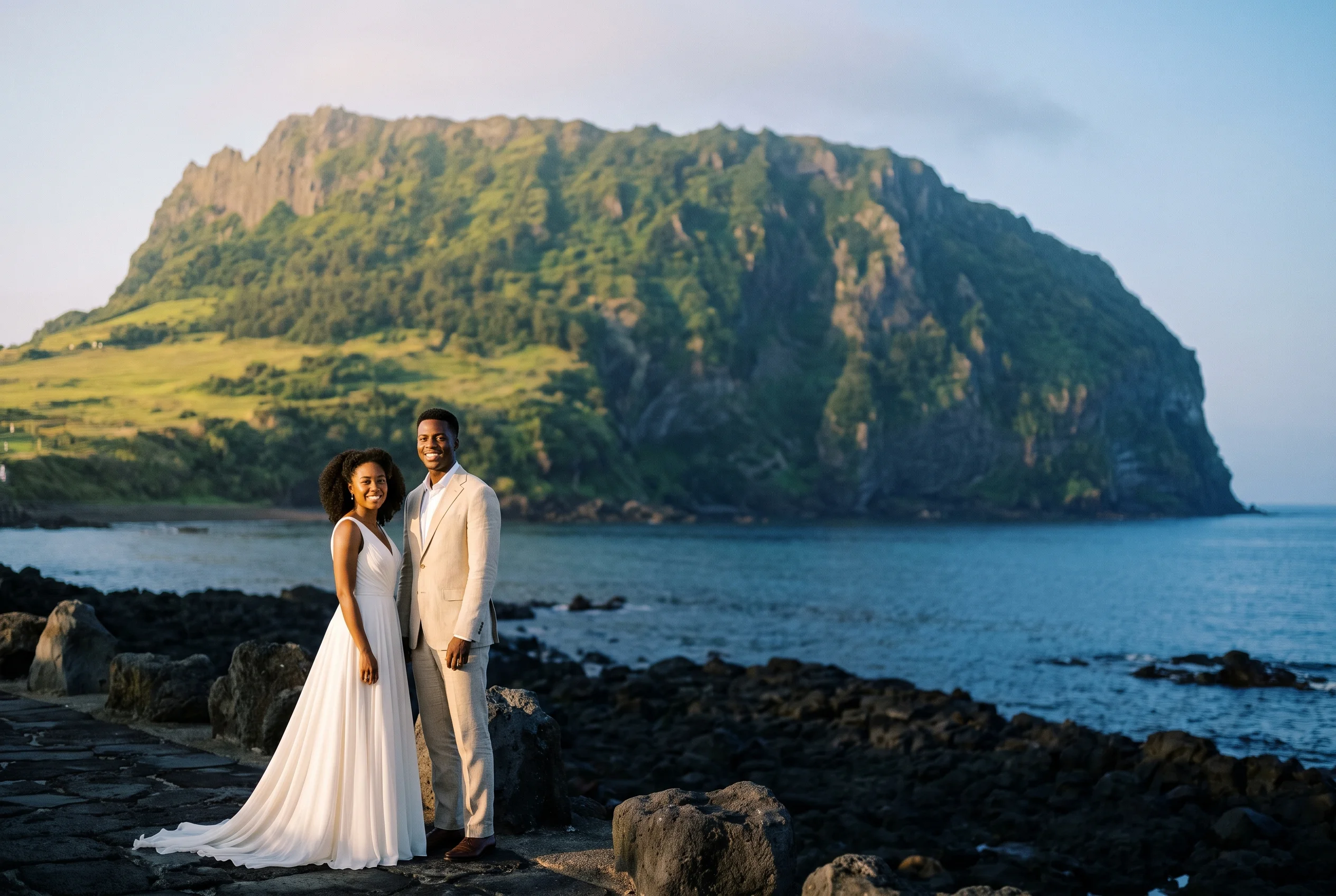
Jeju Island — The Volcanic Coast at Seongsan
Jeju is a volcanic island south of the Korean mainland, and its coast is unlike anywhere else in the country — black volcanic rock, columnar basalt, and a sea that shifts from cobalt to turquoise depending on the angle of the sun. Seongsan Ilchulbong, the tuff cone that rises from the eastern coast, creates a natural amphitheatre of dark rock and green grass that holds the dawn light the way Oeschinensee holds the golden hour.
The light at Seongsan does something specific at dawn. The eastern face of the cone catches the first sun while the western slope and the coastal flats below are still in blue shadow. The contrast — warm cone, cool sea, dark rock — gives the frame a layered quality that a single-temperature landscape never produces. The couple placed on the coastal path below, small against the cone's curve, reads as a portrait set in a landscape that feels geological rather than merely scenic. The black basalt underfoot and the green slope above give the frame a colour palette that no mainland Korean location can match.
The hour that matters: The first 30 minutes after sunrise, approximately 5:30 AM in summer. The cone's eastern face glows for about 15 minutes before the light spreads to the whole landscape and the contrast flattens. Take the first ferry from the mainland the night before and stay in Seongsan village — the walk to the viewpoint is ten minutes.
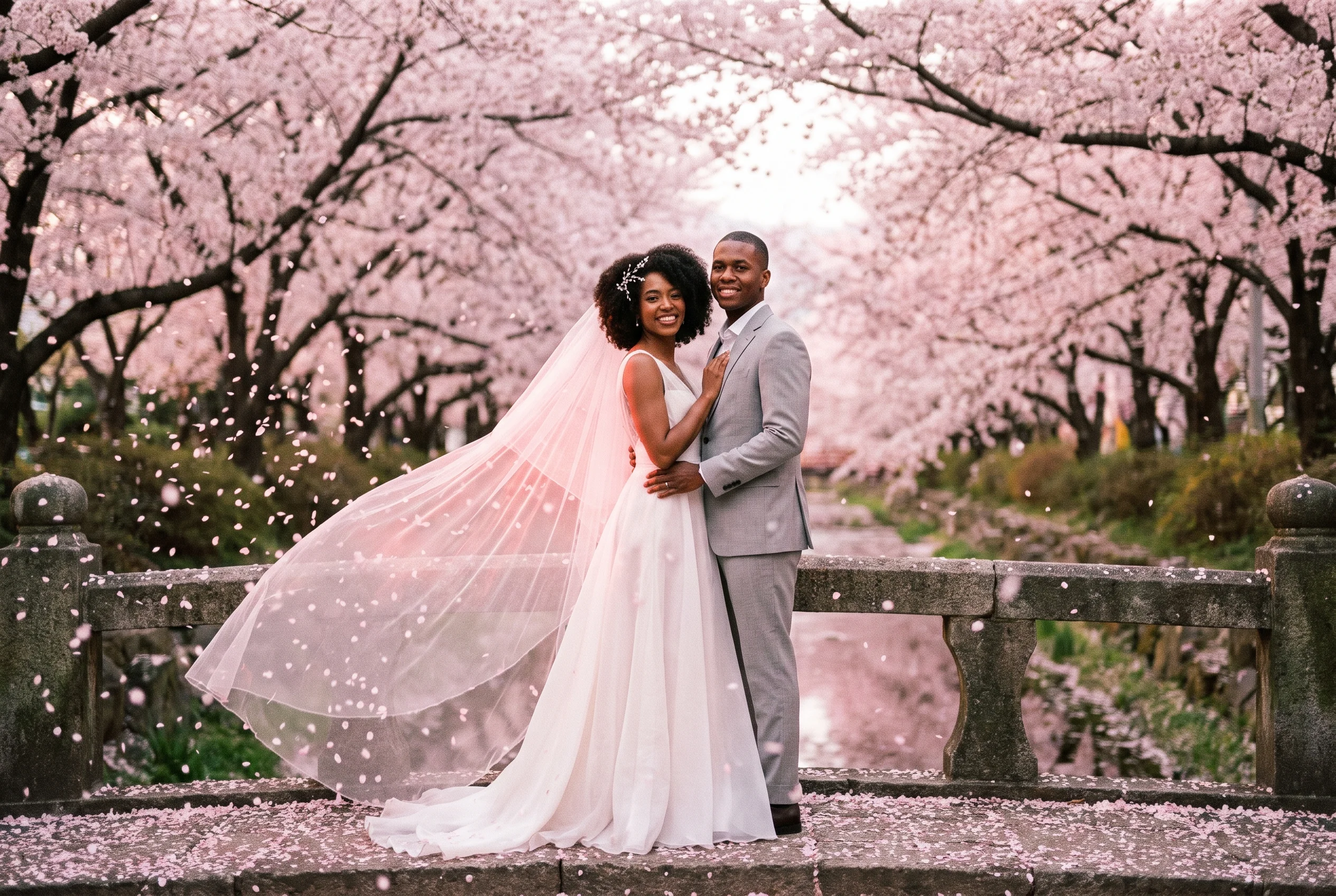
Jinhae — The Cherry Blossom Tunnel
For six days a year, the town of Jinhae becomes the most photographed place in Korea. The cherry trees that line the stream through the old naval port bloom in unison, creating a tunnel of pale pink that arches over the water and the stone bridges. The light filters through the blossoms into something almost translucent — a quality that no other season produces, because the blossoms are dense enough to diffuse the sun but thin enough to let a warm glow through.
The portrait move is to work the bridges and the stream path at the hour when the morning sun comes in low through the blossom canopy. The light on the water, filtered through pink, turns the stream into a mirror of colour. The couple placed on a stone bridge, the blossom tunnel arching over them and the pink-reflected water below, makes a frame that feels like a Korean painting brought to life. The blossom fall — the moment when the petals begin to drop and drift through the air like snow — is the most sought-after condition, and it usually occurs on the fourth or fifth day of bloom, when a light wind arrives.
The hour that matters: 6:30 to 8:00 AM during peak bloom, typically the first week of April. After 8 AM, the festival crowds arrive in tens of thousands. The petals fall best when the morning temperature is above 10°C — too cold and they hold; too warm and they've already dropped.
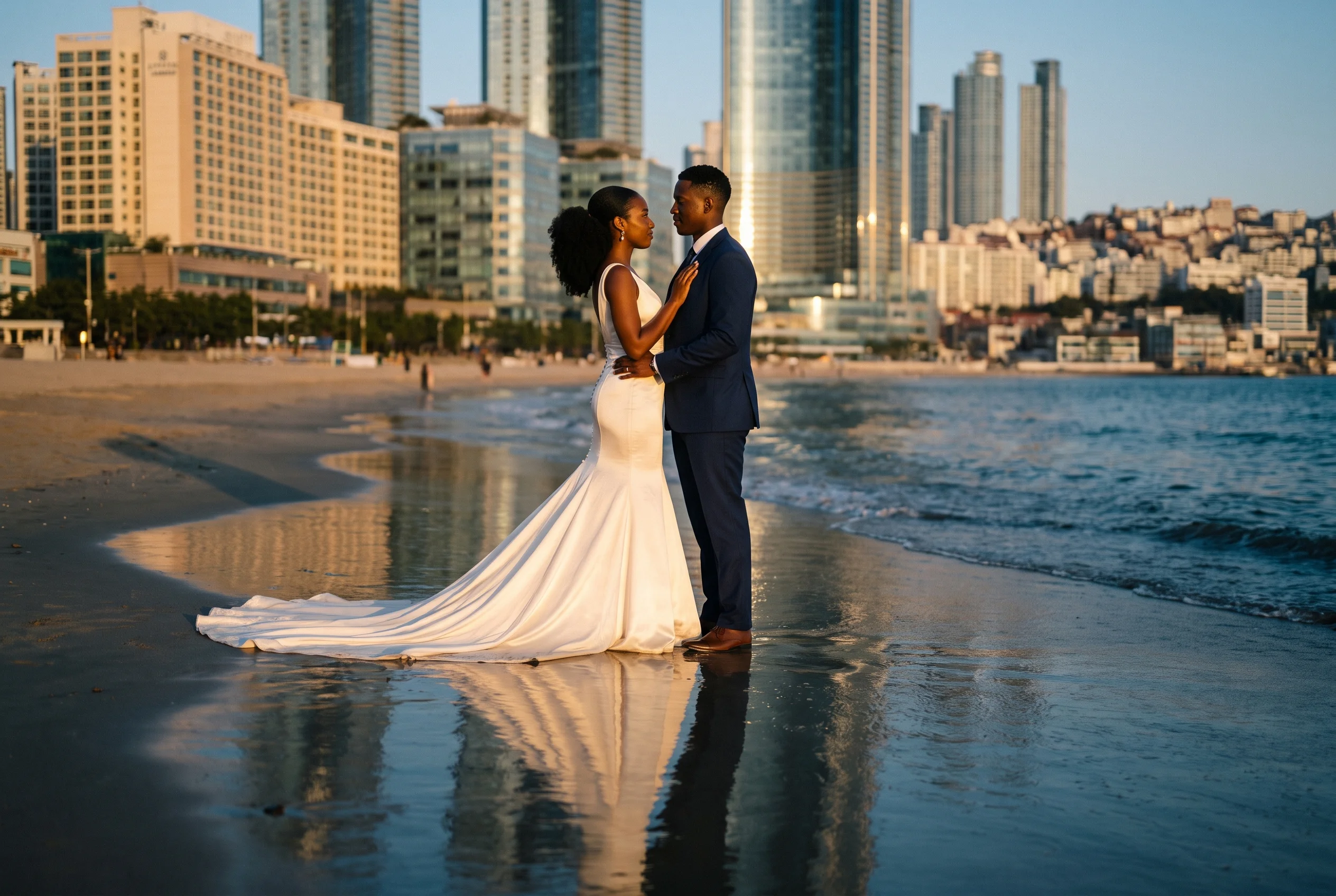
Busan Haeundae Beach — Sunset Over the City Edge
Haeundae is Korea's most famous beach, and at sunset it does something no other Korean beach manages: the western sun drops behind the city skyline rather than the sea, so the light rakes across the beach and the water from the land side, turning the sand warm and the sea into a cool dark mirror. The skyline of Busan's Marine City — a row of glass residential towers — catches the last light on its eastern faces, creating a wall of warm glass above a cool dark beach.
The move here is to work the waterline as the tide recedes, using the wet sand as a mirror that doubles the couple and the skyline. The light is warm where it hits the buildings and the sand, cool where it reflects in the water, and the contrast is what gives the frame its depth. A couple walking the waterline at low tide, the skyline behind them doubled in the wet sand below, makes a portrait that feels like the last frame of a film set in a city that ends at the sea.
The hour that matters: The last 30 minutes before sunset, when the western light rakes across the beach. Check the tide chart — low tide is essential for the wet-sand mirror. At high tide, the beach is narrow and the mirror is gone.
Frequently Asked Questions
Do I need a permit for wedding photography in Bukchon Hanok Village?
Bukchon is a residential neighbourhood, not a park. No formal permit is required for personal portrait photography, but the village enforces quiet hours and restricts large groups. Arrive before 7 AM, use a single photographer, and avoid blocking alleys. Commercial or large-scale shoots require coordination with the Bukchon Cultural Center.
When do the cherry blossoms peak in Korea?
Cherry blossoms typically peak in the first week of April, though the exact dates shift by 5-7 days each year depending on winter temperatures. Jinhae usually peaks 2-3 days before Seoul. The Korea Meteorological Administration publishes a cherry blossom forecast in late March that tracks the bloom front as it moves north. The full bloom lasts 6-7 days; the petal fall lasts 2-3 days after that.
Is Jeju Island accessible for a day trip from Seoul?
Yes — flights from Gimpo to Jeju take 55 minutes and run every 20 minutes from 6 AM. But the coastal locations need golden hour or dawn light, which means an overnight stay. The last flight back to Seoul is around 9 PM, which works for a sunset shoot but not a dawn one. Most couples stay one night in Seongsan village.
You don't need to wait for cherry blossom season to stand in these frames. Pictaway's atelier crafts cinematic wedding portraits set in Korea's most iconic locations — from Bukchon's hanok rooftops to Haeundae's waterline — uploaded in moments, delivered in 24 hours. Explore Korea wedding portraits.
Your Korea wedding portraits — delivered in 24 hours
Get started