maldives · Destination Guide
Where the Water Becomes Sky: A Maldives Wedding Photography Guide
An overwater lagoon at golden hour, a sandbank that exists only at low tide, a turquoise channel where the reef drops, a palm-lined jetty at sunset, and a dhoni on still water — five Maldivian locations where the line between ocean and sky disappears.
The Maldives is a country where the highest point is 2.4 metres above sea level. There are no mountains, no forests, no canyons — just 1,200 islands of white sand sitting on coral reef in water so clear that the ocean floor is visible from the air. The light here is different from any other destination in this guide because it has nothing to bounce off except water and sand. Every photon that arrives either reflects off the lagoon or absorbs into the reef below, and the result is a quality of light that feels weightless — ambient from every direction, warm but never harsh, with a clarity that comes from the absence of anything between the sun and the subject.
This is a guide to five locations where that light does something specific enough to build a portrait around. Each involves water, because in the Maldives everything involves water — but each uses the water differently, as mirror, as frame, as colour, as negative space.
The Overwater Lagoon — Golden Hour on the Deck
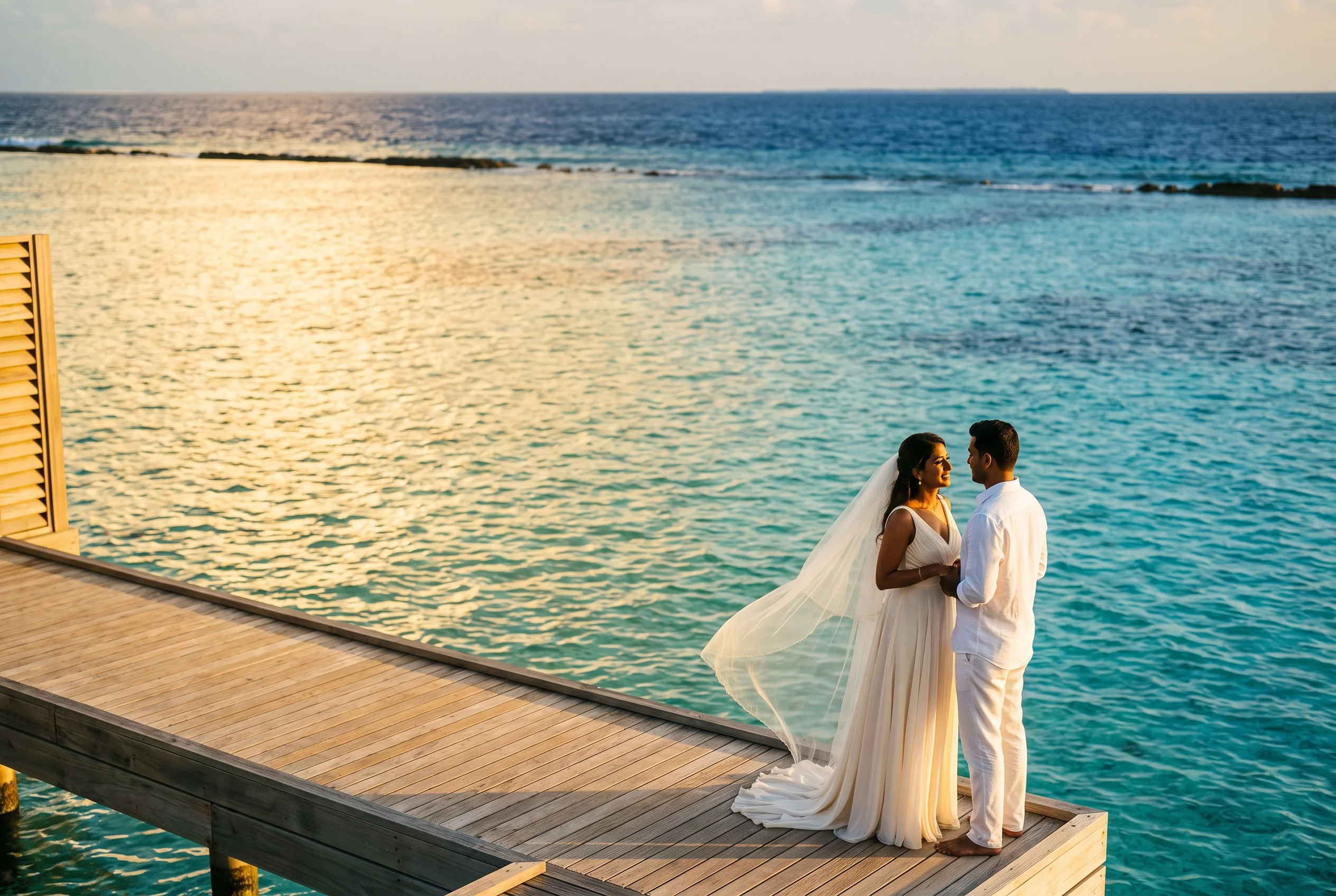
The signature Maldivian frame is a couple on an overwater villa deck, the lagoon stretching behind them, the reef line visible as a shift from turquoise to cobalt on the horizon. The light that makes this frame work is the hour before sunset, when the western sun drops low enough to turn the lagoon surface into a sheet of warm gold while the sky above holds its blue. The couple, backlit by the low sun, becomes a silhouette edged with warm light while the lagoon below carries the gold reflection upward onto their faces.
The composition move is to shoot from the water side, looking back toward the villa, so the deck becomes a platform extending into the lagoon and the couple stands at its edge. The reef drop-off on the horizon — the line where the shallow turquoise gives way to the deep blue of the open ocean — creates a natural horizon that gives the frame scale. The overwater villa architecture provides structure, but the light does the work: warm from behind, cool from the sky above, reflected gold from the water below.
The hour that matters: The last 45 minutes before sunset. Before that, the light is too high and the lagoon reads flat. After sunset, the gold disappears from the water within minutes. The Maldivian sunset is fast — the sun drops through a thin atmosphere and reaches the horizon in what feels like seconds compared to higher latitudes.
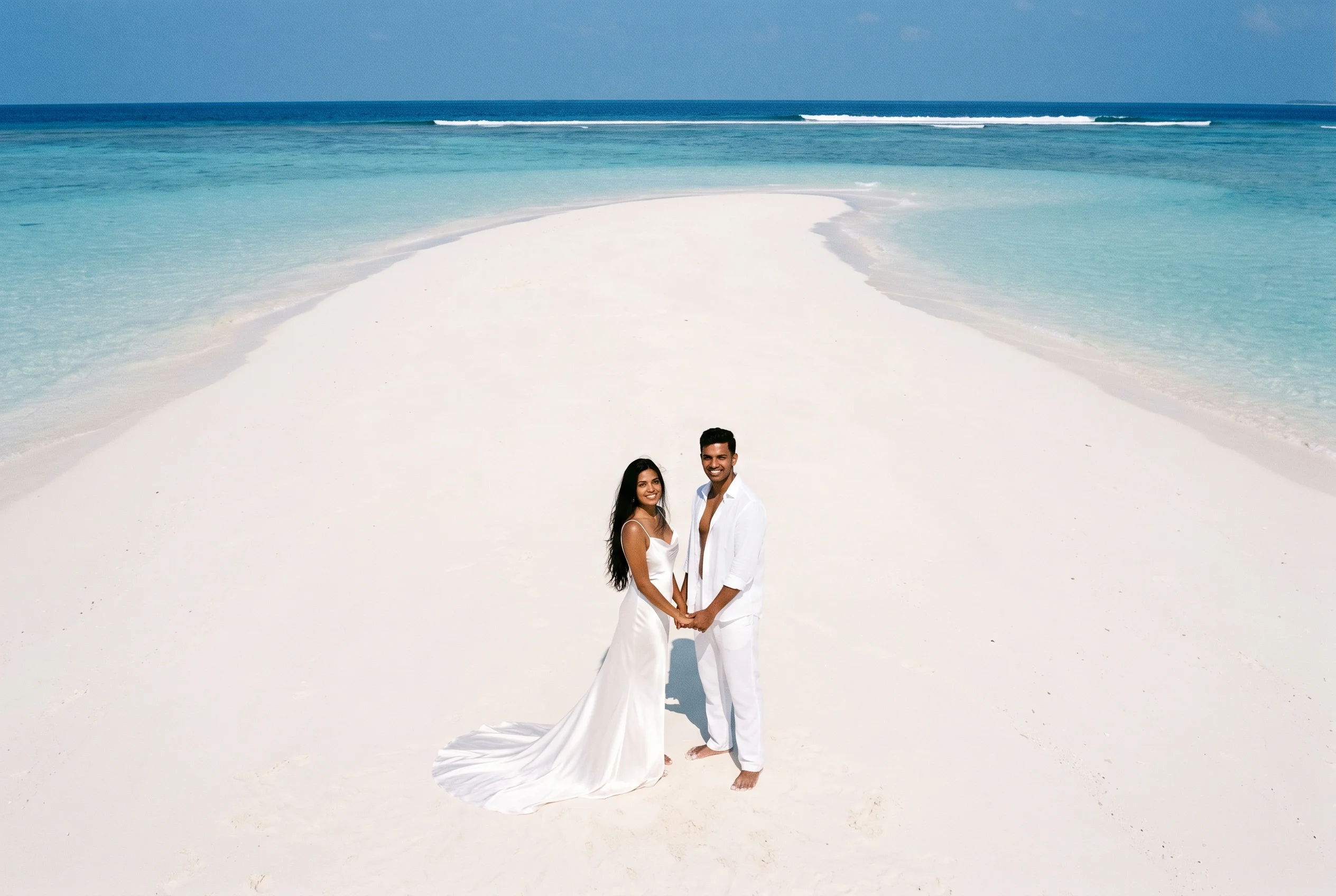
The Sandbank — A Strip of Sand That Exists for Six Hours
A sandbank is a strip of white sand that emerges from the lagoon at low tide, surrounded by water on all sides, with nothing on it — no palms, no structures, no shade. It is the most minimal landscape in wedding photography: white sand, turquoise water, blue sky, and nothing else. The sandbank exists only for the hours around low tide; at high tide it disappears completely, which is why most visitors never see one.
The light on a sandbank is extraordinary because there is nothing to interrupt it. The white sand reflects light upward onto the couple from every angle — a natural reflector that fills every shadow the way a studio fill light does, but softer. The turquoise water surrounding the sandbank creates a colour frame that shifts from pale aqua at the sand's edge to deep cobalt at the reef drop. A couple on the sandbank, small against the surround of water, reads as a portrait set in a place that feels elemental — the earth reduced to its simplest terms.
The hour that matters: The two hours around low tide, timed to coincide with either early morning or late afternoon light. Check the tide charts for your atoll — the Maldivian tide runs on a semi-diurnal cycle, and low tide shifts by about 50 minutes each day. A sandbank visit at the wrong tide is a swim, not a photo location.
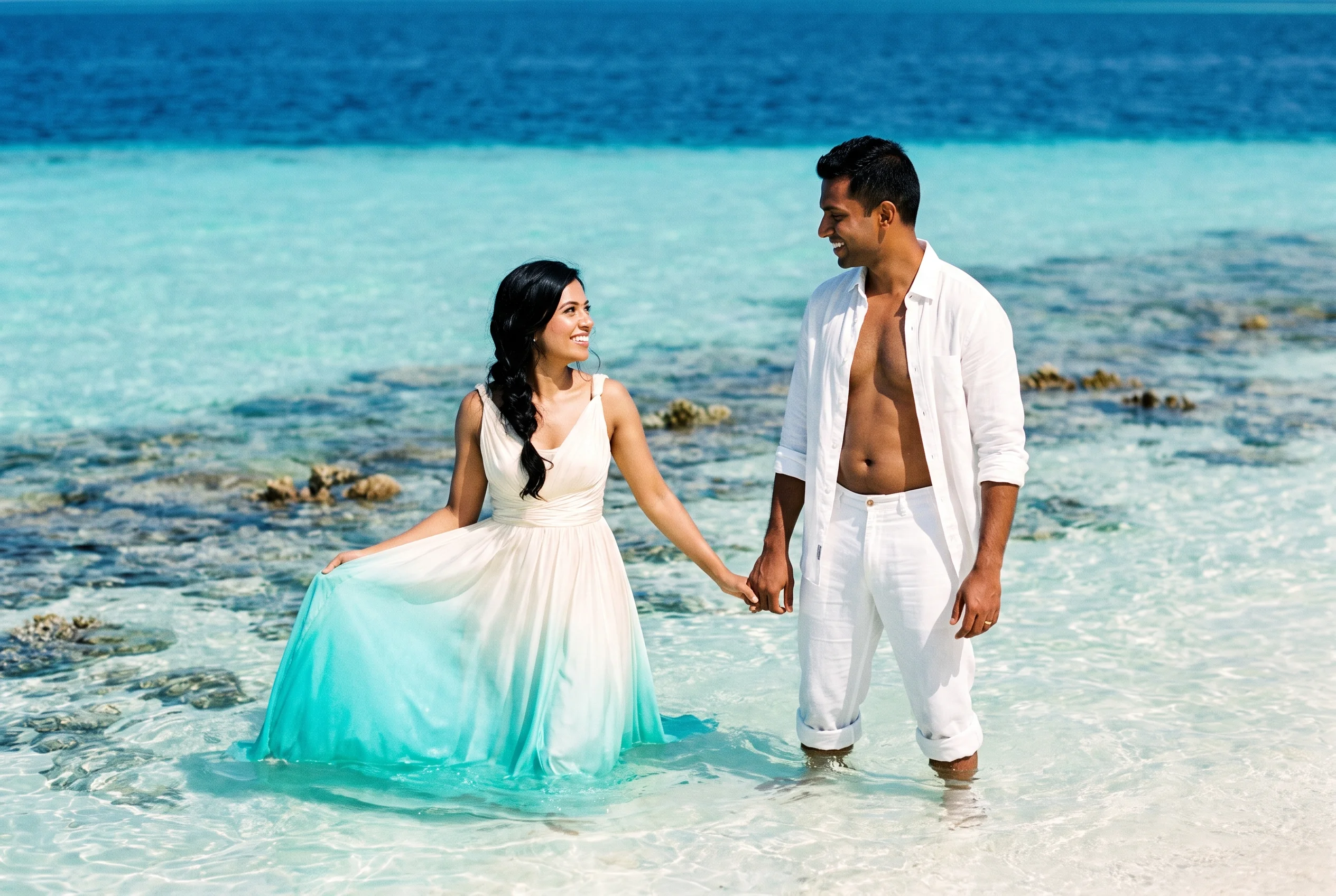
The Reef Channel — Where Turquoise Meets Cobalt
Every Maldivian island sits inside a reef, and every reef has a channel — a break in the coral wall where the shallow lagoon meets the open ocean. The water in the channel is moving constantly, and the colour shift at the edge is the most graphic element in the Maldivian visual vocabulary: pale turquoise on the lagoon side, deep cobalt blue on the ocean side, and a line between them that is visible from the air and dramatic from the water.
The portrait move is to work the channel at mid-morning, when the sun is high enough to illuminate the reef below and the colour contrast between the two water depths is at its maximum. A couple on the shallow reef flat — standing in waist-deep turquoise water with the cobalt channel behind them — makes a frame where the background is not sky or land but pure colour. The water is warm enough to stand in for an hour, the sand floor is white enough to reflect light upward, and the reef edge creates a natural horizon line that separates two shades of blue with a clarity that no horizon between sky and sea ever achieves.
The hour that matters: 10 AM to noon, when the sun is high enough to illuminate the reef floor and the turquoise is at its most saturated. The channel current can be strong — work with a resort water sports team that knows the slack tide window for your specific channel.
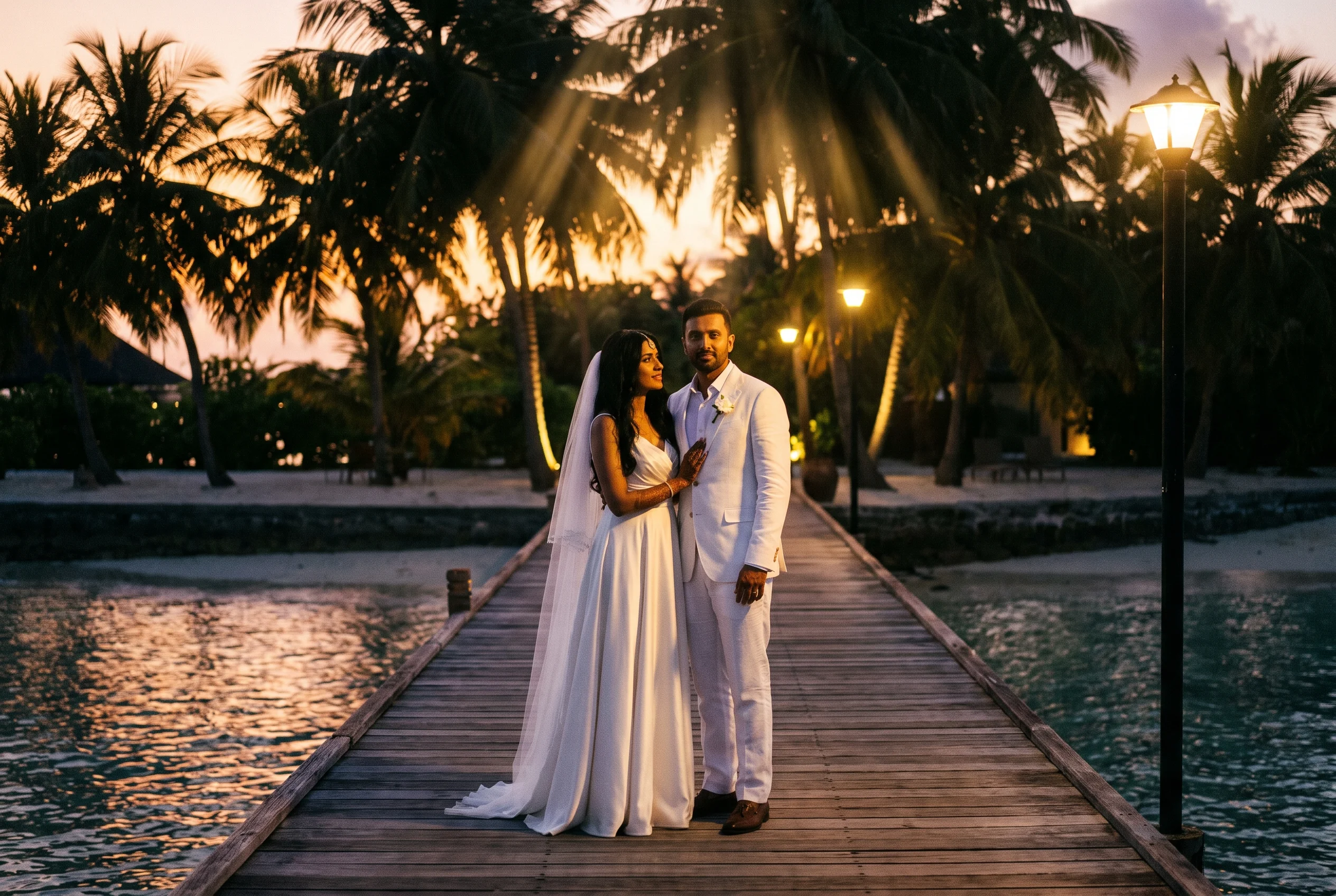
The Palm-Lined Jetty — Sunset Walk to the Water's Edge
Every Maldivian resort has a jetty — a wooden walkway extending from the island across the lagoon to the boat arrival point, lined with palm trees and lampposts. At sunset, the jetty becomes a natural stage: the western sun drops behind the palms, the wooden planks catch warm light, and the lagoon on both sides reflects the sky. The composition is a couple walking the jetty toward the camera, the palms and the sunset behind them, the wooden path leading the eye.
The light here is warm and directional — the sun comes through the palm fronds in shafts that scatter on the wood and the water, creating a dappled quality that flatters skin the way afternoon light through trees does in a Mediterranean location, but with the added reflection off the lagoon doubling the warmth from below. The palms themselves become graphic silhouettes against the sunset sky, and the jetty's straight lines provide structure that the organic landscape otherwise lacks.
The hour that matters: The last 30 minutes before sunset. The jetty lampposts come on about 20 minutes before sunset, and the combination of warm tungsten lamp light and the dying sun through the palms is the frame that most Maldivian resorts use for their signature shots. Walk slowly — the best frame is usually mid-jetty, where the palms on both sides create a natural archway.
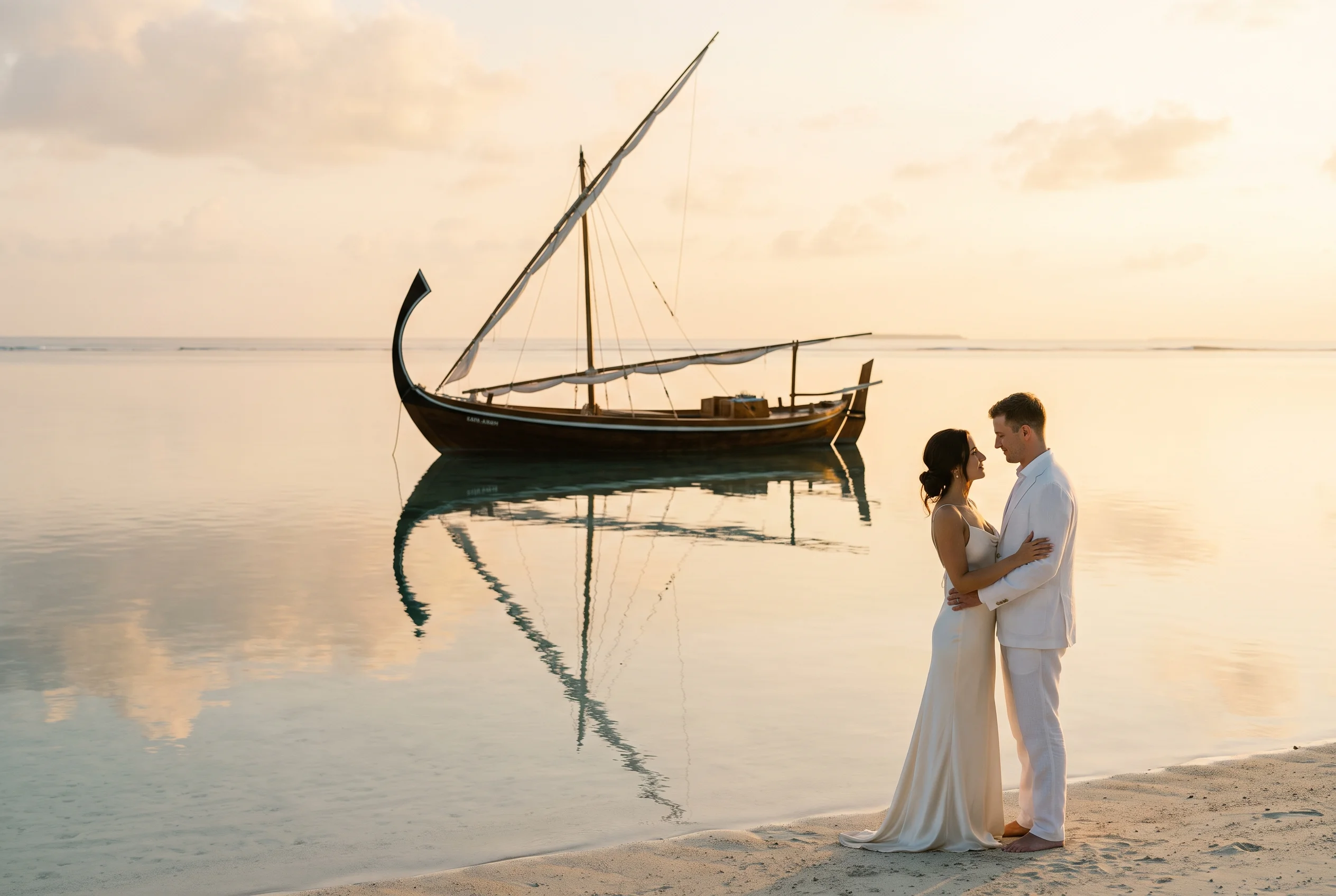
The Dhoni at Dawn — A Boat on Still Water
The dhoni is the traditional Maldivian fishing boat — a wooden vessel with a high prow, a lateen sail, and a hull painted in colours that have faded under decades of sun and salt. At dawn, before the breeze picks up, the lagoon is mirror-still and the dhoni sits on the water like a sculpture on glass. The light at this hour is soft, warm, and low — the sun has not yet cleared the horizon, and the sky is doing the work, sending a diffuse golden glow across the water and the boat.
The portrait move is to position the couple on the shore with the dhoni on the still water behind them, or to place them on the boat itself. The still water doubles everything — the boat, the couple, the sky — and the reflection is so perfect that the frame reads as symmetric, which gives it a formality that the organic island landscape rarely produces. The dhoni's dark wood and faded paint provide a textural anchor that the white sand and turquoise water cannot, and the sail — if it is raised — adds a vertical element that the flat island landscape entirely lacks.
The hour that matters: 5:30 to 6:30 AM, the hour before the sun clears the horizon. By sunrise, the thermal breeze begins and the mirror breaks. The light is soft enough that no direction matters — it is omnidirectional, coming from the entire sky, which means the couple can face any way and still be flattered. This is the most forgiving light in the Maldives and the most fleeting.
Frequently Asked Questions
Which Maldivian atoll is best for wedding photography?
The North Malé Atoll and the Baa Atoll offer the clearest lagoons and the most accessible sandbanks. Resorts in the southern atolls — Laamu, Addu — have fewer crowds but more variable weather. The key factor is not the atoll but the resort's house reef and lagoon depth; a resort with a wide shallow lagoon and a clear reef channel will give you more frame options than one with a narrow lagoon.
Can we do a wedding ceremony on a sandbank?
Many resorts offer sandbank ceremonies, but they are tide-dependent and weather-dependent. The sandbank is available for approximately four hours around low tide, and a sudden swell can reduce that window. Most couples book a sandbank as a portrait location rather than a ceremony venue, with the legal ceremony on the resort island.
What happens if it rains during our Maldives photo session?
The dry season (November to April) has rain on fewer than 5 days per month, but the equatorial weather can produce sudden showers year-round. The light after a brief rain is often the best of the day — the air is washed clean, the lagoon surface is refreshed, and the low sun through breaking clouds produces dramatic shafts of light. Most portrait sessions can work around a 20-minute shower. Plan for a two-hour window and use the flexibility.
You don't need to fly twelve hours to stand in this water. Pictaway's atelier crafts cinematic wedding portraits set in the Maldives' most iconic locations — from overwater lagoons to sandbanks that vanish with the tide — uploaded in moments, delivered in 24 hours. Explore Maldives wedding portraits.
Your Maldives wedding portraits — delivered in 24 hours
Get started