switzerland · Destination Guide
Where the Alps Hold the Light: A Switzerland Wedding Photography Guide
Oeschinensee at first light, Lauterbrunnen's waterfall cathedral, the Matterhorn's mirror, Jungfraujoch's glacier plateau, and Lake Lucerne at blue hour — five Swiss locations where the light does something extraordinary.
There is a moment in the Swiss Alps when the sun drops behind a ridge and the entire valley fills with a light that has no name in English — warm enough to flatter skin, cool enough to turn snow into blue crystal, directional enough to carve every granite face into a study of shadow. Photographers who work in these mountains chase that hour the way surfers chase swell. Most couples never see it, because most couples are eating dinner when it arrives.
This is a guide to the five Swiss locations where that hour — and a few others — produces wedding portraits that feel less like photographs and more like the opening frames of a film. Each is chosen for a specific quality of light, a specific hour, and a mood that cannot be replicated at noon or in a different valley.
Oeschinensee — The Turquoise Mirror at Golden Hour
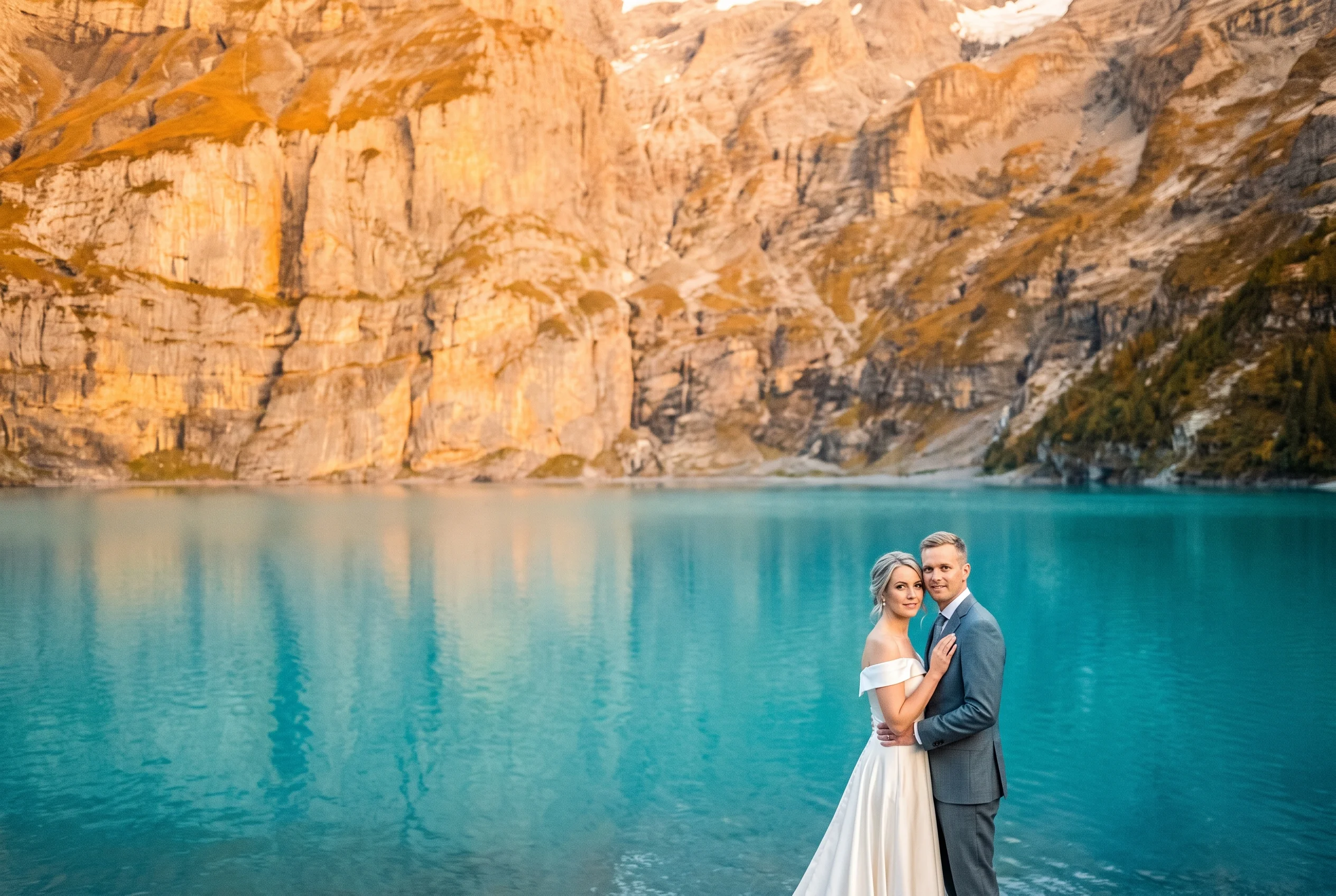
Oeschinensee is a lake so saturated in colour that first-time visitors often assume the photographs have been edited. The water is a mineral turquoise that comes from glacier flour — rock ground to powder by ice, suspended in the water, catching light at a frequency the eye reads as impossible. Surrounded by 3,000-metre limestone walls on three sides, the lake sits in a natural amphitheatre that holds golden light for nearly an hour after the surrounding valleys have gone dark.
The move here is to arrive by the last gondola of the afternoon, walk the forty minutes to the lake, and shoot the western shore as the sun drops behind the Oeschinenhorn. The cliff walls go through a sequence — warm amber, then rose, then a cool blue that makes the turquoise water read as almost electric. A couple placed at the water's edge, the cliff walls rising behind them, becomes small against a landscape that feels primordial in a way no manicured European garden ever can.
The hour that matters: The last 60 minutes before sunset, when the amphitheatre walls glow and the water is at its most saturated. By the time the sun drops below the ridge, the lake loses its turquoise in minutes. The walk back to the gondola is in near-darkness — bring a headlamp.
Lauterbrunnen Valley — The Waterfall Cathedral
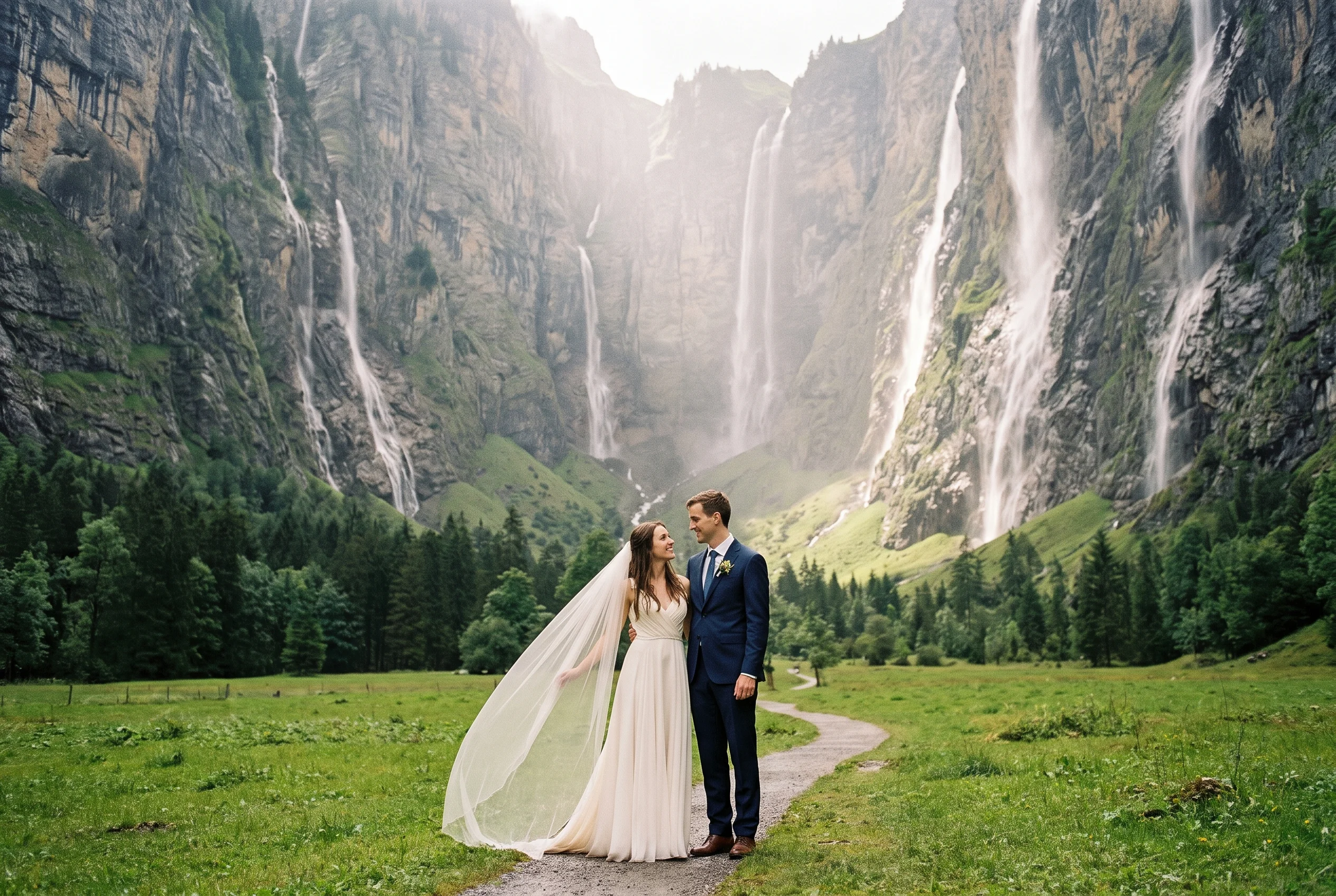
Lauterbrunnen is a valley so narrow and so deep that the locals call it the valley of 72 waterfalls. The cliff walls rise 300 metres vertically on both sides, and waterfalls cascade from hanging valleys above in thin white threads that the wind scatters into mist before they reach the valley floor. The result is a natural cathedral — vertical stone, perpetual rain, a quality of air that feels more like a rainforest than the Swiss Alps.
The light here is unlike anywhere else in Switzerland. The valley is so deep that direct sun reaches the floor for only a few hours in the middle of the day. The rest of the time, the light is reflected — bouncing off the cliff walls, diffused through waterfall mist, arriving at the valley floor as a soft, omnidirectional glow that flatters skin the way a studio softbox does, but with a warmth the studio never manages. A couple walking the valley path, the cliffs rising vertically behind them and a waterfall catching the light above, makes a frame that reads as mythic rather than merely scenic.
The hour that matters: Late morning, 10 AM to noon, when the sun is high enough to send shafts of direct light between the cliff walls and the waterfalls catch the light individually. The diffused light on the valley floor is consistent all day, but the waterfalls only sparkle when the sun hits them directly.
Riffelsee — The Matterhorn's Mirror at First Light
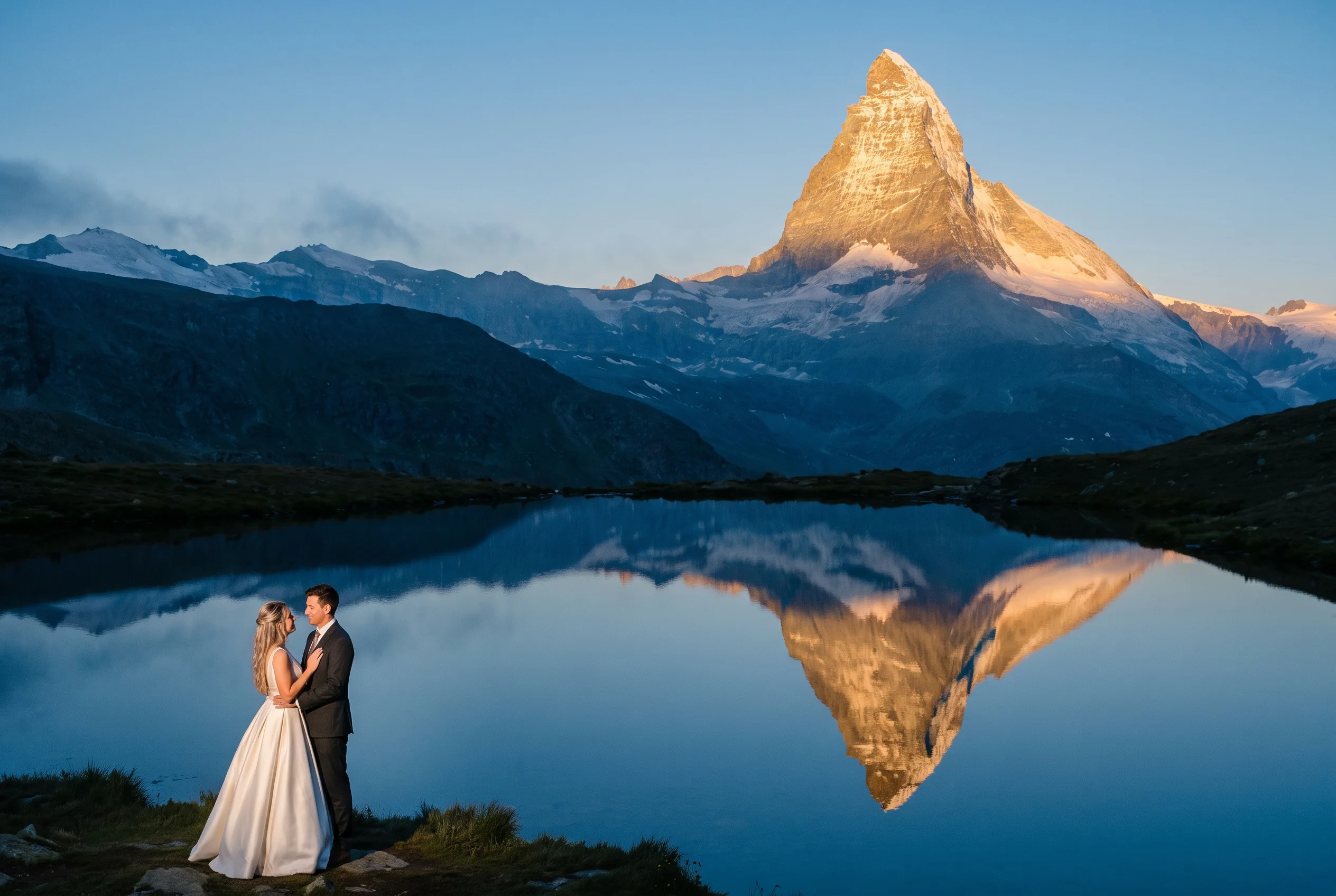
Most Matterhorn photographs are made from Gornergrat, the ridge above Zermatt, where the mountain fills the frame and the tourists fill the foreground. The better location is fifteen minutes below, at the Riffelsee — a small tarn that catches the Matterhorn's reflection in its still morning water. The composition here is doubled: the mountain above, the mountain inverted below, the couple between them.
The light at Riffelsee does something specific. At first light, the eastern face of the Matterhorn catches the sun while the valley below is still in shadow. The mountain glows warm against a cold blue sky, and the reflection in the water is warmer still because the lake surface holds the shadow's cool tone while the reflected light carries the dawn warmth. This temperature contrast — warm mountain, cool water — is what makes the frame feel cinematic rather than postcard-pretty. The couple placed at the lake's edge, small against the doubled mountain, gives scale to something that would otherwise be merely monumental.
The hour that matters: The first 20 minutes after the Matterhorn catches sunrise light — approximately 6:30 AM in summer. Before that, the mountain is in shadow. After that, wind from the valley usually ripples the lake surface and destroys the reflection. This is a 20-minute window. Set the alarm.
Jungfraujoch — The Glacier Plateau
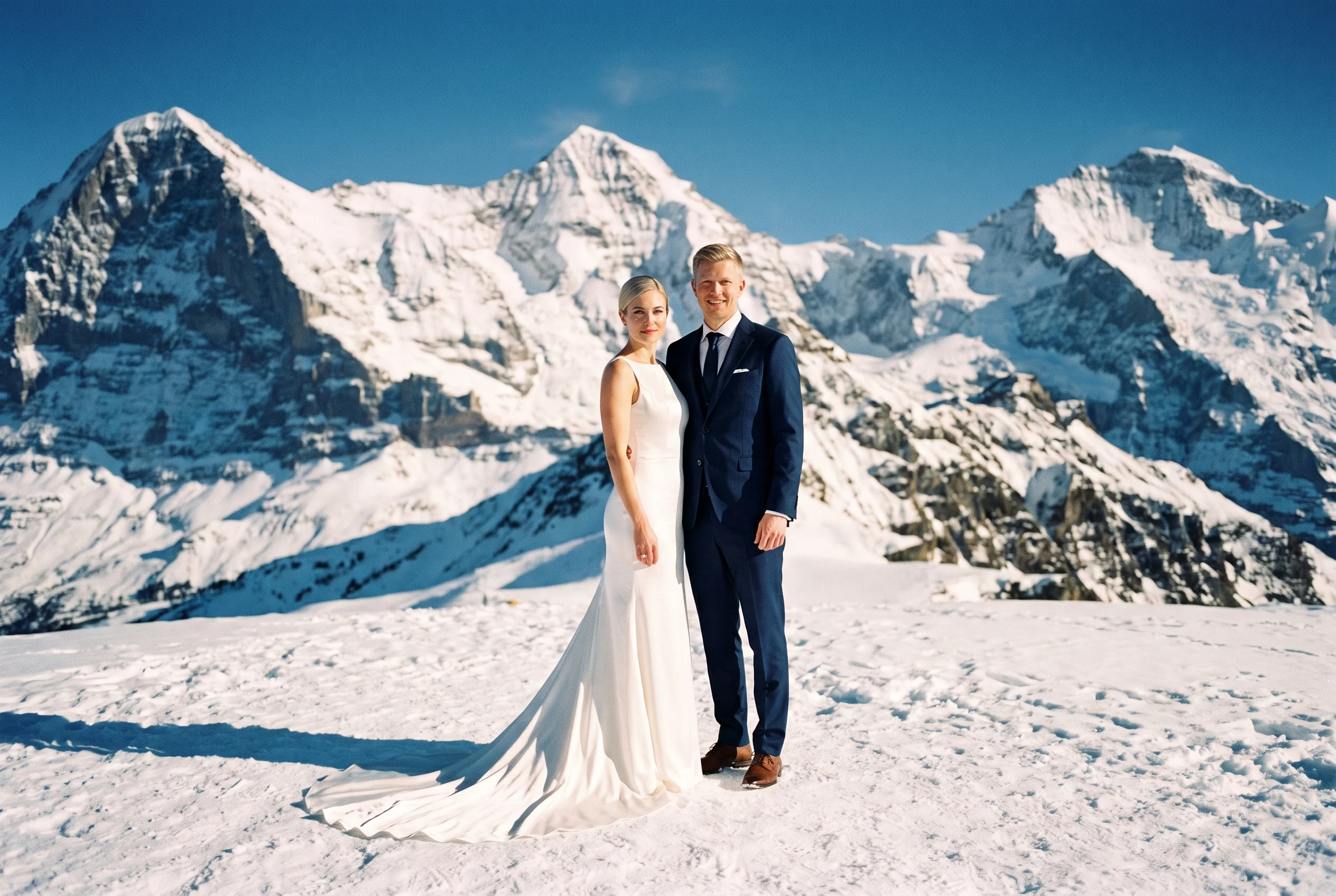
At 3,454 metres, Jungfraujoch is the highest railway station in Europe and the only accessible location in Switzerland where you can stand on a glacier plateau surrounded by 4,000-metre peaks on every side. The light here is harsh, clean, and stripped of atmosphere — the air is too thin to scatter the warm wavelengths, so everything reads as high-contrast, almost architectural. Snow becomes a study in blue shadow and white highlight, and skin reads with a clarity that lower elevations never produce.
The move is to shoot the glacier plateau in the late morning, when the sun is high enough to illuminate the saddle between the Mönch and Jungfrau peaks but before the afternoon clouds roll in. A couple on the snow plateau, the peaks behind them, reads as an editorial fashion shoot set on another planet. The white snow acts as a natural reflector that fills every shadow on the face, producing a quality of light that studio photographers spend careers trying to replicate. Ivory silk against blue-white snow is a colour combination that cannot be improved.
The hour that matters: 10 AM to noon, before the afternoon clouds build. The plateau is above the cloud layer in the morning, but by 2 PM the valley moisture has risen and the peaks begin to disappear. The first train up is early enough; the last train back is not.
Lake Lucerne — The Blue Hour on the Waterfront
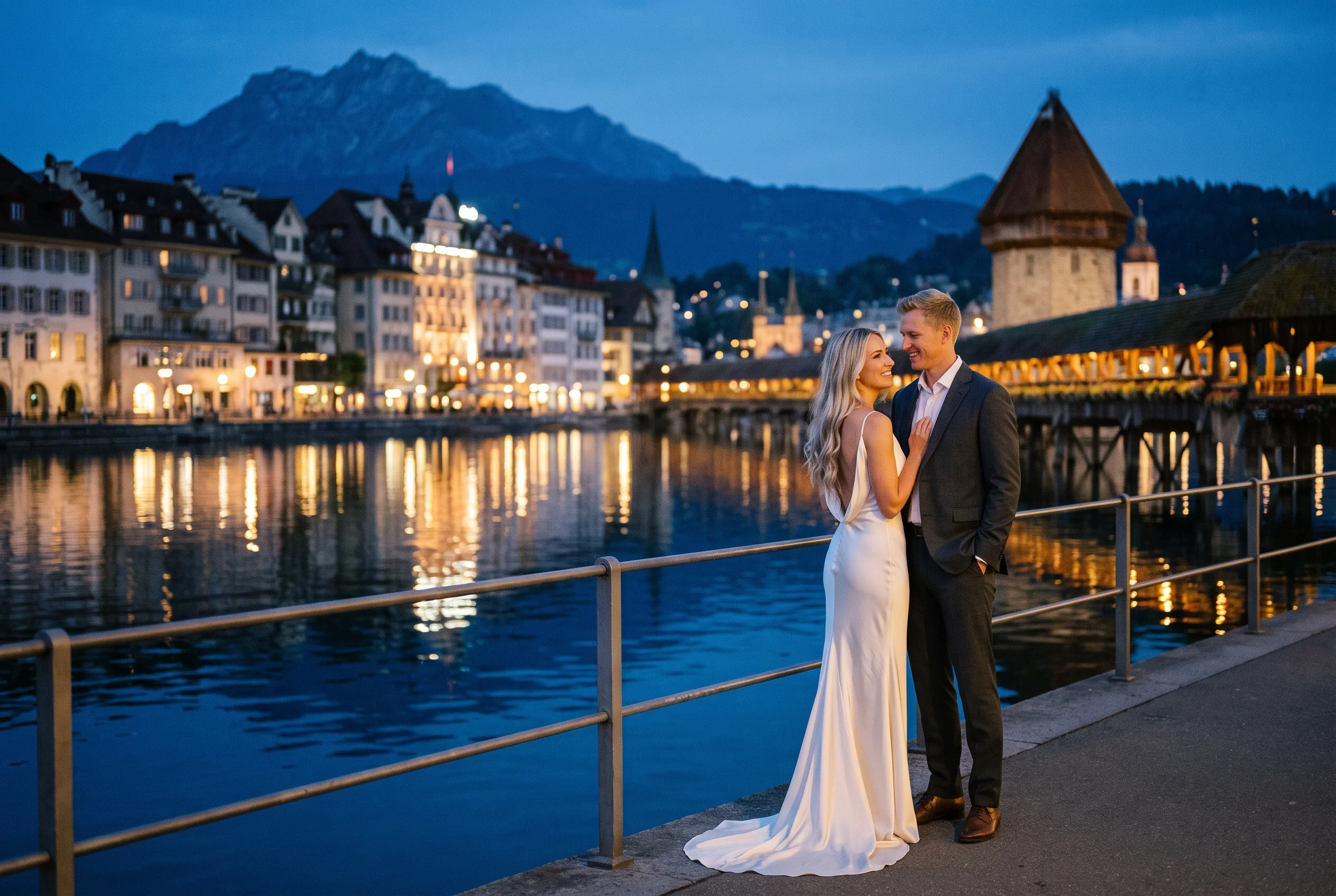
Lake Lucerne is a lake so irregular in shape that it curls through four cantons like a river that forgot to pick a direction. The waterfront in Lucerne itself is where the lake narrows, and the old town's painted facades, the Kapellbrücke's wooden covered bridge, and the rising peaks of Mount Pilatus behind create a composition that is half city, half mountain, entirely Swiss.
At blue hour — that thirty-minute window after sunset when the sky turns deep cobalt and the city lights have come on but the lake is still bright enough to reflect — the waterfront produces the most layered light in Switzerland. The sky is cool, the city lights are warm, the lake is a mirror that doubles both. A couple on the waterfront promenade, the old town and Pilatus behind them reflected in the water, makes a frame that no other Swiss city can produce because no other Swiss city sits on a lake with mountains rising directly behind it.
The hour that matters: 25 to 40 minutes after sunset. Before that, the city lights are too faint. After that, the lake goes dark and the reflections vanish. The window is short but the light is extraordinary.
Frequently Asked Questions
Is it cold enough to need a jacket for Swiss wedding photos?
Even in July, alpine locations above 2,000 metres can drop to 10°C at golden hour. Bring a tailored overcoat or wrap that complements the gown — a structured wool coat in ivory or charcoal photographs beautifully and saves you from shivering in the portraits. The valleys are warmer but the wind off the lakes can be cold.
Can we access these locations without hiking?
Oeschinensee requires a 40-minute walk from the gondola station. Lauterbrunnen valley is flat and walkable. Riffelsee is a 15-minute descent from the Gornergrat railway station. Jungfraujoch is reached by train. Lake Lucerne is waterfront level. Only Oeschinensee involves real effort; the rest are accessible to anyone who can walk on a path.
What time of year has the best alpine light?
September is the sweet spot — the summer crowds have gone, the alpine lakes are still warm enough that morning mist rises off them, and the lower sun angle produces longer golden hours. June has the best wildflowers. July is the warmest but also the most crowded. Avoid October through May unless you specifically want snow portraits.
You don't need to charter a helicopter to stand on these glaciers. Pictaway's atelier crafts cinematic wedding portraits set in Switzerland's most iconic alpine locations — from Oeschinensee's turquoise mirror to Jungfraujoch's glacier plateau — uploaded in moments, delivered in 24 hours. Explore Switzerland wedding portraits.
Your Switzerland wedding portraits — delivered in 24 hours
Get started