japan · Destination Guide
The Japan You Came For: An Iconic Wedding Photography Guide
Shibuya Crossing at blue hour, cherry blossoms at first light, Mount Fuji from the lake, Arashiyama's bamboo cathedral, Hokkaido's lavender hills, and Gion's lantern streets — the iconic Japan every couple dreams of, shot at the hours that turn postcards into cinema.

Japan is the country most couples have already seen before they arrive — in films, in photographs, in the back of their imagination. Shibuya Crossing, Mount Fuji, cherry blossoms, bamboo forests, lavender hills, lantern-lit wooden streets. These are not hidden gems; they are the images that drew them here. The question for wedding photography is not whether to shoot them, but how to shoot them so they feel like cinema rather than postcards.
This is a guide to the six most iconic locations in Japan — the ones every couple asks for — and the specific hours, angles, and decisions that separate a frame made in each one from a frame copied in each one. Most photographers show up at midday and leave with what everyone leaves with. The atelier approach is different: you arrive at the hour the location was made for, you compose for the light rather than the landmark, and you earn the icon.
Mount Fuji from Lake Kawaguchi — The Icon Earned
Mount Fuji is the image most couples want from a Japanese wedding shoot, and it is the one most photographers fail to deliver. The mountain is visible from the southern shore of Lake Kawaguchi for roughly two-thirds of the year, but the conditions that make it cinematic — clear air, low light, and still water reflecting the mountain as a mirror — converge in a narrow window. The frame that works is not the telephoto compression of Fuji filling the frame; it is the wide environmental portrait where the mountain sits in the distance, the lake holds its reflection, and the couple stands small in the foreground, giving the volcano its scale.
The hour that matters is the first thirty minutes after sunrise, from roughly 5:30 to 6:00 AM in spring, when the lake is at its stillest and the low angle light rakes across the water and hits the couple's faces from the side. The air is calmest at dawn — by 8:00 AM the thermals begin and the water surface breaks, destroying the reflection. The Oishi Park and the promenade at the north shore offer the clearest sightline with cherry trees in the foreground that bloom in mid-April, giving you the triple composition — couple, sakura, Fuji — that is the holy grail of Japanese wedding photography.
The hour that matters: Late April for cherry trees in bloom at the lake shore. 5:30 to 6:30 AM for still water and the reflection. Check the Fuji visibility forecast — the mountain is clouded over roughly one in three days year-round. Plan two mornings; one will deliver. White and ivory silk reads most powerfully against the blue-grey mountain and the pink cherry trees.
Shibuya Crossing — The Scramble at Blue Hour
Shibuya Crossing is the most photographed intersection on earth, and the frames most couples make there are identical: midday, crowd behind them, flash on the camera, the neon signs blown out and the faces flat. The atelier approach is to shoot it at blue hour, roughly thirty minutes after sunset, when the sky turns cobalt and the crossing's overhead signage shifts from functional to cinematic. At this hour the neon reads as layered color rather than glare, the wet pavement (if it has rained) doubles every sign in the reflection, and the crowd density thins enough to isolate the couple in the frame without erasing the energy.
Position the couple on the north side of the crossing, facing south toward the Q Front building and the tower of screens, so the neon wall fills the background. Shoot at 1/30 second shutter to let the crossing pedestrians blur into motion streaks while the couple stands still — the contrast between sharp subjects and moving crowd is what makes the frame feel like a film still rather than a tourist shot. A gown with a train works beautifully here: the wet asphalt gives the train a second reflection that doubles its presence.
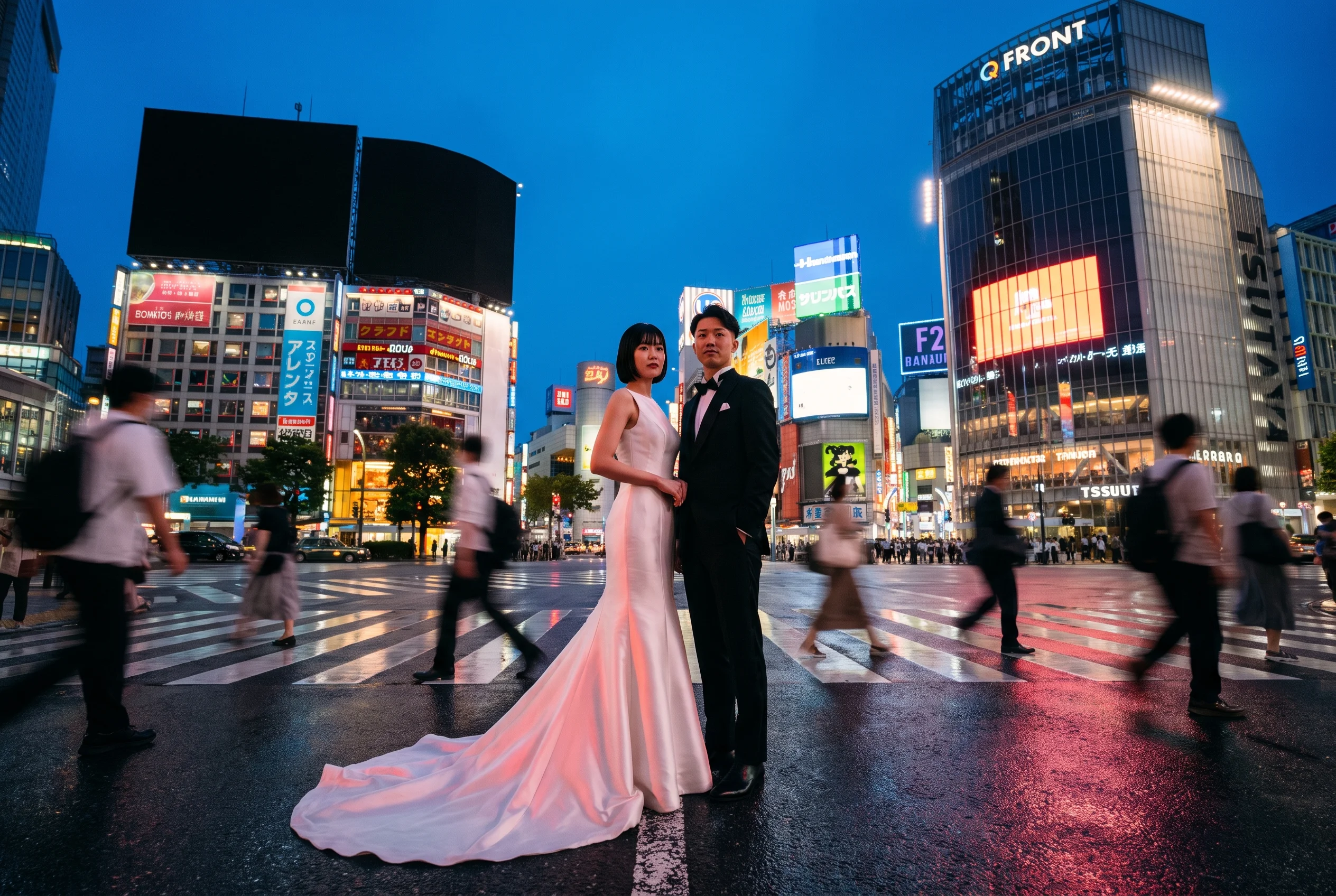
The hour that matters: 7:00 to 7:45 PM in spring and autumn for the ideal blue hour balance. Avoid summer — the crossing is too crowded until 9:00 PM and the blue hour is gone. If it has not rained, bring water bottles to wet the pavement yourself — the reflection is worth the thirty seconds of effort. A structured silk-mikado gown holds its shape against the urban backdrop better than flowing chiffon, which gets lost in the neon chaos.
Arashiyama Bamboo Grove — The Green Cathedral
The Arashiyama Bamboo Grove in western Kyoto is the most photographed nature spot in Japan, and the reason is physical: the soaring Phyllostachys edulis stalks rise thirty meters vertical and filter the overhead light into a green cathedral glow that no studio can replicate. The problem is that by 9:00 AM the main path is a river of tourists, tripods, and selfie sticks that makes deliberate composition impossible. The atelier move is to arrive at 6:00 AM — the grove opens to the public at 8:30 but the adjacent paths are accessible at dawn — and shoot in the first hour when the light is softest and the path is empty.
The frames that work here are vertical compositions using the bamboo as leading lines, with the couple placed small in the lower third and the stalks rising above them into the green-filtered light. A 24mm wide lens captures the height without distorting the couple's proportions. White and ivory silk turns green-gold in this light, as if the fabric has absorbed the forest. A flowing veil catches the still air and gives the frame a quality of suspended time that separates it from every other bamboo grove portrait on Instagram.
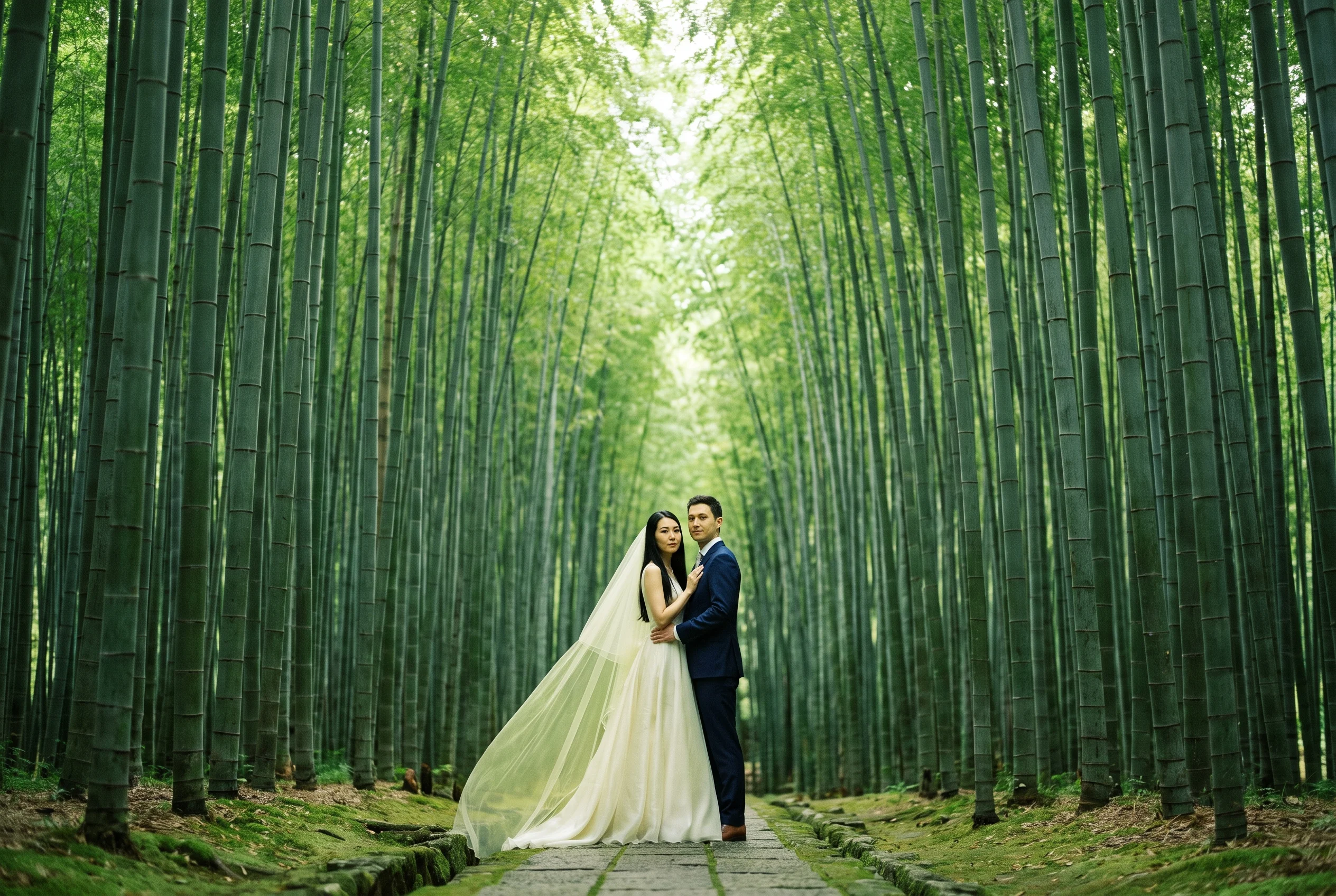
The hour that matters: 6:00 to 8:00 AM, April through June for the most luminous green. The grove is on the western edge of Kyoto — plan forty minutes of transit from central hotels. Avoid weekends entirely. A cathedral-length veil is the one element that catches the still, damp air and makes the frame feel alive. If the main path is occupied, the side trails through the same bamboo offer equally cinematic angles with fewer witnesses.
Meguro River — Cherry Blossoms at First Light
The Meguro River, flowing through central Tokyo, is lined for nearly four kilometers with cherry trees, and in late March and early April it becomes the tunnel of pale pink that defines the Japanese spring. This is the most seasonal location in this guide — miss the bloom by a week and you have a river; hit it and you have one of the most saturated, color-rich environments available anywhere in the world. The frames that distinguish a wedding portrait from a postcard are made not at peak bloom but in the days immediately after, when the petals begin to fall. A breeze sends thousands of blossoms drifting through the frame like confetti, and the light scatters through the petals into something almost translucent.
The timing here is not just about the hour but about the day. Peak bloom is narrow — typically four to seven days — and petal fall begins on the second or third day after peak. The most cinematic frames are made at first light, 6:00 to 7:30 AM, when the path is empty, the air is still, and the only movement is the slow drift of petals. A flowing silk veil catches the same breeze that moves the blossoms — the detail that separates a posed portrait from one that feels alive. By midday the path is a crowd and the petals have been trampled into the pavement.
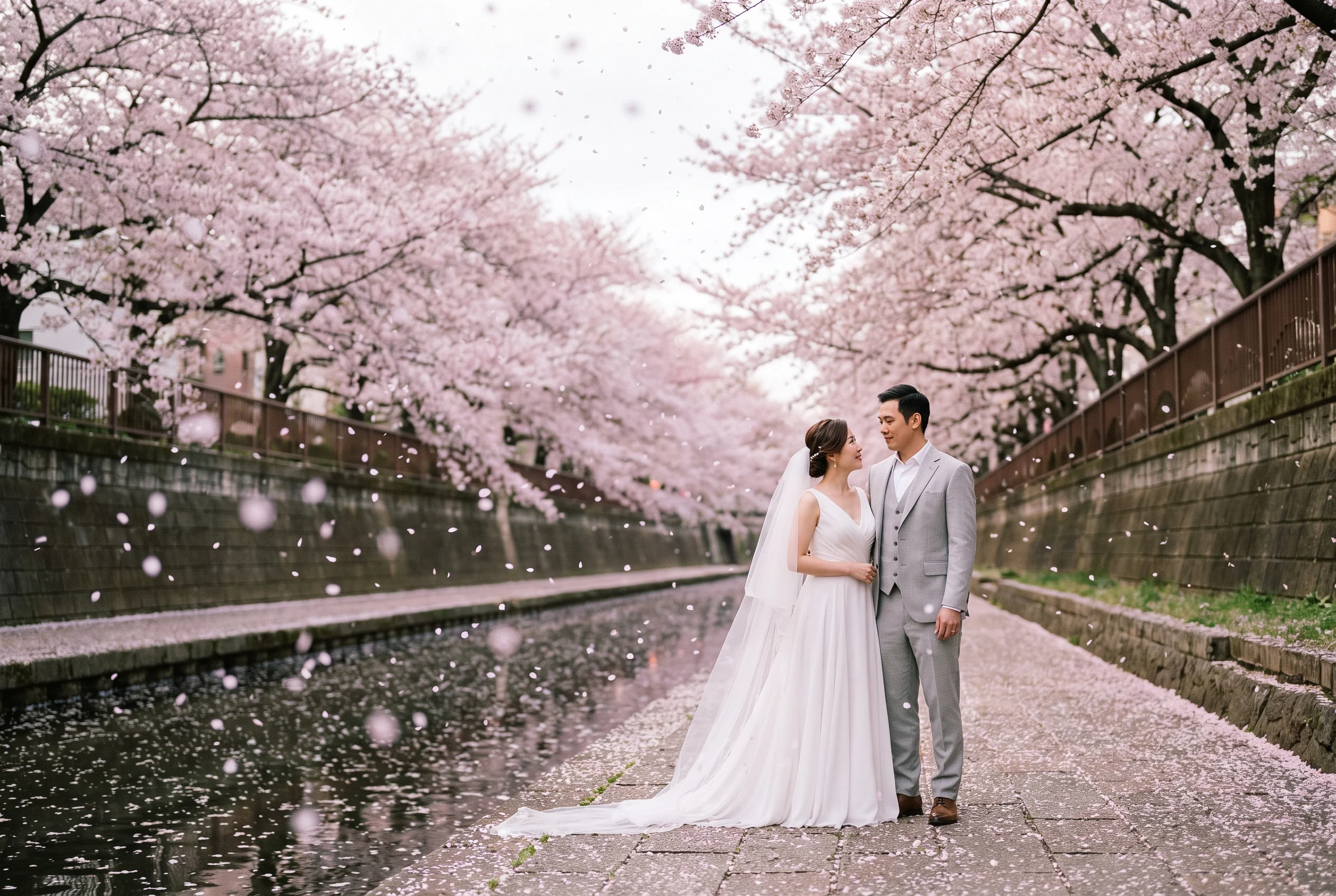
The hour that matters: Late March to early April, 6:00 to 7:30 AM. Monitor the Japan Meteorological Agency sakura forecast — the bloom is unpredictable year to year. Petal-fall frames are best in the two or three days after peak. White and blush silk reads most beautifully against the pale pink; a darker fabric would fight the delicacy of the petals. A cathedral-length veil is non-negotiable — it is the one element that can catch the same breeze as the blossoms and make the frame feel like motion rather than stillness.
Hokkaido — Furano's Lavender Hills in July
Hokkaido in summer is the Japan that most couples have not considered — and the one that produces the most unexpected frames. The Furano region, in central Hokkaido, erupts into lavender, lupine, and cosmos in July, covering rolling hills in bands of purple, pink, and white that run to the horizon under a sky that, at this latitude, runs a deeper blue than anywhere on Honshu. The scale here is the opposite of everything else in this guide: instead of compressing the couple into a narrow alley or a grove of trees, you are placing them small in a vast landscape, giving the fields their scale.
Farm Tomita in Nakafurano is the most famous lavender farm, and its hillside rows — purple in the foreground, green in the middle distance, the Daisetsuzan volcanic range on the horizon — compose themselves. The hour that matters is the hour after sunrise, when the low light rakes across the rows and the dew still clings to the stems, giving the lavender a velvet texture that flat midday light destroys. Hokkaido's summer dawn is early — 4:30 AM in July — so the practical call time is 5:00 AM for a 5:30 first-light shoot. The reward is a frame that does not look like it was made in the same country as the bamboo grove or the Shibuya neon, but in the same quality of attention.
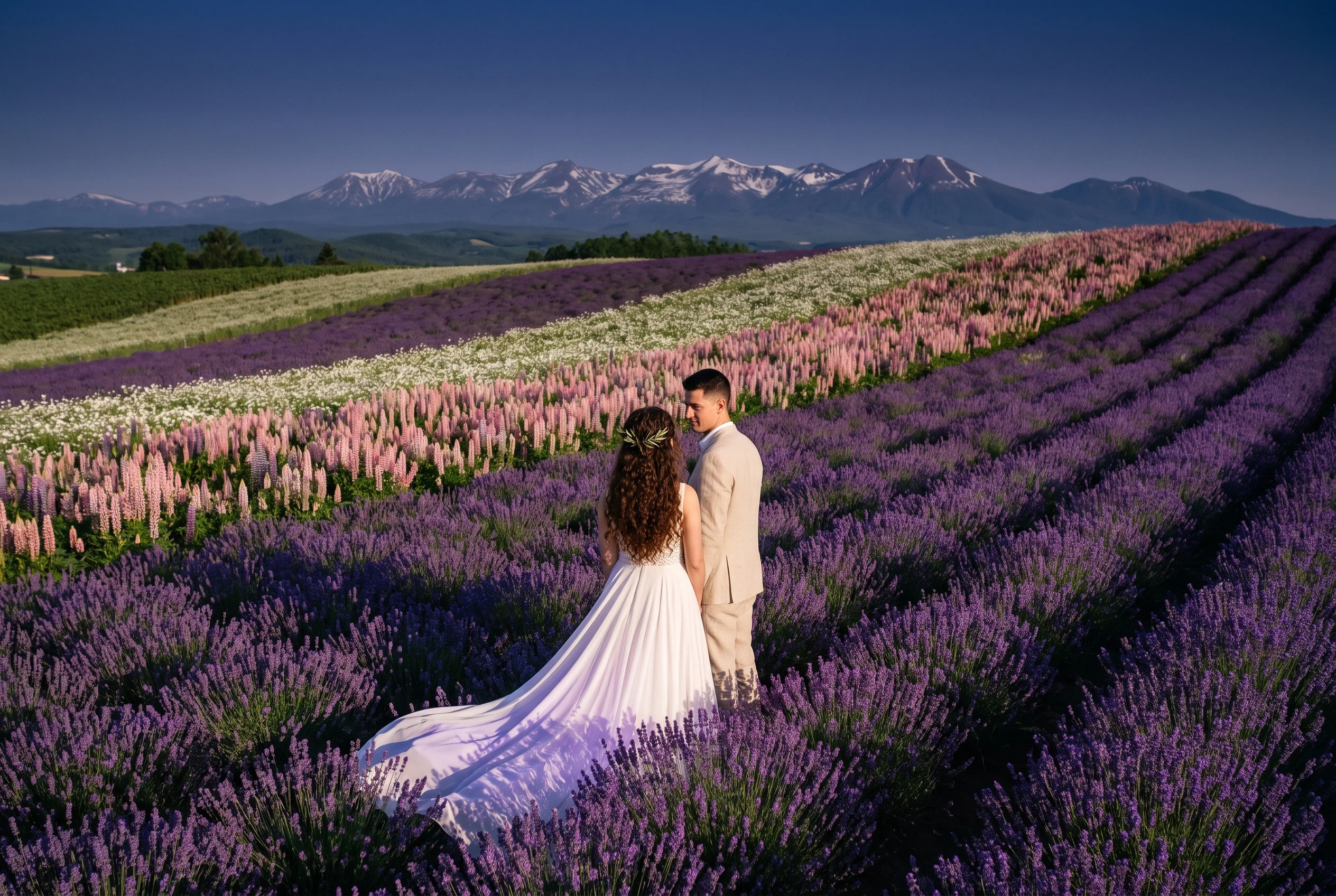
The hour that matters: Mid-July for peak lavender bloom at Farm Tomita. 5:00 to 7:00 AM for the low light and dew. The fields face east, so morning light rakes across the rows rather than backlighting them. Avoid August — the lavender is harvested by late July and the fields return to green. A silk-chiffon gown in white or ivory catches the lavender color in its reflection, turning the fabric faintly violet in the most beautiful way.
Gion, Kyoto — Lantern Streets at Dusk
Gion is the Kyoto that couples picture when they close their eyes: dark wooden machiya townhouses, paper-screen windows, stone-paved alleys, and the glow of washi paper lanterns at dusk. This is the district where the traditional aesthetic of Japan is most intact, and the hour that transforms it from a tourist street into a film set is the transition from day to night — roughly 6:00 to 7:15 PM in late spring, when the sky holds a deep blue behind the warm lantern light and the paper screens of the machiya glow amber from within.
The side alleys off Hanamikoji-dori — barely wider than a wedding dress train — give you the intimate, architectural portraits that feel like stills from a film set in another century. The washi paper acts as a natural diffuser, turning the tungsten glow into something soft, directional, and deeply flattering to skin. For couples who want to wear kimono, this is the location: a bride in white silk with a kimono layered over it, standing in a lantern-lit alley, is the frame that most couples come to Kyoto to make. Gion at dusk is quieter than during the day — the tour groups leave at 5:00 PM and the lanterns come on at 6:00, giving you a forty-five minute window of near-solitude in the most famous district in Kyoto.
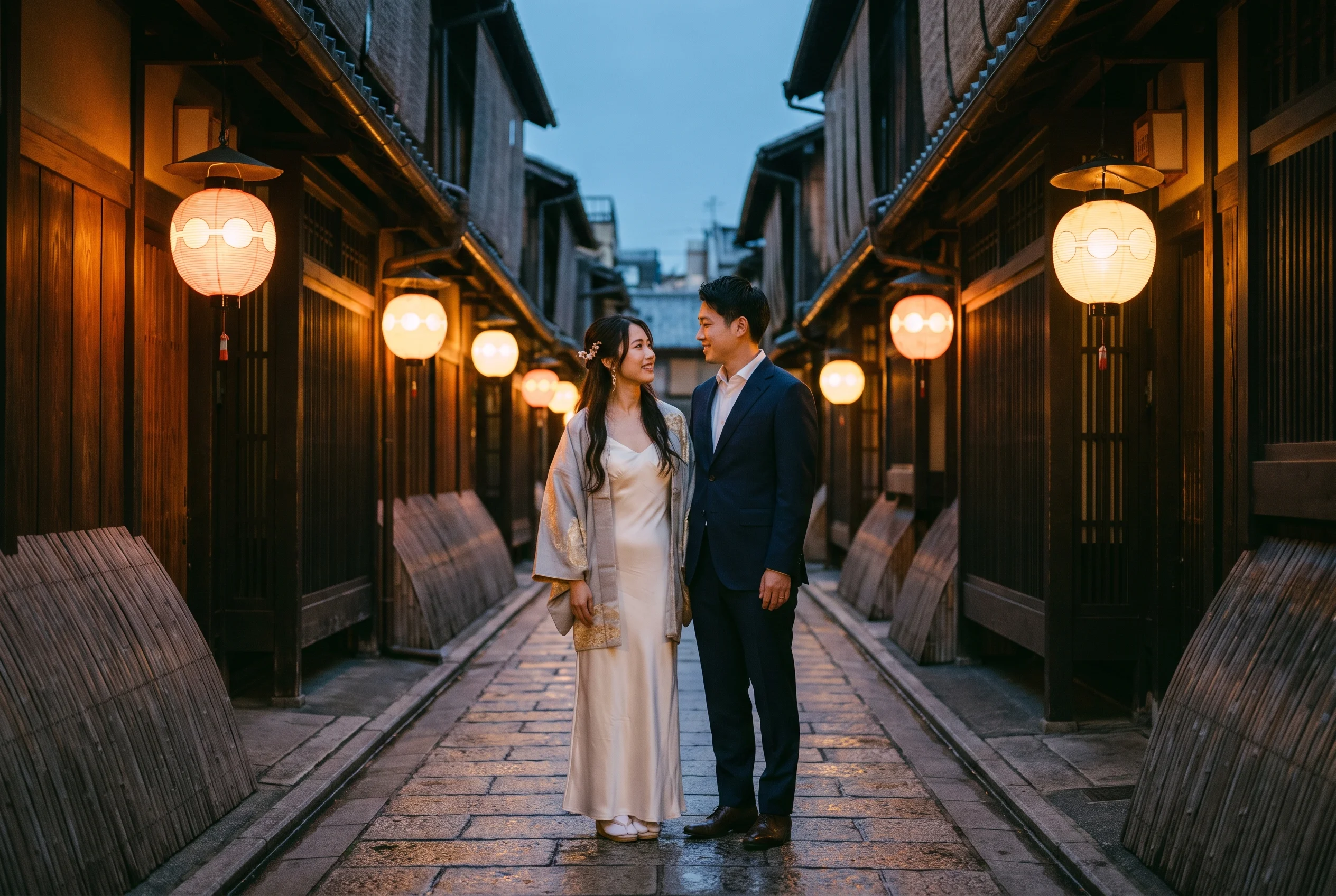
The hour that matters: 6:00 to 7:15 PM in May for the ideal lantern-dusk balance. Weekday evenings are almost empty. A silk gown in ivory or cream catches the warm lantern light and holds it — the fabric reads as lit from within. If wearing a kimono, choose one with subtle pattern rather than bold florals — the setting is already visually rich, and a quiet kimono lets the lantern light do the work.
Frequently Asked Questions
What are the best wedding photo spots in Japan?
The five most iconic locations for Japanese wedding portraits are Shibuya Crossing at blue hour, Mount Fuji from Lake Kawaguchi, the Arashiyama Bamboo Grove in Kyoto, the cherry blossom tunnel along Meguro River, and the lavender fields of Furano in Hokkaido. Gion's lantern-lit streets at dusk round out the set for couples who want the traditional Kyoto aesthetic.
When is cherry blossom season in Japan for wedding photos?
Cherry blossoms typically peak in Tokyo from late March to early April. The Meguro River offers the most photogenic sakura tunnel for wedding portraits in central Tokyo. The peak bloom window is narrow — often just four to seven days — and the most cinematic frames are made in the two or three days after peak, when petals begin to fall and drift through the frame.
What should couples wear for wedding photos in Japan?
White and cream silk catches the green-filtered light of bamboo groves and the warm lantern light of Gion streets more beautifully than any other palette. Silk chiffon and organza catch the breeze in open spaces like Shibuya and add movement to stillness. For Gion and traditional Kyoto streets, a kimono over the wedding gown creates a layering that honors the setting without competing with it.
These are the six frames most couples come to Japan to make — Fuji, Shibuya, bamboo, sakura, lavender, lanterns. The difference between a postcard and a portrait is not the location but the hour, the lens, and the attention to what the light is doing in each one. Mount Fuji at 5:30 AM with still water and cherry trees is a different image from Mount Fuji at noon with chop and tour buses. Shibuya at blue hour with wet pavement and a 1/30 shutter is a different image from Shibuya at midday with flash. That is what we craft for every couple who trusts Pictaway with their Japanese wedding portraits — the iconic Japan, shot at the hours that make it cinema. See pricing.
Your Japan wedding portraits — delivered in 24 hours
Get started