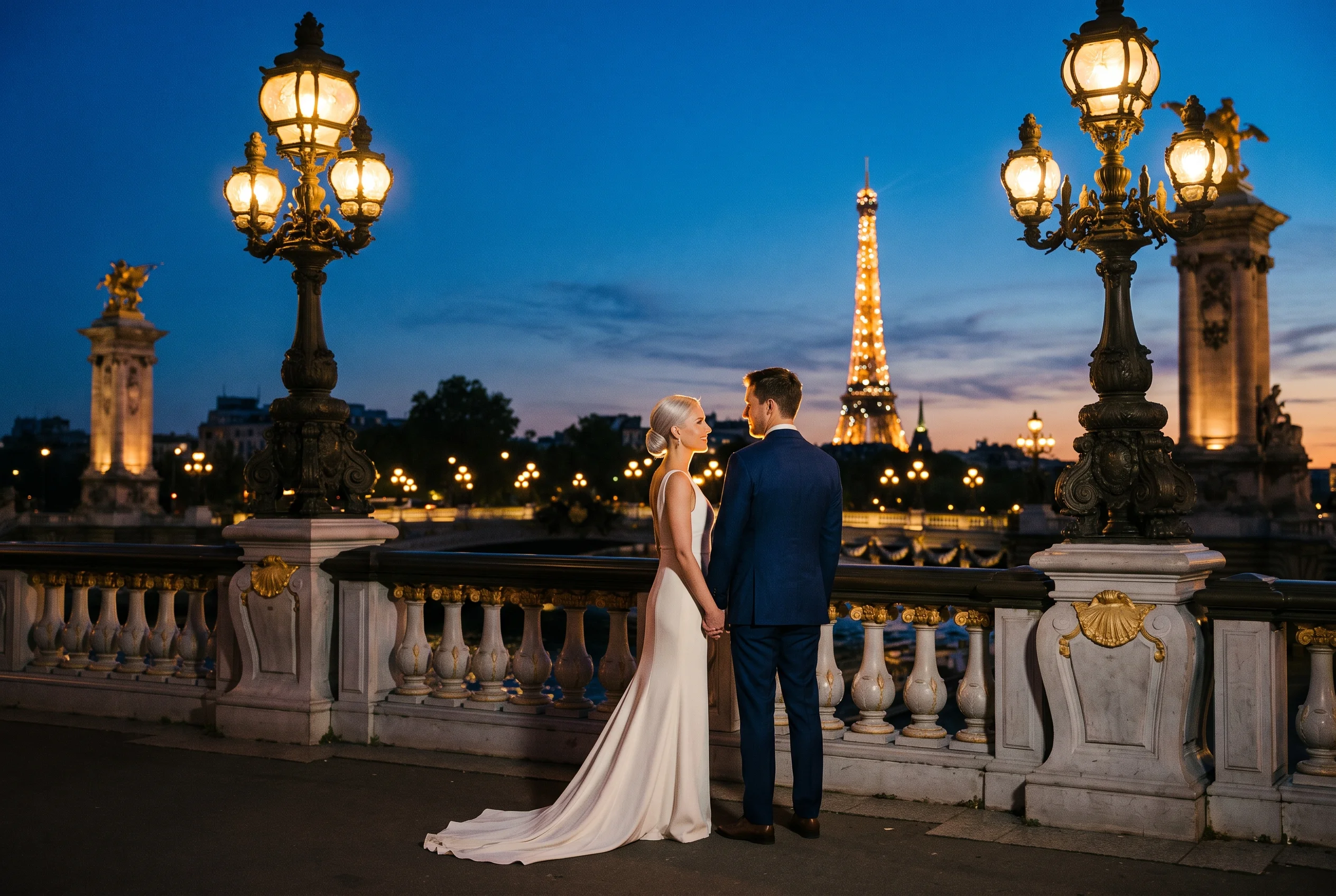
italy · Destination Guide
Where the Light Turns to Gold: An Italy Wedding Photography Guide
From Tuscany's golden vineyards to Florence at blue hour — discover the Italy wedding photo spots most couples never find. An atelier guide to cinematic Italian wedding photography.
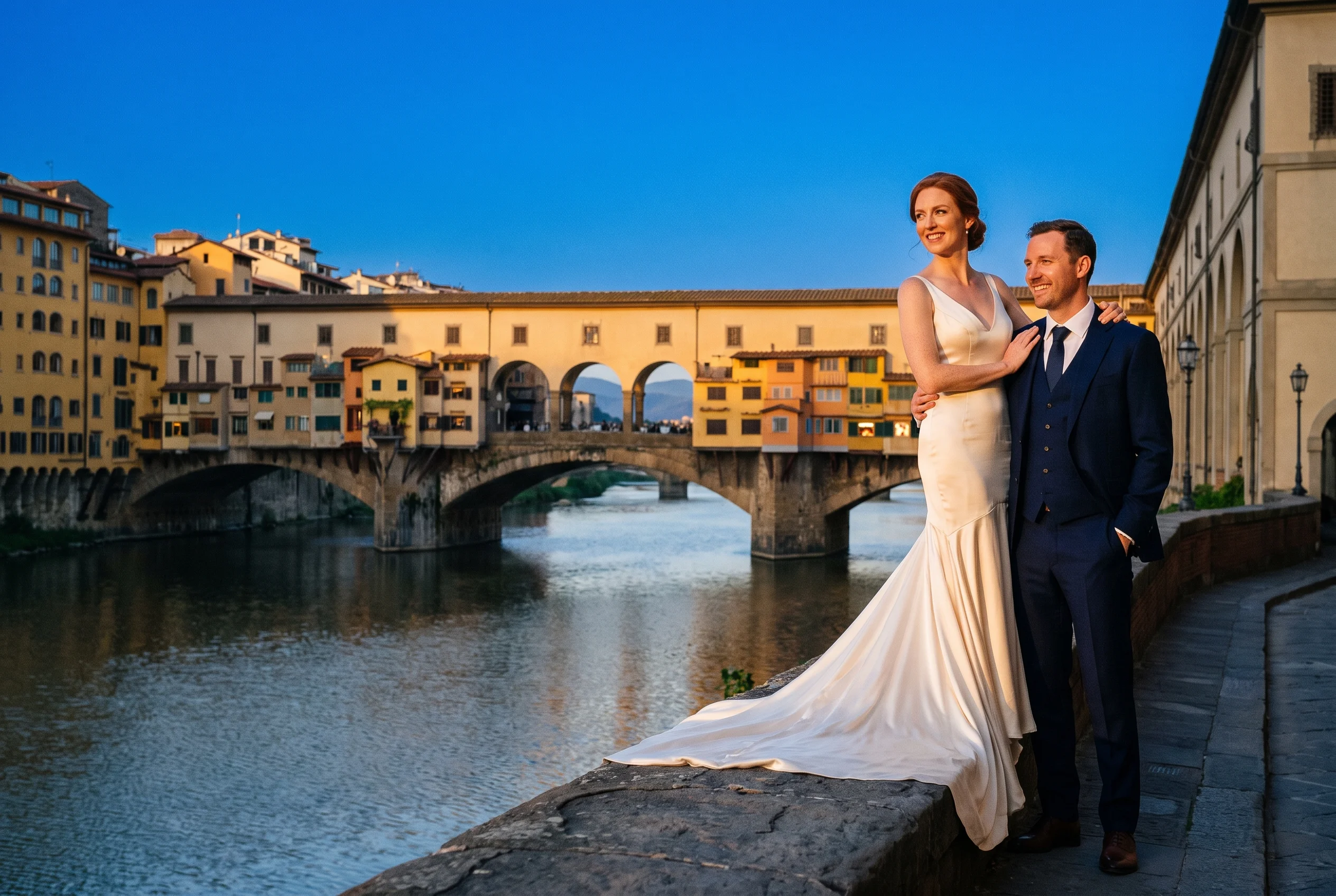
There is a reason Italy has become the most-requested destination in our atelier — and it is not simply the obvious beauty. The light here behaves differently. It arrives soft and diffused through maritime haze along the Adriatic, turns molten as it crosses the Tuscan hills, and ends each day in the long, amber ribbons that Florentine painters spent centuries trying to capture. For wedding photography, this is a country that rewards patience. The finest frames are not made at midday in front of a famous monument; they are made at the edges of the day, in the side streets and riverbanks where Italy has always kept its most intimate beauty. This guide is an atelier's field notes — the specific spots, the precise hours, and the small decisions that separate a competent wedding portrait from a cinematic one.
Florence: The Arno at Blue Hour
Florence is not a city you photograph so much as one you compose with. The Renaissance urban plan — tight streets opening suddenly onto wide river vistas — was practically designed for the dramatic frame. The Arno riverbank is where the city's light is most generous, and the hour that matters most is not golden hour but the fifteen minutes before it: blue hour, when the sky holds a deep cobalt and the reflections on the water turn liquid silver.
Position yourself along the Lungarno, just downstream of Ponte Vecchio. The bridge's shopfronts catch the last warm light while the river below carries the cool blues of dusk. This is the frame that feels timeless — the kind of portrait that could have been made in 1955 or 2025. For the most art-directed result, shoot westward as the sun drops behind the hills, letting the silhouette of Ponte Santa Trinita anchor the background.
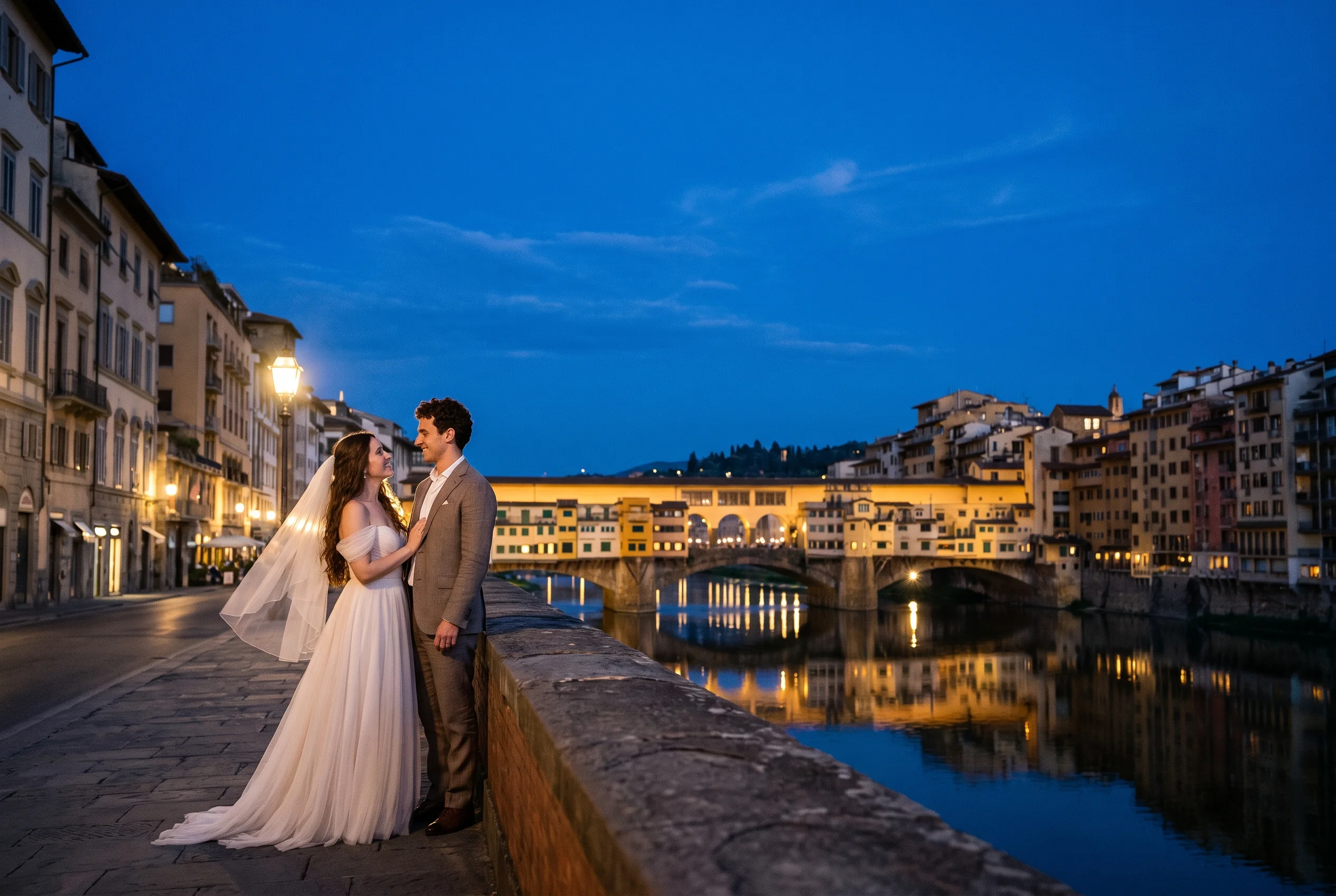
The hour that matters: Arrive by 7:30 PM in summer, 5:15 PM in late autumn. Blue hour in Florence lasts roughly twenty minutes — move fast, work deliberately. Avoid weekends at Ponte Vecchio itself; the weekday crowds thin enough to let you work the riverbank unbothered.
Tuscany: The Val d'Orcia's Cypress Alleys
South of Siena, the Val d'Orcia unfolds into the landscape most people picture when they close their eyes and think of Italy — rolling hills, lone farmhouses, and the cypress alleys that wind like dark calligraphy across the gold. This is the most cinematic wide-angle territory in the country, and the light here is the reason photographers make the drive.
The zone between San Quirico d'Orcia and Pienza holds the iconic cypress rows. For wedding portraits, the trick is to arrive when the light is low enough to give the trees long shadows but still warm enough to flatter skin tones — roughly 6:00 to 7:30 PM in May and September. Earlier in the day the sun is too high and the hills flatten into washed-out green. Later, and the shadow of the western ridgeline swallows the valleys before the sky itself goes gold.
If you want the mist-softened, dreamlike Tuscan frames — the ones where the hills fade into each other in layers of grey and rose — you need to be out at first light. The valley fog burns off by 9:00 AM in spring, so a 6:00 AM call time is non-negotiable. This is the hardest hour to commit to on a wedding trip, and the one that produces the most singular images.
The hour that matters: Late May for peak green vineyards. September for the harvest gold. Avoid August — the fields are brown, the light is harsh, and the heat makes long outdoor sessions punishing for the couple.
Rome: Trastevere and the Colosseum at Dawn
Rome is the city most couples underestimate for wedding photography. The instinct is to frame the obvious — the Colosseum, the Trevi Fountain, the Spanish Steps — and walk away with images that look like every other couple's. The atelier approach is different: you take the icon, but you earn it.
The Colosseum is one of the few landmarks that rewards an actual sunrise. At 6:30 AM in late spring, the eastern light hits the curved arches at a low angle, raking across the stone and giving it a texture you cannot get any other hour. The crowds have not yet arrived, and Via dei Fori Imperiali is quiet enough to use as a leading line. This is the frame that feels cinematic rather than touristic — the difference between a still from a film and a postcard.
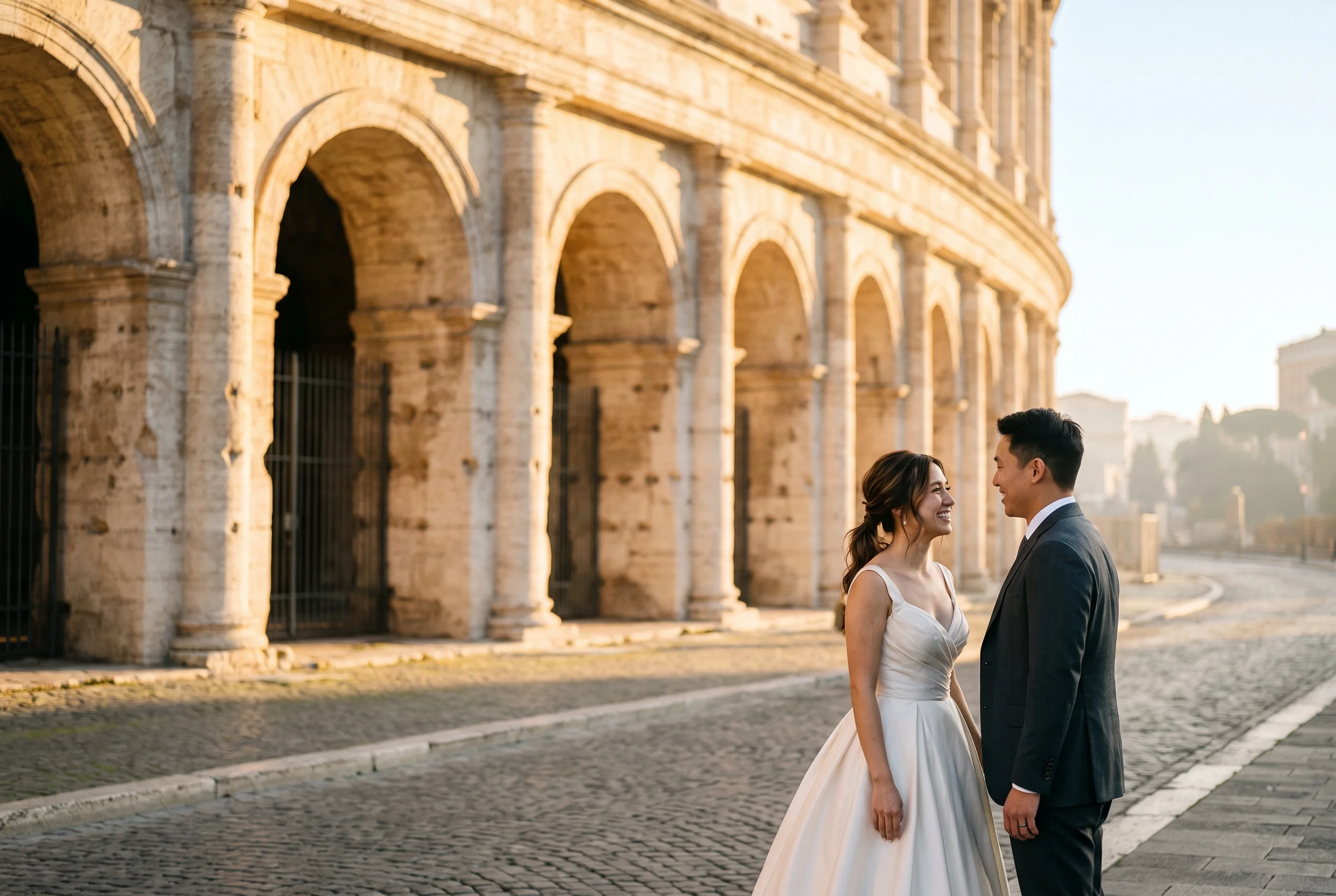
For a softer, more editorial portrait, move across the river to Trastevere in the late afternoon. The neighborhood's narrow streets and ivy-covered walls scatter the light into something diffused and warm — ideal for intimate, candid frames. Piazza di Santa Maria in Trastevere at 5:00 PM in October is one of the most forgiving and beautiful light conditions in all of Italy.
The hour that matters: Colosseum — 6:15 to 7:45 AM, mid-week to avoid tour groups. Trastevere — 4:30 to 6:00 PM, when the western light comes in low through the streets.
Venice: The Quiet Canals of Cannaregio
Venice is the most photographed city in Italy, which makes it the hardest to photograph well. The Rialto and Piazza San Marco are traps — at any usable hour they are filled with people, and the frames made there tend toward the generic. The atelier move is to go north, into Cannaregio and the Fondamente Nove, where the canals are quieter and the light hits differently.
Cannaregio's side canals give you the reflections and pastel facades Venice is known for, but without the crowds. The Madonna dell'Orto canal, in particular, sits on a quiet waterway that catches the late western light beautifully from 6:00 to 7:15 PM in September. For something more austere and modern, the Fondamente Nove waterfront faces the lagoon's northern islands — a long, open horizon that makes for striking minimalist frames when the sky goes pink.
If you want the misty, cinematic Venice — the one with fog on the water and silhouettes of gondolas — plan for late October or November. The city is quieter, the light is lower, and the acqua alta season adds an unpredictable, art-directed quality to the frames that no other time of year can replicate.
The hour that matters: Cannaregio canals — 6:00 to 7:15 PM. Fondamente Nove — 7:00 AM for flat morning lagoon light. Avoid July and August; the heat and crowds make deliberate work nearly impossible.
The Amalfi Coast: Ravello Over Positano
The Amalfi Coast presents a specific challenge: the most famous town, Positano, faces west — which means the golden light here is spectacular but the window is extremely narrow, and the steep cliffs cast long shadows that swallow the town before the sun reaches the horizon. The result is that most Positano wedding portraits are either backlit into silhouettes or shot in flat midday light.
Ravello, perched 365 meters above the sea, solves this. It faces south and east, which means it holds usable light longer into the evening, and its gardens — particularly Villa Cimbrone's Terrace of Infinity — offer one of the most dramatic wedding portrait backdrops in Europe: a marble balustrade falling away to the Tyrrhenian Sea. This is where you make the image that goes above the mantle.
For the coastal color that defines Amalfi — the bougainvillea cascading over white walls, the lemon groves in terraced rows — the path between Ravello and Amalfi, the Valle delle Ferriere, offers shaded, diffuse light that flatters skin even at midday. This is rare in southern Italy and worth building into a schedule.
The hour that matters: Villa Cimbrone — 6:30 to 7:45 PM in September for warm light on the sea. May for peak bougainvillea bloom. Avoid August entirely — the coast is at its most crowded, and the heat makes outdoor portrait sessions uncomfortable.
Frequently Asked Questions
What are the best wedding photo spots in Italy?
Beyond Venice and the Amalfi Coast, Tuscany's Val d'Orcia vineyards, Florence's Ponte Vecchio at blue hour, and Rome's Trastevere district offer cinematic wedding photography backdrops.
Do I need a permit for wedding photography in Italy?
Public spaces generally allow personal photography without permits. Organized shoots with professional equipment at landmarks like the Colosseum or Florence's Piazza della Signoria may require permits from local authorities.
What is the best time for wedding photos in Italy?
May-June and September offer golden light, mild temperatures, and fewer crowds than peak summer. Tuscany's vineyards are greenest in late May.
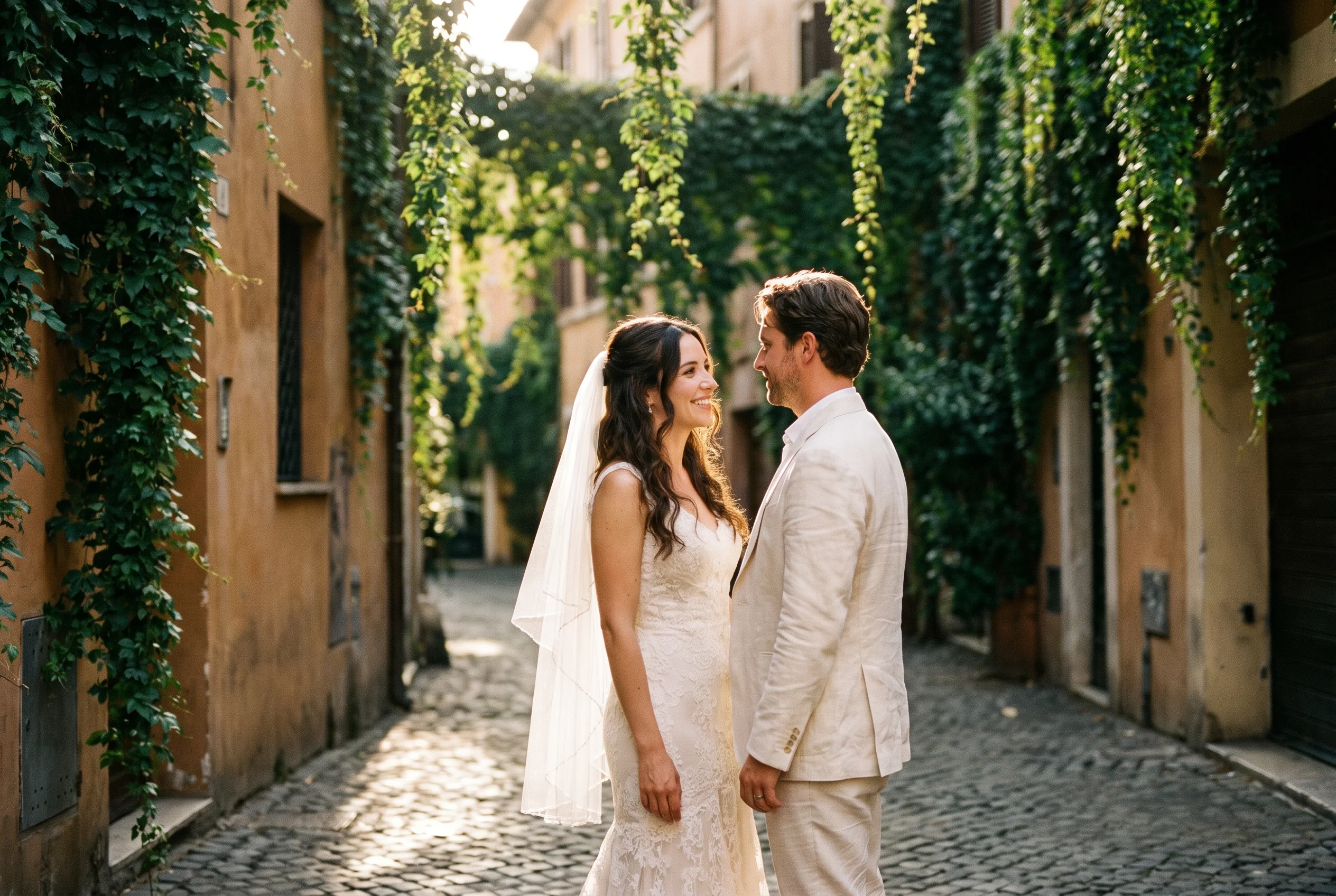
Italy rewards the couple who plan for the edges of the day — the early fog in Tuscany, the blue hour over the Arno, the first light on the Colosseum. These are the frames that feel art-directed rather than assembled, and they are what we craft for every couple who trusts Pictaway with their Italian wedding portraits. If you are planning a wedding or portrait session in Italy, we deliver cinematic, location-specific photography with a 24-hour turnaround — see pricing and details.
Your Italy wedding portraits — delivered in 24 hours
Get started