china · Destination Guide
The Scale of Everything: A China Wedding Photography Guide
The Great Wall at golden hour, Shanghai's Bund in blue hour, Guilin's karst mountains on the Li River, Zhangjiajie's stone pillars above the clouds, and West Lake's willow-lined shores — five Chinese locations where the landscape rewrites the meaning of scale.
China is a country where the word "large" loses its meaning. The Great Wall crosses 21,000 kilometres of mountain ridges. Zhangjiajie's stone pillars rise 1,000 metres from a valley floor that is itself above the clouds. The Li River winds through a karst landscape so improbable that for centuries the Chinese believed it was painted, not real. The scale is not just geographic — it is emotional. A couple standing on the Great Wall, or on a Li River boat, or on a Zhangjiajie overlook, becomes small against something that predates every human story, and the portrait acquires a weight that no studio backdrop can produce.
This is a guide to five Chinese locations where scale and light combine to create frames that feel less like wedding photographs and more like classical Chinese landscape paintings with a couple standing in them. Each location is chosen for a quality of light that exists only at a specific hour, and each rewards the couple who arrives at that hour rather than the convenient one.
The Great Wall at Huanghuacheng — Golden Hour on the Ridge
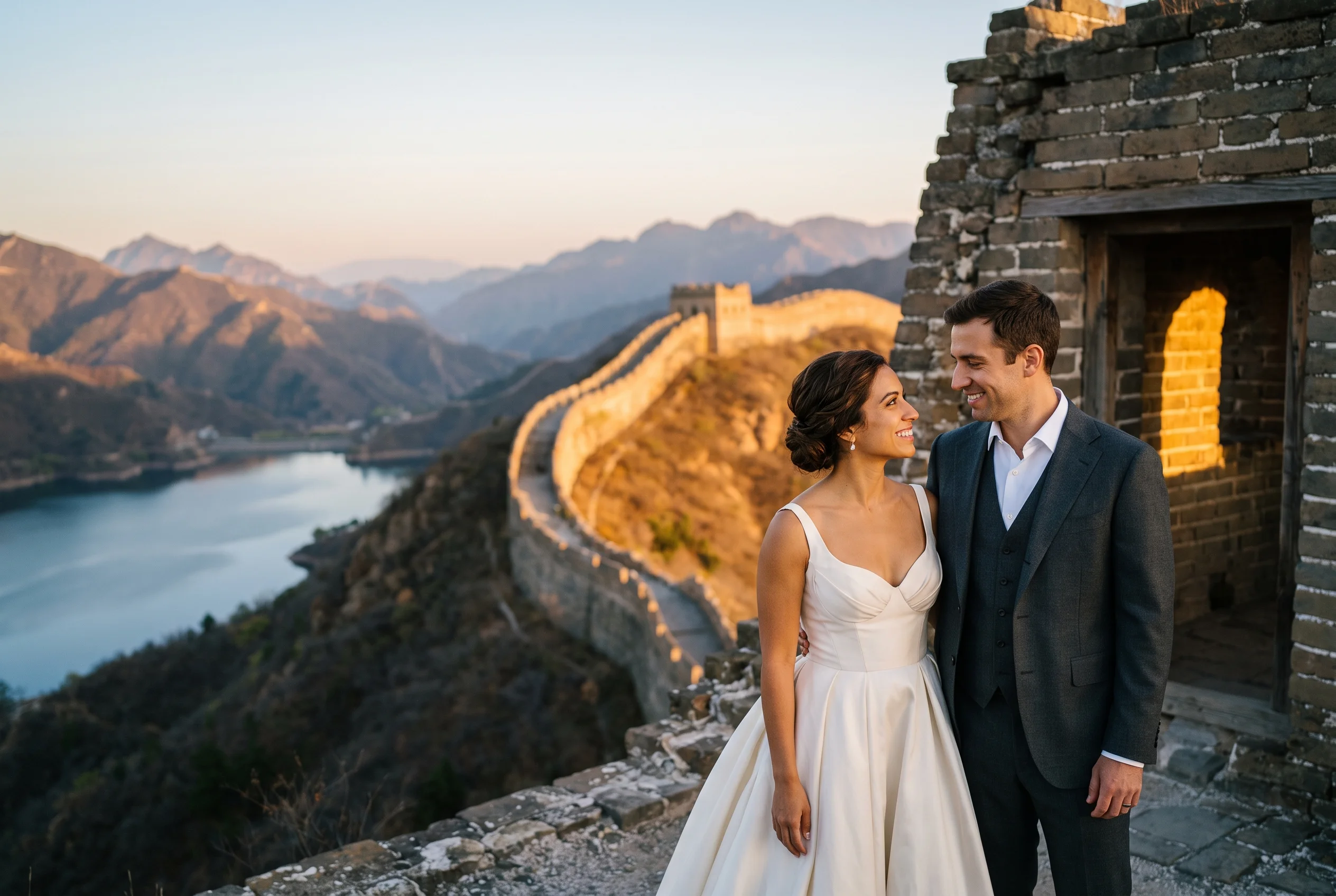
The Great Wall at Badaling is the most photographed section, which is why you should not shoot there. Huanghuacheng, ninety minutes north of Beijing, is a wild section where the wall follows the ridge line without restoration — crumbling watchtowers, overgrown stone, and a reservoir below that reflects the wall in its still water. At golden hour, the wall's stone catches warm light from the west while the reservoir below holds the cool blue of the fading sky, and the ridge line creates a natural leading line that draws the eye from the couple to the wall's curve over the mountains.
The portrait move is to climb to a watchtower on the western ridge and shoot along the wall as the sun drops. The couple placed at a tower doorway, the wall extending behind them along the ridge and the reservoir reflecting the sky below, makes a frame that gives the portrait two layers of scale: the wall against the mountains, and the couple against the wall. The crumbling stone is warm enough to lean against, and the overgrown sections provide foreground texture that the restored sections at Badaling have lost. This is the Great Wall as landscape rather than monument.
The hour that matters: The last 45 minutes before sunset, October through April, when the western light rakes along the wall and the watchtower doorways glow warm. The climb takes 40 minutes — leave the trailhead 90 minutes before sunset. The path is rough; wear shoes you can hike in, then change at the tower.
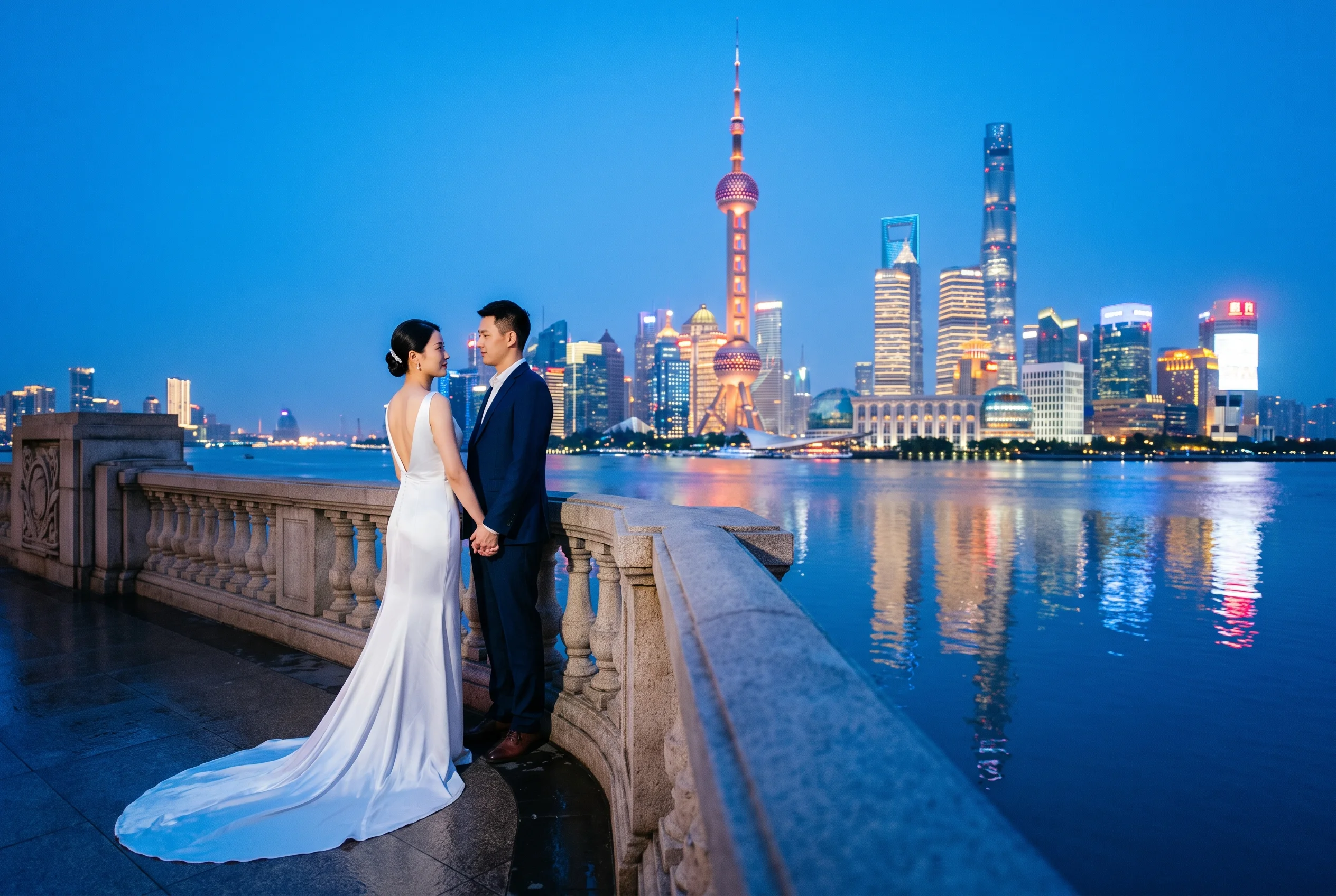
The Shanghai Bund — Blue Hour Across the River
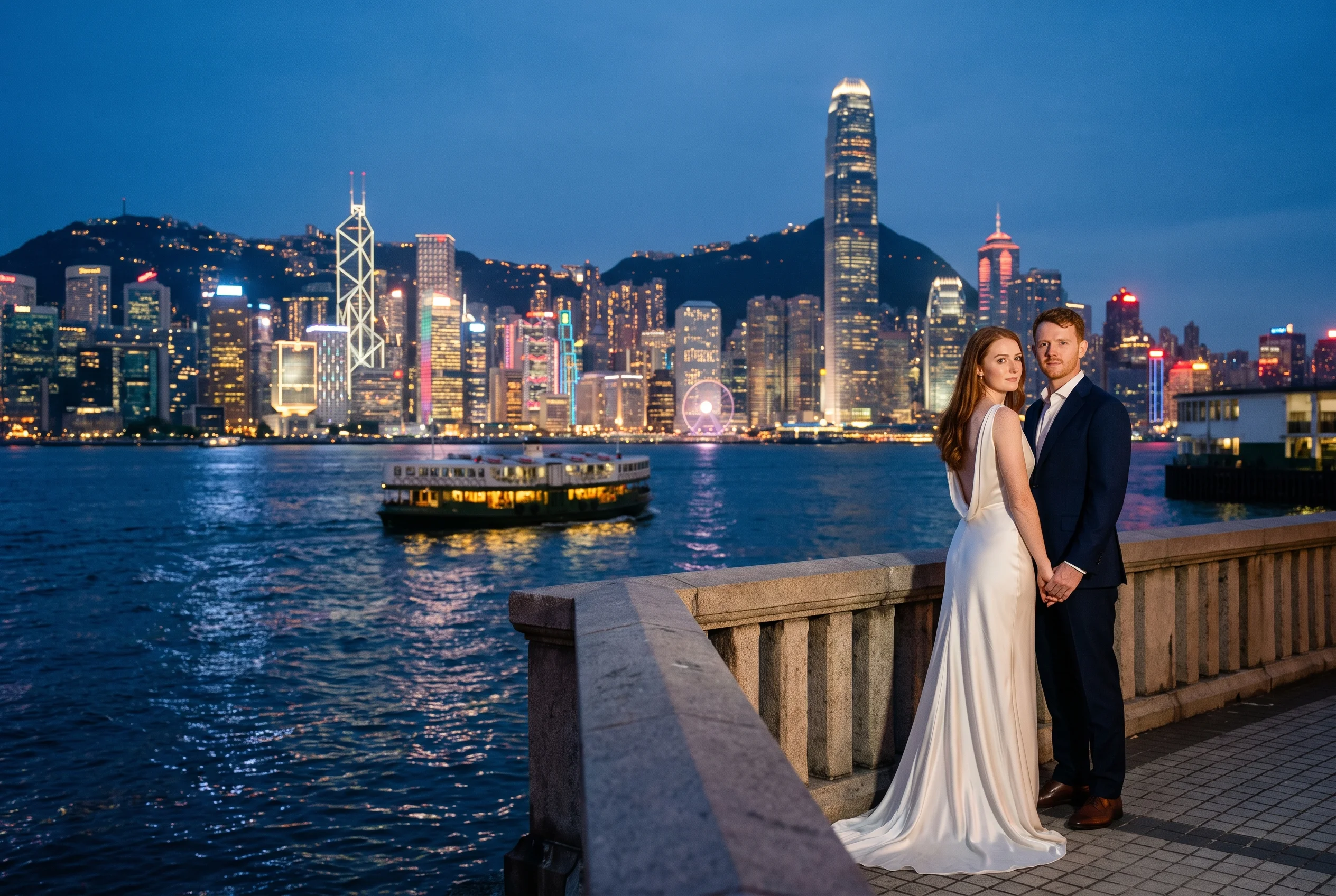
The Bund is Shanghai's waterfront promenade on the west bank of the Huangpu River, facing the Pudong skyline across the water. At blue hour, the frame that appears is one of the most photographed in the world: the Oriental Pearl Tower, the Shanghai Tower, and the Jin Mao Tower lit against a deep cobalt sky, their reflections doubled in the dark river below. What most photographers miss is that the Bund itself — the row of 1920s Art Deco buildings behind the promenade — is equally extraordinary, and the portrait move is to use both sides: the historic architecture as backdrop from one angle, the futuristic skyline from the other.
The light at blue hour is the key. The sky holds a deep saturated cobalt for about twenty minutes, and during that window the contrast between the warm city lights and the cool sky produces a colour-temperature split that no single-temperature light can match. A couple on the Bund promenade, the Pudong skyline behind them reflected in the river, reads as a portrait of a city standing between two centuries. The Art Deco balustrade of the promenade provides a graphic foreground element, and the wet stone after an evening rain doubles every light source into a second reflection below.
The hour that matters: 25 to 45 minutes after sunset. The Pudong skyline lights come on at dusk, but the sky needs to darken to full cobalt for the frame to work. A light rain earlier in the evening is an advantage, not a problem — the wet stone is essential.
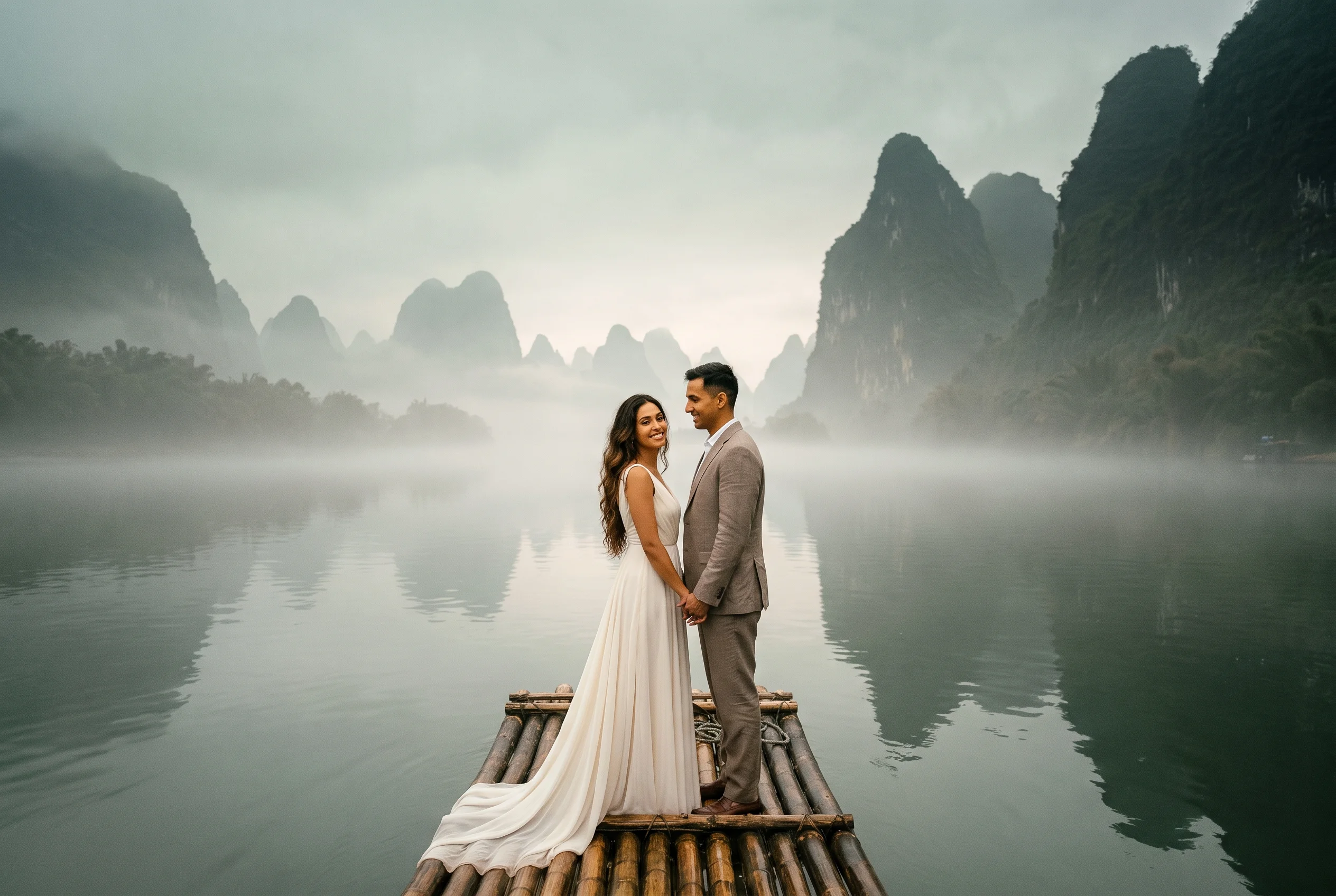
Guilin and the Li River — Karst Mountains at First Mist
The Li River between Guilin and Yangshuo passes through a karst landscape that has no equivalent anywhere on earth. Limestone peaks rise 200 metres from the river plain in shapes that defy the expectations of geology — rounded, twisted, sheer, forested, bare — in a sequence that runs for eighty kilometres. The Chinese poet Han Yu wrote that the landscape was "like a jade hairpin," and for once the poetry is not exaggeration.
The portrait move is to take the first bamboo raft down the river at dawn, when the overnight mist has not yet burned off and the karst peaks emerge from the fog like ink drawings materialising on silk paper. The light at this hour is soft, diffuse, and slightly cool — the mist filters the sun into an omnidirectional glow that flatters skin and turns the river surface into a mirror of grey-green. The couple on the raft, the karst peaks rising from the mist on both sides, the river carrying their reflection, makes a frame that looks like a Song Dynasty scroll painting with two people standing in it. This is the most painterly light in China, and it exists for about forty minutes before the sun burns through the mist and the magic is gone.
The hour that matters: 5:45 to 7:00 AM, April through October. The mist is thickest in spring and after overnight rain. By 8 AM, the sun is high enough to break the mist and the light goes flat and directional. The bamboo rafts launch at first light from both Guilin and Yangshuo; book the night before.
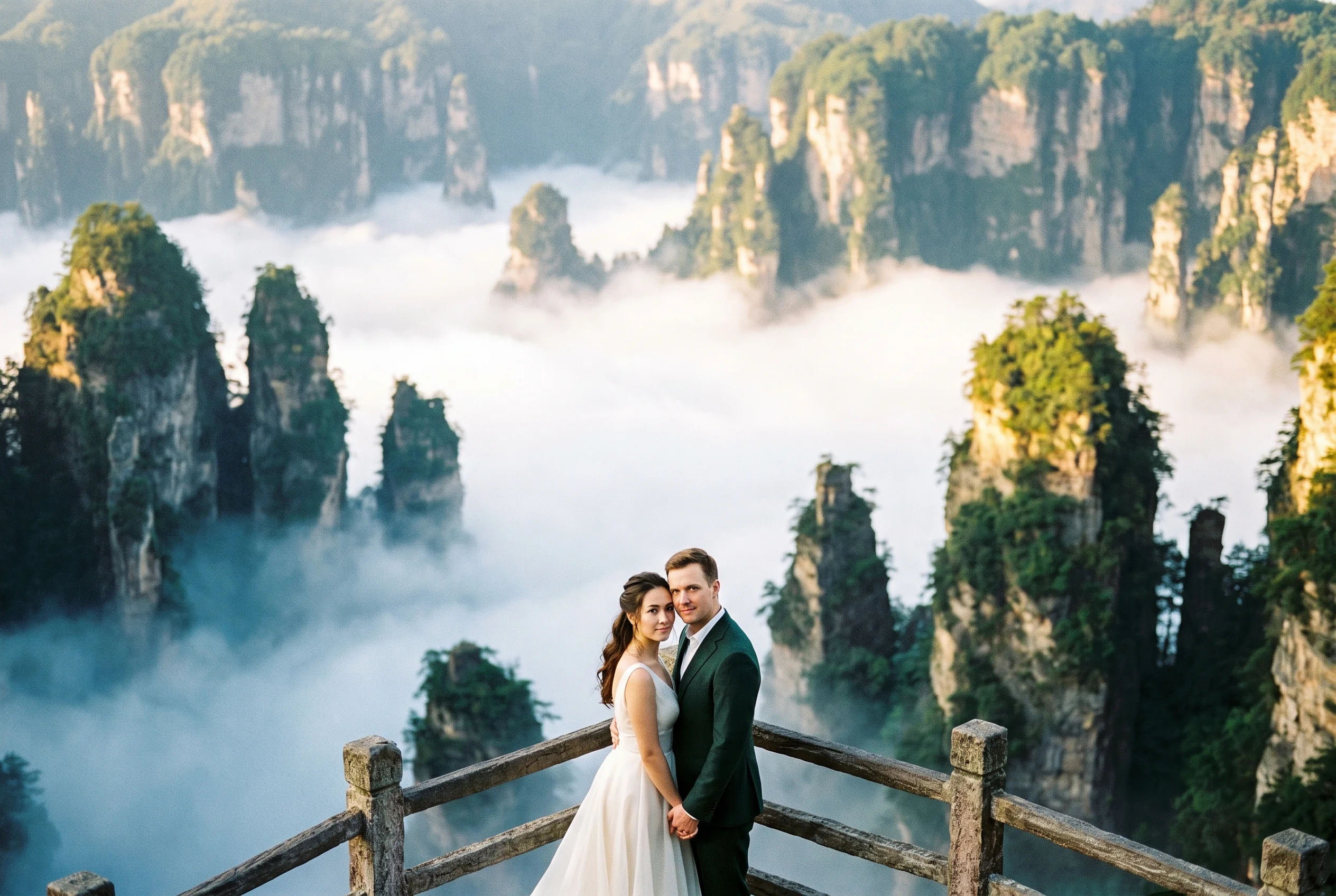
Zhangjiajie — Stone Pillars Above the Clouds
Zhangjiajie is the forest of stone pillars that inspired the floating mountains in Avatar — 3,000 quartzite columns rising from a subtropical valley, some over a kilometre tall, covered in vegetation that clings to their sheer faces. The park's most extraordinary condition is the sea of clouds: after an overnight rain, the valley fills with cloud while the pillars' summits rise above it, and the landscape becomes an archipelago of stone islands in a white sea.
The portrait move is to take the Bailong elevator — the world's tallest outdoor lift, 326 metres — to the summit plateau at dawn, after an overnight rain, and shoot from the overlook as the cloud sea fills the valley below. The light at this hour is warm where it hits the pillar tops and cool in the cloud sea below, and the contrast is what gives the frame its depth. The couple placed at an overlook railing, the stone pillars and the cloud sea behind them, reads as a portrait set in a landscape that looks like another planet. The scale is impossible to convey in words — the pillars are taller than the Eiffel Tower, and there are thousands of them.
The hour that matters: The first hour after sunrise, the day after an overnight rain. The cloud sea is not guaranteed — it requires specific humidity and temperature conditions. Check with the park rangers the evening before. When it happens, it is the most extraordinary landscape condition in China, and possibly in the world. When it doesn't, the pillars are still extraordinary but the frame loses its most distinctive element.
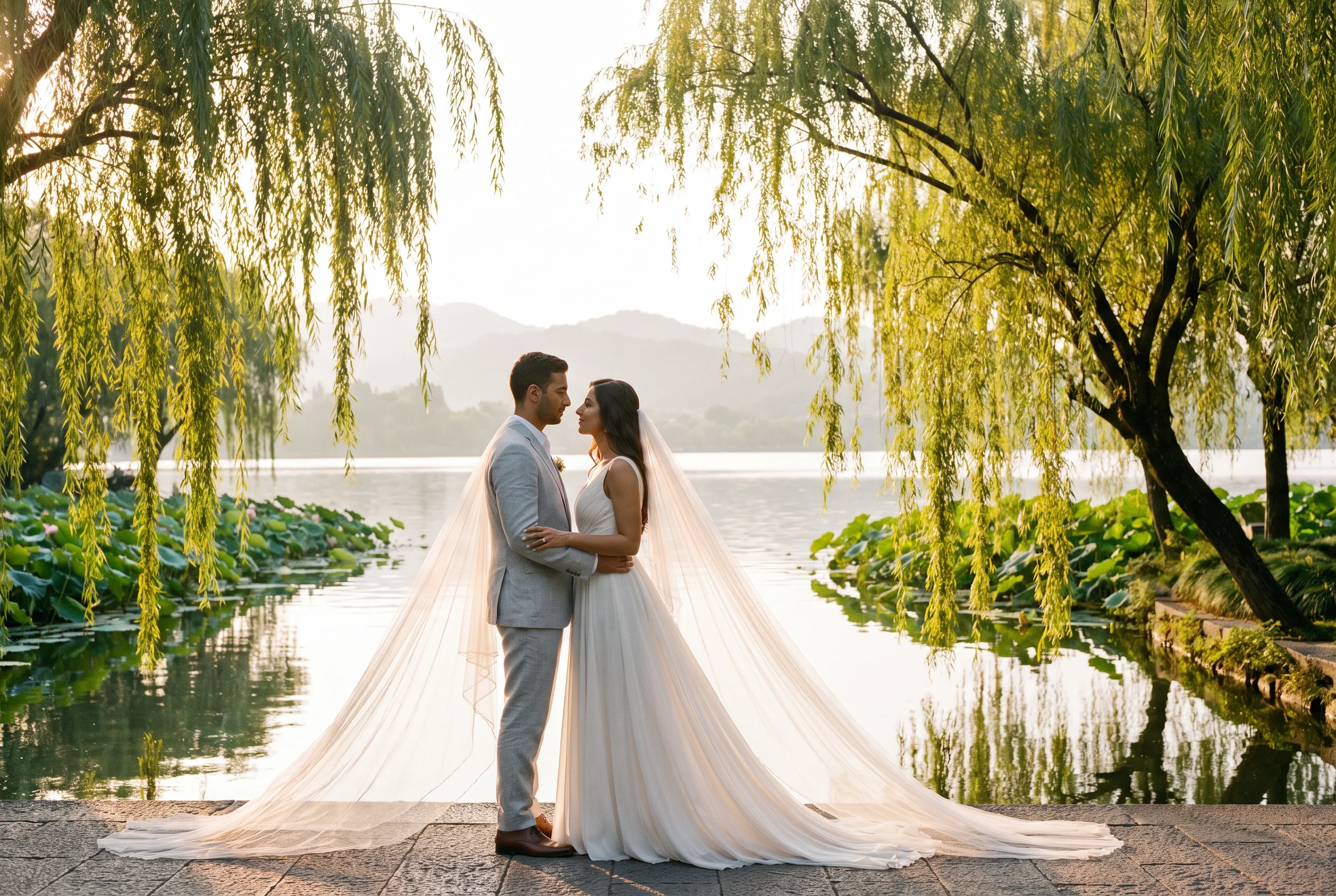
West Lake, Hangzhou — Willows and First Light
West Lake is the most romanticised landscape in Chinese literature — Su Shi, Bai Juyi, and a thousand poets wrote about its willow-lined shores, its causeways, and the quality of its morning mist. The lake is surrounded by hills on three sides and the city on the fourth, and its shores are lined with weeping willows whose branches trail in the water and catch the first light in a way that no other tree species manages.
The portrait move is to work the Su Causeway at dawn, when the willows are backlit by the low eastern sun and their trailing branches create a natural frame of golden-green filaments around the couple. The light at this hour is warm, low, and directional — it rakes through the willow branches and scatters on the lake surface, creating a quality of light that the Chinese call "broken gold." The couple on the causeway, the willows arching over them and the lake and hills behind, makes a frame that has been painted a thousand times but never photographed with the same intimacy. The lotus beds along the shore add a foreground element in summer, and the broken causeway reflections in the still water double every element.
The hour that matters: 5:30 to 7:00 AM, June through September, when the lotus is in bloom and the willows are at their fullest. The lake is mirror-still before 7 AM — by 8, the tourist boats begin and the surface breaks. The Broken Bridge — the most famous spot on the causeway — is best at the very first light, when the sun clears the eastern hills and hits the willows at a 15-degree angle.
Frequently Asked Questions
Do I need a special permit for Great Wall wedding photography?
The restored sections (Badaling, Mutianyu) require entry tickets and do not allow wedding dresses during peak tourist hours. The wild sections (Huanghuacheng, Jiankou) have no ticket gates but require a local guide — the paths are unmaintained and unsafe without someone who knows the route. Most couples book a local photography guide for the wild sections, who handles access and safety.
How do I get to Zhangjiajie?
Zhangjiajie has its own airport (DYG) with flights from Shanghai, Beijing, and Guangzhou. The park entrance is 40 minutes by car. The Bailong Elevator and Tianmen Mountain cable car are the two primary vertical access points. Plan two full days — the cloud sea requires an overnight, and the pillar overlooks are spread across a large area.
Is the Li River boat trip suitable for a wedding gown?
The bamboo rafts are flat, stable, and sit low on the water — safe for a gown. The larger cruise boats are less photogenic and crowded. Book a private bamboo raft from Xingping, which is the most scenic section of the river. The raft pilot poles the vessel, and you can sit or stand. Bring a change of shoes — the raft deck gets wet.
You don't need to travel the Silk Road to reach these landscapes. Pictaway's atelier crafts cinematic wedding portraits set in China's most iconic locations — from the Great Wall's golden ridges to Zhangjiajie's stone pillars above the clouds — uploaded in moments, delivered in 24 hours. Explore China wedding portraits.
Your China wedding portraits — delivered in 24 hours
Get started