spain · Destination Guide
The Hour of Copper Light: A Spain Wedding Photography Guide
Barcelona's Passeig de Gracia at golden hour, Andalusia's white hill towns, the Alhambra's Generalife gardens, San Sebastian's La Concha bay at sunset, and the Ribera del Duero vineyards — five Spanish locations where light and architecture converge.
Spain is a country where the light has a colour you can name. In Andalusia, it is copper — the warm, slightly reddish quality that comes from sunlight passing through dry air and reflecting off whitewashed walls and terracotta tile. In Barcelona, it is amber — the golden tone that rakes across modernist facades and turns the city's stone into something that glows from within. In San Sebastian, it is silver — the cool, reflective light of the Bay of Biscay that softens everything it touches. No other country offers this range of light quality within a single border, and the result is a destination where the same gown, the same couple, and the same hour produce entirely different portraits depending on which region you choose.
This is a guide to five locations where that light does something specific enough to build a portrait around. Each is iconic — not hidden, not undiscovered, but chosen for the hour when the location transforms from a place into a frame.
Barcelona — Passeig de Gracia at Golden Hour
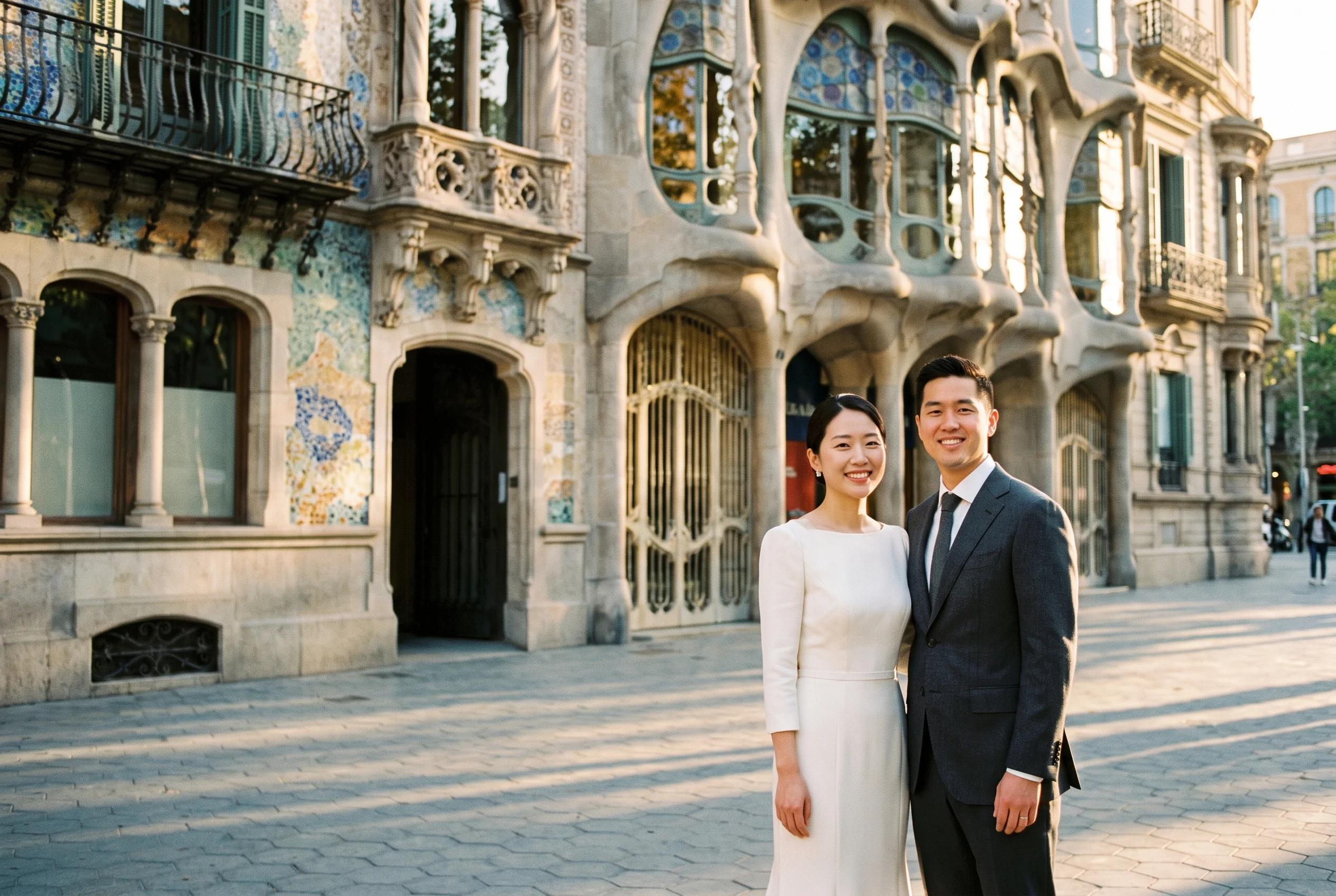
Passeig de Gracia is Barcelona's grandest boulevard, lined with Gaudi's Casa Batllo and Casa Mila, Puig i Cadafalch's Casa Amatller, and the modernist facades that make the street an open-air museum of Catalan architecture. The buildings are organic, sculptural, and covered in detail — broken-tile mosaics, wrought-iron balconies, undulating stone facades — and at golden hour, the western light rakes across all of it, turning every surface into a study in texture and shadow.
The portrait move is to work the sidewalk outside Casa Batllo at the last hour of daylight, when the sun drops low enough to send shafts of warm light through the narrow side streets and illuminate the mosaic facades from the side. The light on the broken-tile surface of Casa Batllo produces a quality of colour — blue, green, and gold tiles catching the warm light at different angles — that no other building in the world produces. The couple, placed on the sidewalk with the facade behind them, reads as a portrait in a city where architecture and art are the same thing. The wide sidewalk provides enough space to work without blocking pedestrian flow, and the building's curves provide a natural frame that straight facades cannot.
The hour that matters: The last 45 minutes before sunset, when the western sun rakes across the facades. Casa Batllo faces northwest, so it catches the last light directly. By sunset, the light is gone from the facade and the street is in shadow. June and September give the best light angle — the sun sets far enough north to illuminate the facade fully.
Andalusia — The White Hill Towns
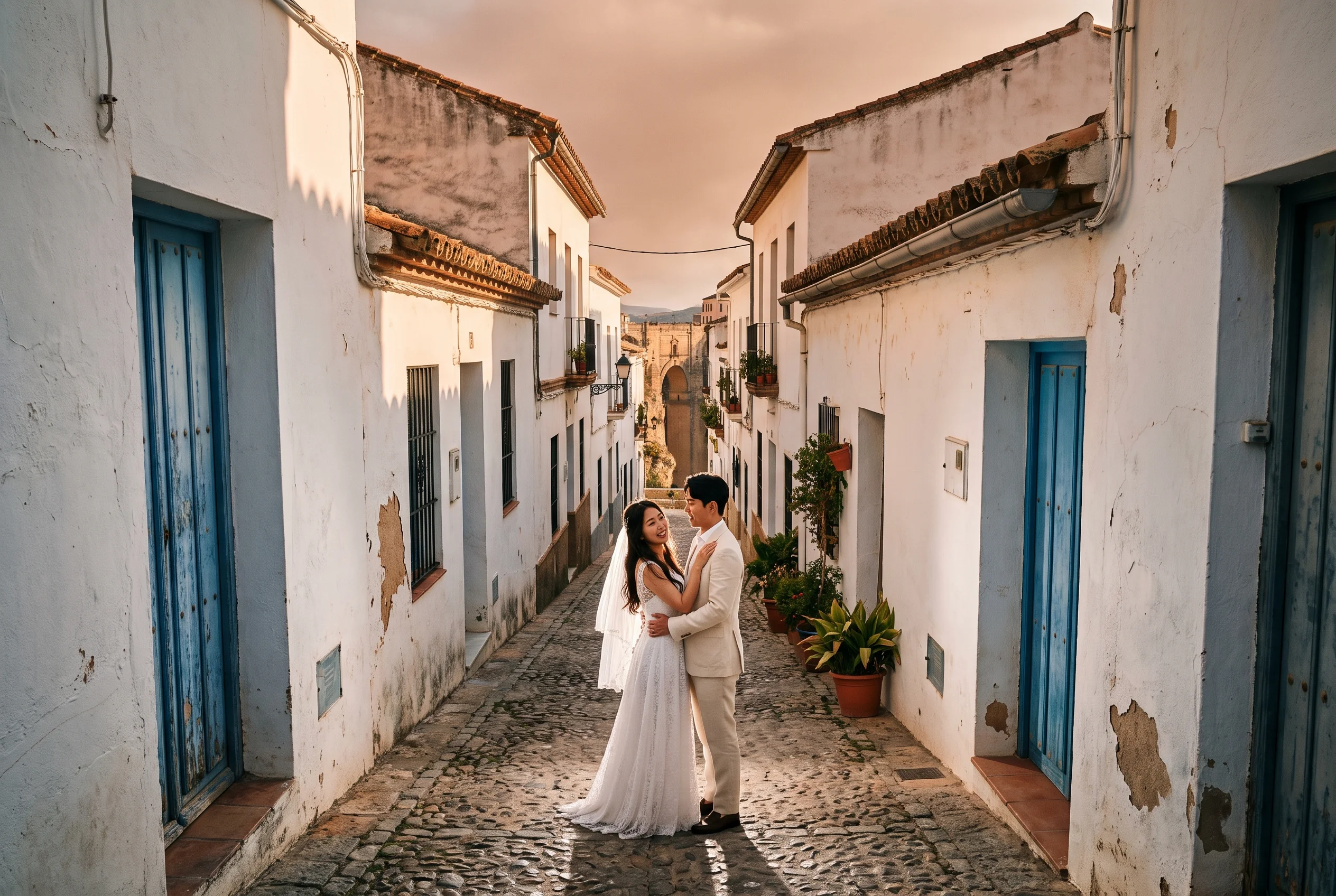
The white towns of Andalusia — Ronda, Mijas, Frigiliana — are villages of whitewashed houses stacked on hilltops in southern Spain, with narrow cobblestone streets, blue-painted doors, and red-tile roofs. Ronda is the most dramatic: the town is split in two by a 100-metre gorge, the Tajo, with a stone bridge spanning the chasm and white houses clinging to both cliff edges. The light in these towns is the copper light that defines Andalusia — warm, slightly reddish, reflected off whitewashed walls that bounce it into every shadow.
The portrait move is to work the narrow streets above the gorge in Ronda at the hour when the western sun sends shafts of light between the buildings and the whitewashed walls reflect it into the shadows. The light in these streets is omnidirectional — warm from the direct sun, warm from the wall reflections, and soft enough to flatter skin without a fill light. The couple, placed in a cobblestone alley with white walls on both sides and blue-painted doors behind them, reads as a portrait that could only be made in Andalusia. The gorge, visible from the cliff-edge streets, provides a dramatic background element that the other white towns cannot match.
The Alhambra — Generalife Gardens
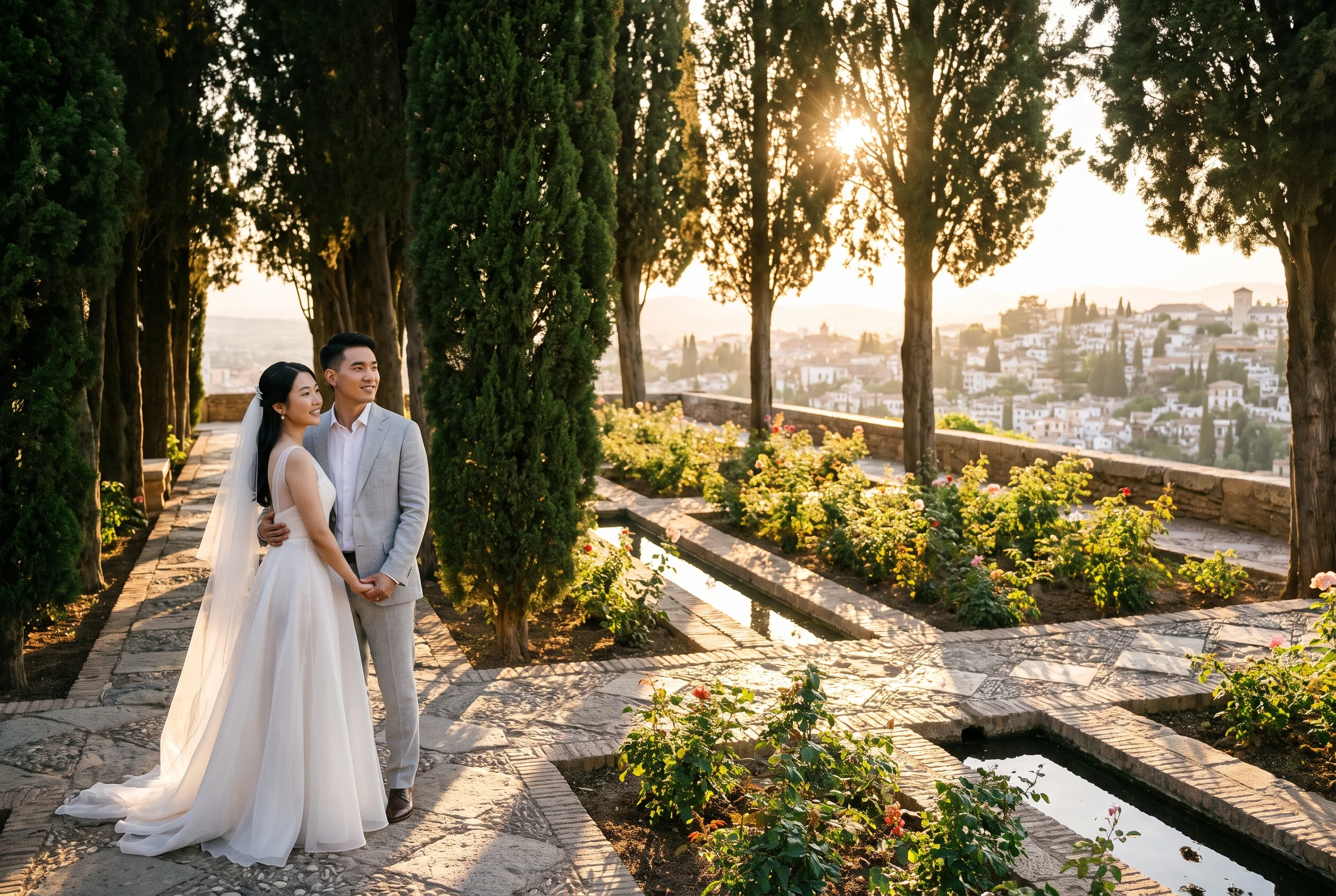
The Alhambra is the Nasrid palace complex on a hill above Granada, and the Generalife is its summer palace garden — a series of terraced courtyards with cypress hedges, rose bushes, stone channels of running water, and pavilions overlooking the city below. The gardens are the most refined landscape architecture in Spain, and the light that moves through them is filtered, dappled, and constantly shifting as the cypress hedges cast moving shadows on the stone paths.
The portrait move is to work the upper terraces of the Generalife at the last hour before sunset, when the western light comes through the cypress trees and creates a dappled pattern on the stone paths and the couple. The light is warm but soft — filtered through the hedges — and the running water in the stone channels catches the light and reflects it upward onto the couple's faces. The couple, placed on the path with the cypress arcade behind them and the city of Granada visible below, reads as a portrait in a garden that has been refined for 700 years.
San Sebastian — La Concha Bay at Sunset
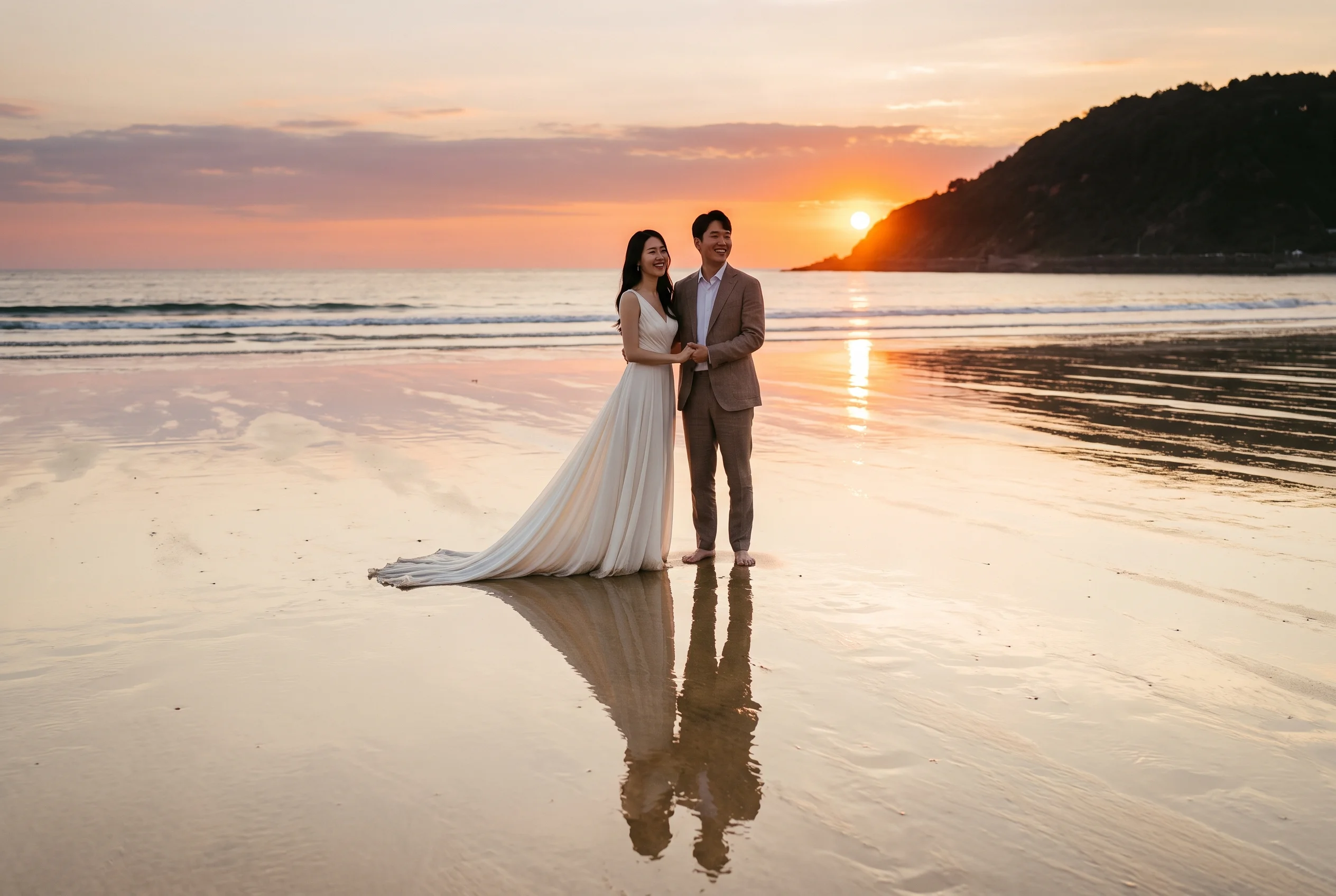
La Concha is the crescent-shaped bay that defines San Sebastian, with a wide sand beach, a promenade, and the Monte Igueldo headland rising at the western end. The bay faces west, which means the sunset drops into the sea directly at the end of the beach — a condition that almost no other Spanish beach offers. The light at sunset is the silver light of the Bay of Biscay — cool, clear, and slightly metallic — and the wet sand at low tide mirrors the sunset and the headland.
The portrait move is to work the waterline at the western end of the beach, where the sand is widest at low tide and the sunset drops behind Monte Igueldo. The light rakes across the wet sand, turning the receding tide into a mirror that doubles the couple and the sunset. The headland provides a natural frame that narrows the composition and gives the portrait a structure that the open beach cannot. The couple, placed at the waterline with the sunset behind them and the wet sand mirror below, reads as a portrait at the edge of a bay that was designed by geography for this exact frame.
Ribera del Duero — The Vineyards at First Light
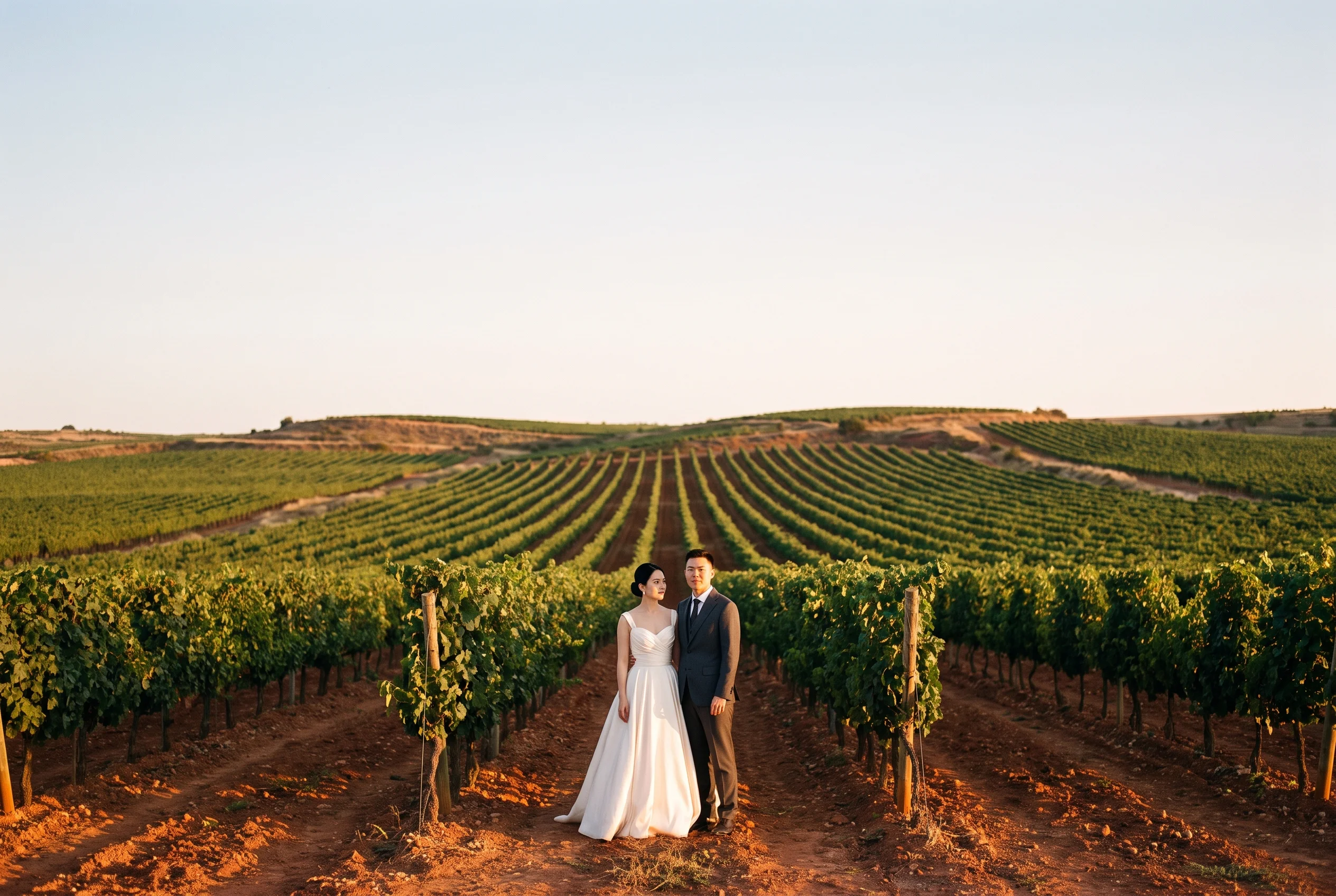
Ribera del Duero is the wine region on the high plateau of Castilla y Leon, where Tempranillo vines stretch in linear rows across rolling hills at 900 metres altitude. The landscape is spare — rows of vines, red soil, and a sky that is enormous because the plateau is flat. At dawn, the light is the clearest in Spain — the altitude and the dry air produce a quality of light that is sharp, warm, and shadowless for the first 30 minutes.
The portrait move is to work the vine rows at the moment the sun clears the eastern horizon. The low light rakes along the rows, giving the vines a dimensional texture, and the red soil reflects warm light upward. The couple, placed at the end of a vine row with the linear perspective leading the eye to the horizon, reads as a portrait in a landscape that is geometric — the rows of vines create natural leading lines that no other Spanish location produces. The altitude means the air is cool even in summer, and the dawn light is the most forgiving of the day.
Frequently Asked Questions
Do I need a permit for wedding photography at the Alhambra?
The Alhambra requires timed-entry tickets, and professional photography with tripods or lighting equipment requires a specific permit from the Patronato de la Alhambra. Personal portrait photography with a handheld camera is permitted within the Generalife gardens during visiting hours. Book late-afternoon tickets well in advance — the Alhambra limits daily visitors and sells out.
Which is better for wedding photos: Ronda or the smaller white towns?
Ronda offers the gorge, which is the most dramatic single element in any white town. But Ronda is also the most visited, and the narrow streets are crowded by 10 AM. Frigiliana and Mijas are less crowded and have the same whitewashed architecture, but without the gorge. Most couples choose Ronda for the iconic frame and accept the crowds by arriving before 8 AM.
When are the Ribera del Duero vineyards at their best?
May and June, when the vines are green and the soil is still moist from spring rains. July brings heat and the vines begin to turn golden. September offers the harvest — the vines are amber and the light is softer, but the vineyards are busy with workers. The high altitude means frost is possible in April and October, so confirm weather before booking.
You don't need to chase the copper light across Andalusia to stand in these frames. Pictaway's atelier crafts cinematic wedding portraits set in Spain's most iconic locations — from Barcelona's modernist boulevards to the vineyards of Ribera del Duero — uploaded in moments, delivered in 24 hours. Explore Spain wedding portraits.
Your Spain wedding portraits — delivered in 24 hours
Get started