newzealand · Destination Guide
The Long Light: A New Zealand Wedding Photography Guide
Milford Sound's sheer fjord walls at dawn, the peaks of Mount Cook at golden hour, the Wanaka lake tree at first light, the Tongariro volcanic plateau, and the Coromandel coast — five New Zealand locations where the light travels forever.
New Zealand is a country where the light has room to travel. The land is long, narrow, and empty — 5 million people in a country the size of the United Kingdom — and the sky is enormous because there is nothing on the horizon to break it. The light here behaves differently than it does in Europe or Asia: it arrives cleaner, because the air has crossed thousands of kilometres of open ocean, and it stays golden longer, because the low latitude of the southern hemisphere means the sun's angle changes slowly. A golden hour in New Zealand can last 90 minutes, not 30, and this alone makes it one of the finest wedding photography destinations on earth.
Milford Sound — The Fjord at Dawn
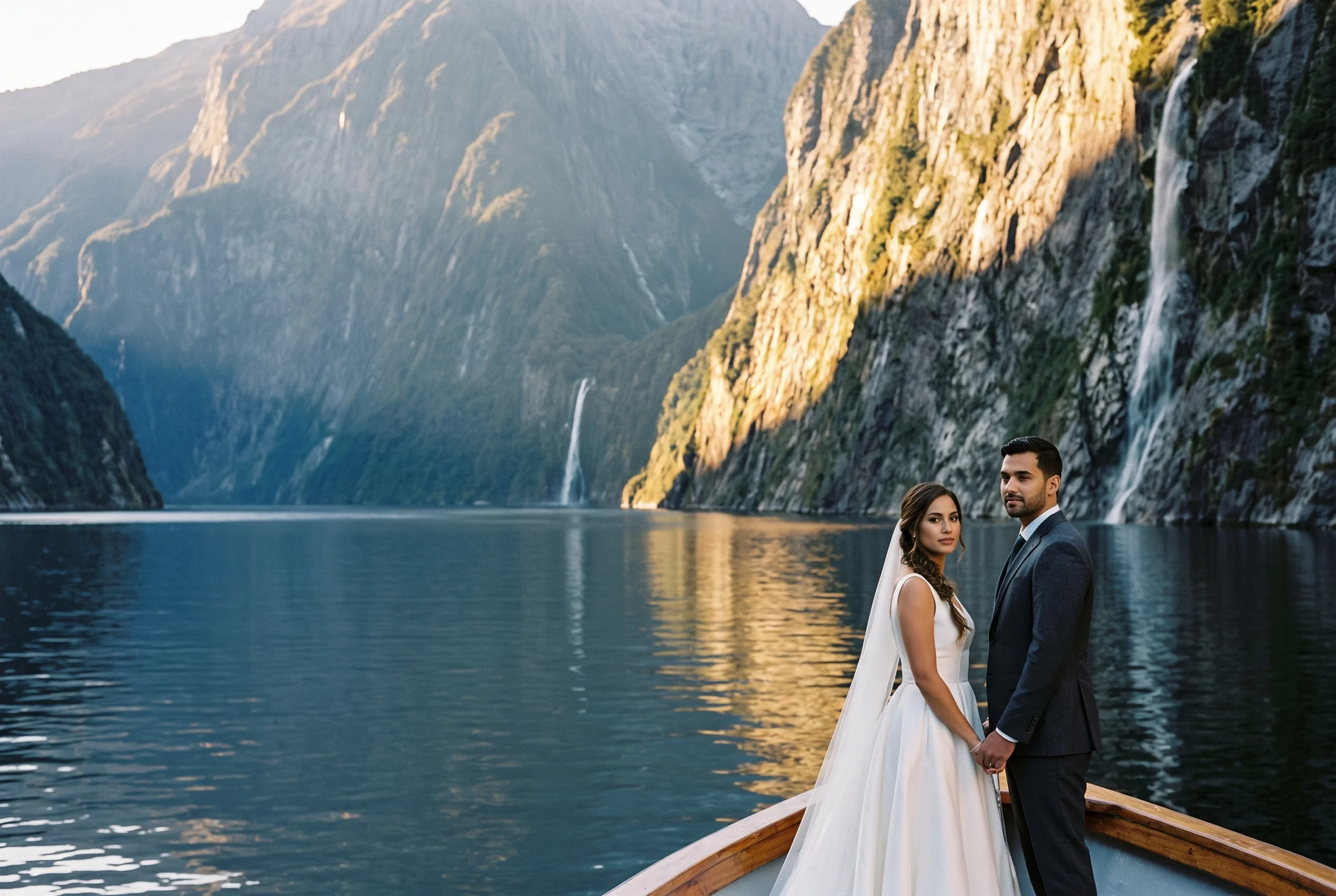
Milford Sound is the most famous fjord in New Zealand — a 15-kilometre inlet of the Tasman Sea between vertical cliffs that rise 1,200 metres from the water. The cliffs are sheer grey schist, streaked with waterfalls that drop from the rainforest above, and the water is dark, deep, and still at dawn. The fjord faces east, which means the first light enters the sound as a horizontal beam that travels along the water surface, lighting the cliff faces from the side while the water remains in shadow.
The portrait move is to be on the water at dawn — on a charter boat or kayak — positioned at the entrance of the sound where the cliffs are tallest. The first light hits the eastern cliff faces warm and direct, while the western wall and the water remain in cool blue shadow. The contrast — warm cliff, cool water, dark sky — gives the frame a layered quality that no inland landscape produces. The couple, positioned on the boat's bow with the cliff face rising behind them, reads as a portrait in a landscape that feels like it was carved yesterday — which, geologically, it was.
The hour that matters: The first 30 minutes after sunrise. The fjord is narrow, so the direct sun only reaches the water for about 45 minutes before the cliffs block it. By 8 AM, the sound is in shadow and the light is flat. The water is calmest at dawn before the tourist boats begin running at 9 AM. Charter a private dawn boat from Milford Sound — the drive from Te Anau is 2 hours, so leave at 3:30 AM.
Mount Cook — The Hooker Valley at Golden Hour
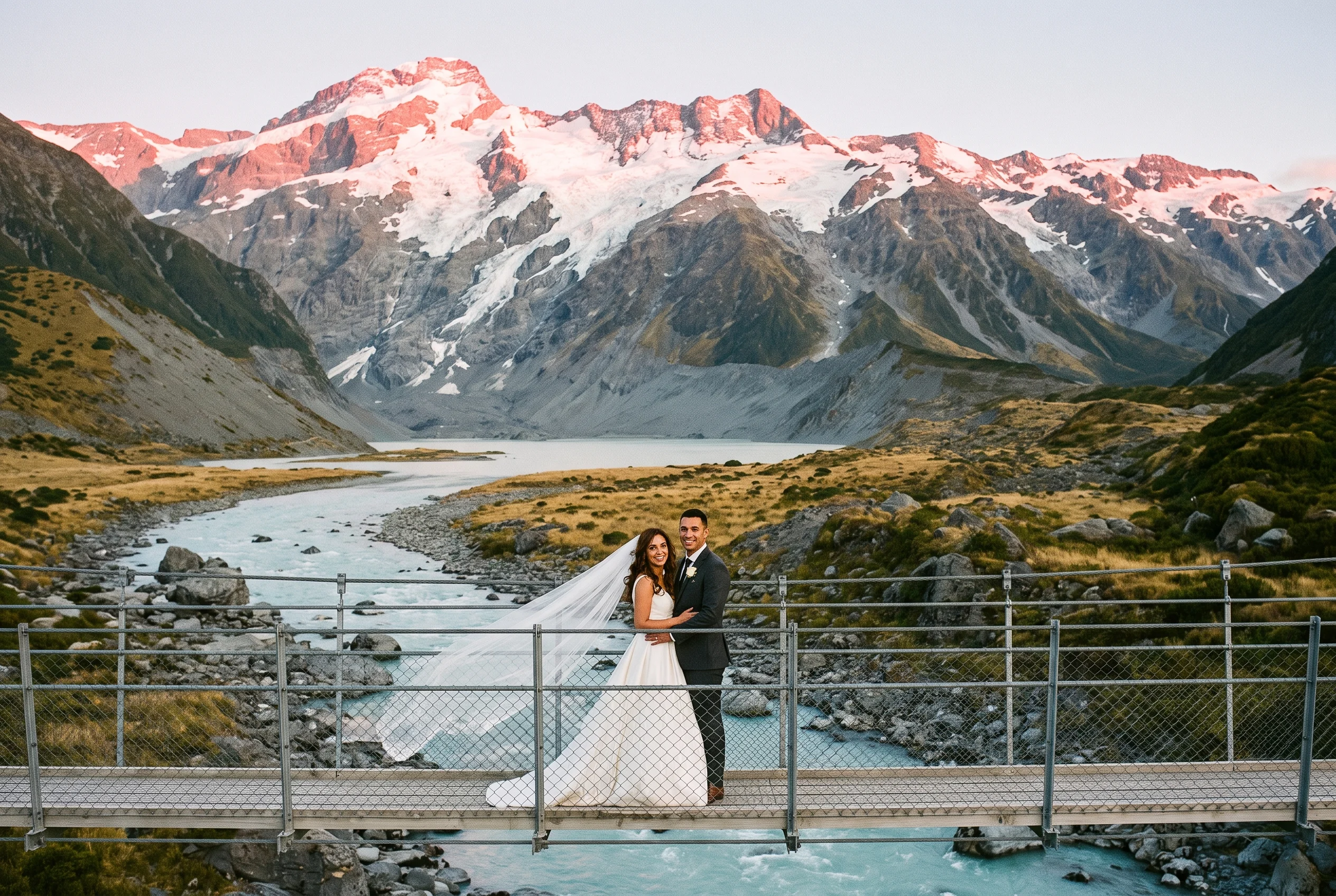
Mount Cook (Aoraki) is New Zealand's highest peak at 3,724 metres, and the Hooker Valley is the alpine valley that leads to its base — a landscape of grey moraine, glacial streams, and the white ice of the Hooker Glacier, with the peak itself rising at the valley's head. The valley floor is flat and accessible by a 3-hour return walking track that crosses three swing bridges over glacial rivers, and the views from every section of the track are the most dramatic alpine landscape in New Zealand.
The portrait move is to work the second swing bridge at the last hour of daylight, when the western sun turns Mount Cook's summit a warm pink that climbers call "alpenglow" and the valley floor fills with warm golden light. The couple, placed on the bridge with the peak behind them and the glacial river below, reads as a portrait in a landscape that feels Himalayan. The alpenglow on the summit lasts about 15 minutes and is the most sought-after light in New Zealand alpine photography.
Wanaka — The Lone Tree at First Light
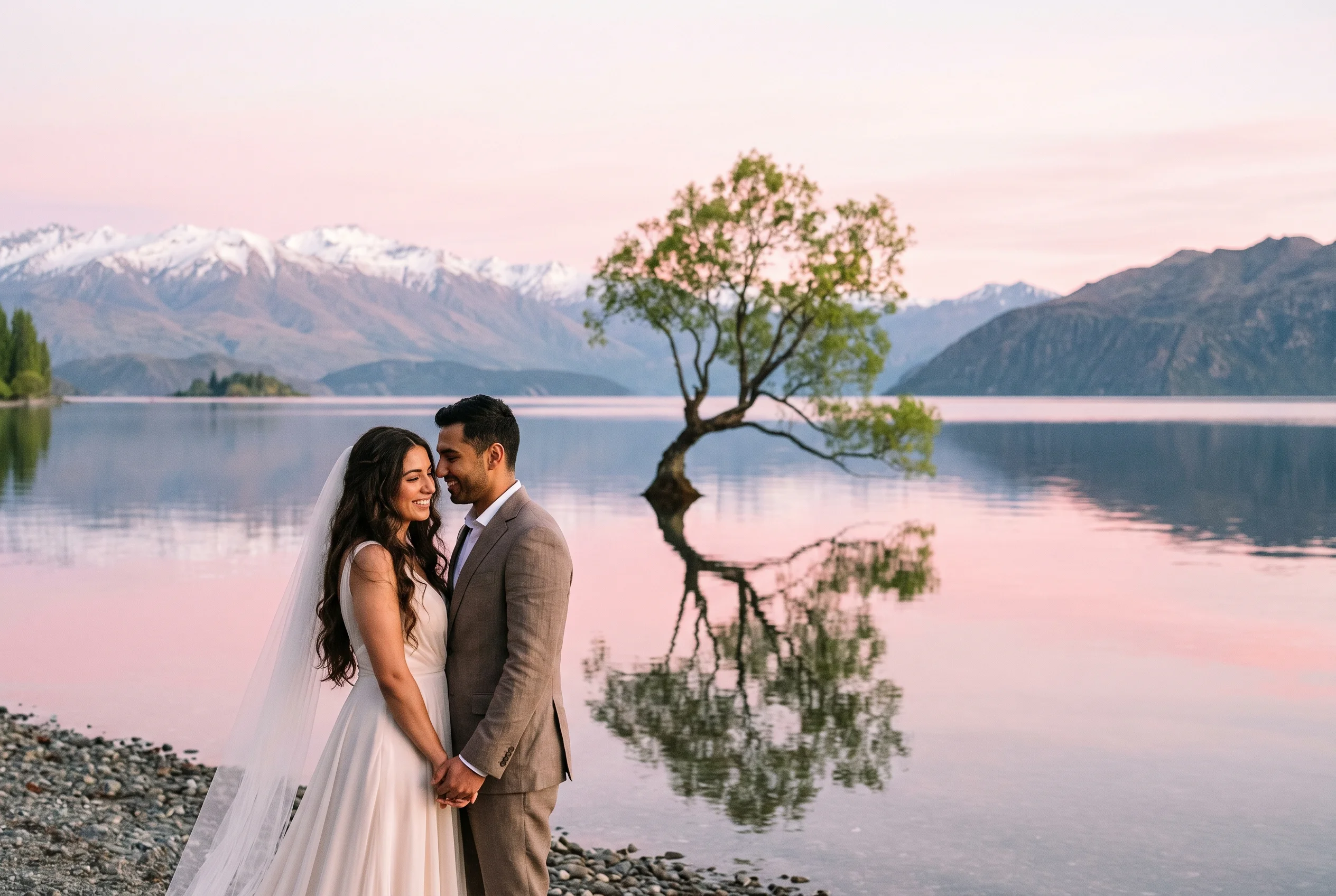
That Wanaka Tree — the single willow growing in Lake Wanaka — is the most photographed tree in New Zealand. It stands alone in the shallows of the lake, 30 metres from the shore, with the peaks of Mount Aspiring National Park rising behind it across the water. At dawn, the lake is mirror-still and the tree is silhouetted against the first light, which turns the sky and the water the same shade of pink.
The portrait move is to work the lakefront at the moment the first light touches the peaks across the lake. The couple, placed on the shore with the tree in the water behind them and the peaks reflected in the lake, reads as a portrait that contains three elements — the couple, the tree, and the mountain — that together form the most iconic New Zealand composition. The still water at dawn is essential; by 8 AM, the wind picks up and the mirror breaks. The tree is in shallow water, so a photographer willing to wade can shoot from the water side, putting the couple between the camera and the mountain.
Tongariro — The Volcanic Plateau
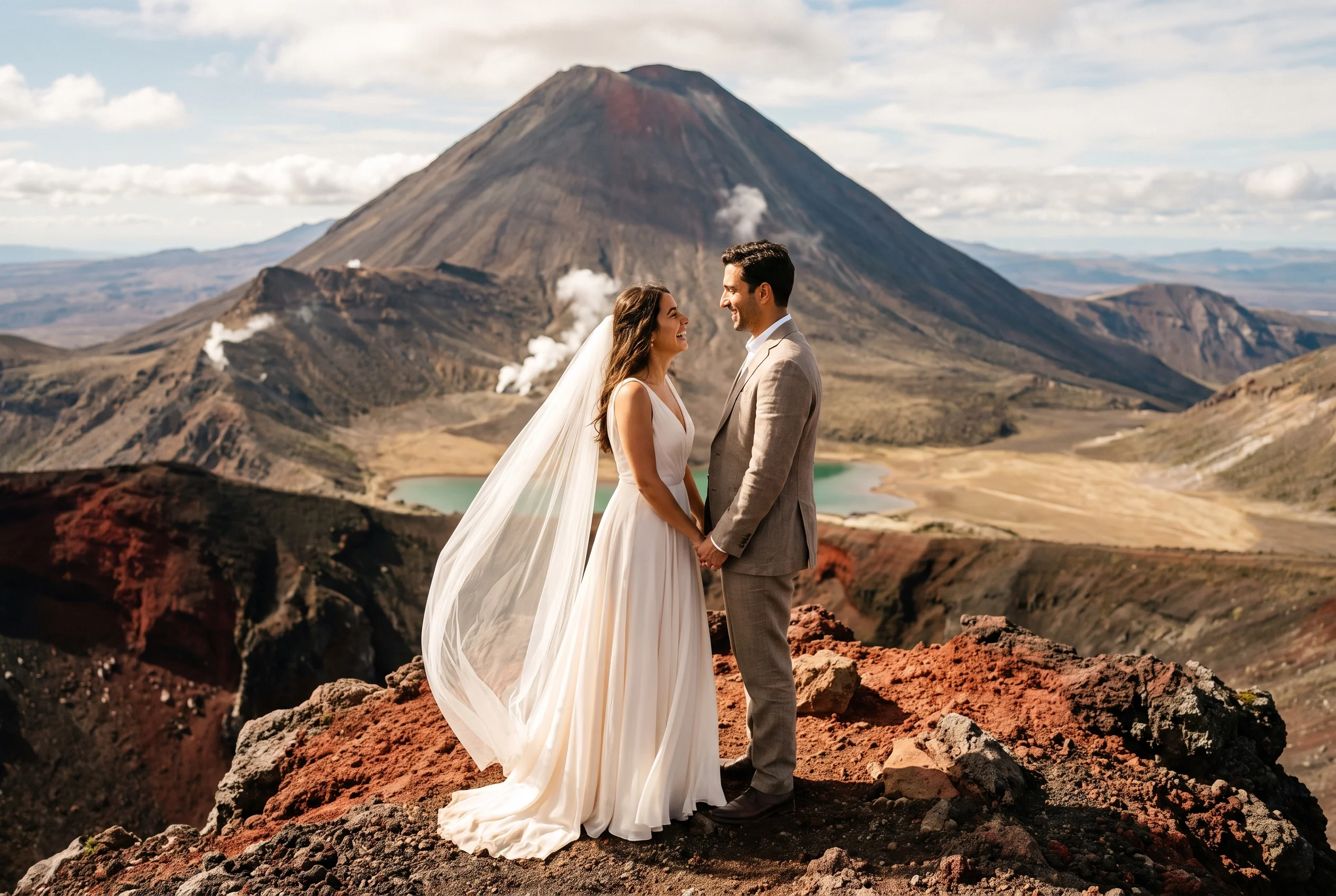
Tongariro National Park is the volcanic plateau in the centre of the North Island — a landscape of red and black volcanic rock, emerald crater lakes, and three active volcanoes: Tongariro, Ngauruhoe, and Ruapehu. The Tongariro Alpine Crossing is the most famous day walk in New Zealand, and the landscape along the crossing is the most otherworldly in the country — the red craters, the steam vents, and the emerald lakes that sit in volcanic craters are colours that do not exist in non-volcanic landscapes.
The portrait move is to work the South Crater section of the crossing at mid-morning, when the sun is high enough to illuminate the crater floor and the volcanic colours are at their most saturated. The red volcanic rock catches warm light, the emerald lakes are at their most vivid, and the volcanic plateau stretches to the horizon in every direction. The couple, placed on the crater rim with Ngauruhoe's cone behind them and the red rock below, reads as a portrait on a landscape that feels like another planet.
Cathedral Cove — The Coromandel Coast
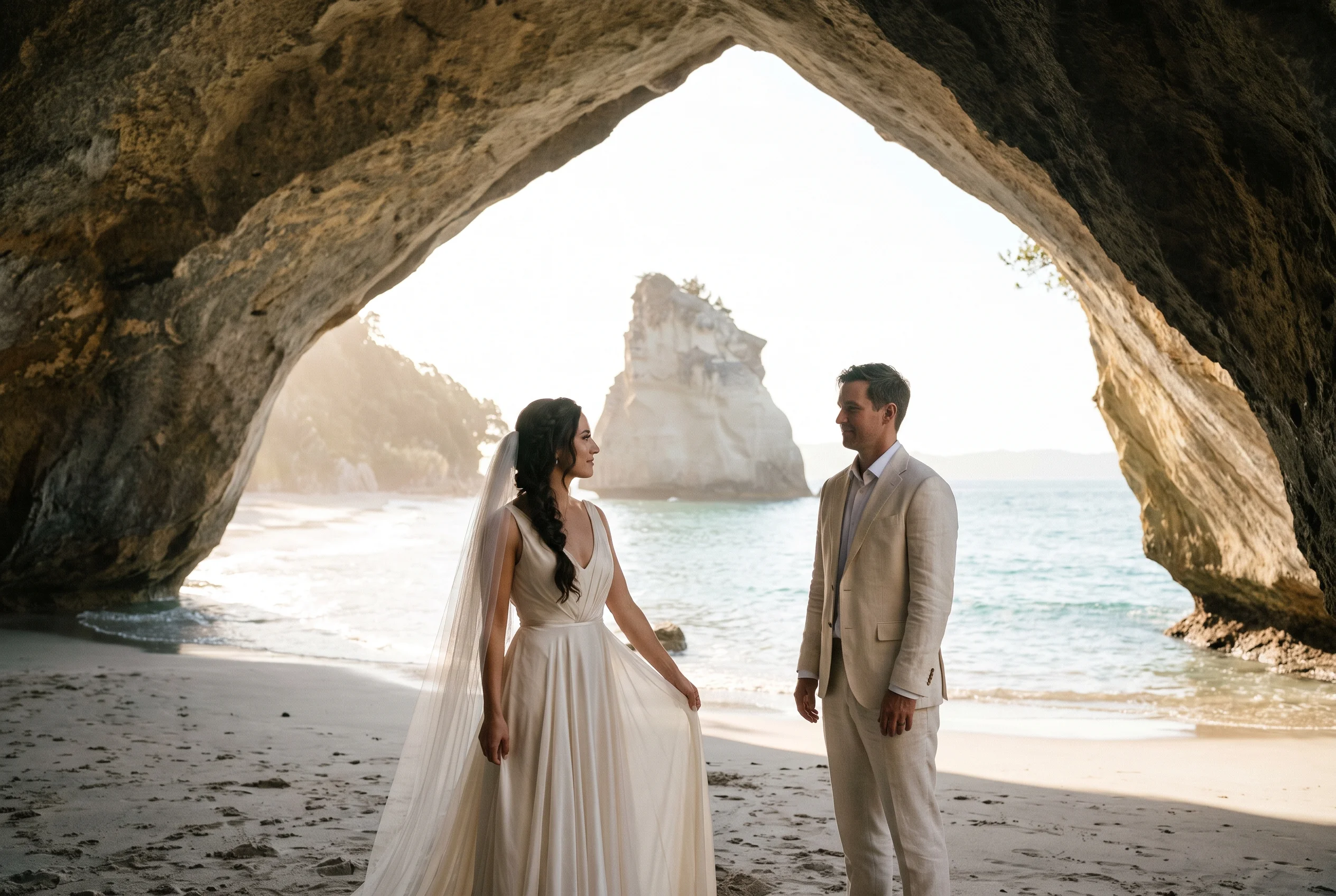
Cathedral Cove is a sea cave on the Coromandel Peninsula — a natural archway in white limestone that connects two beaches, with a massive pyramid-shaped rock standing in the water at the cave's entrance. The cove is accessible only by foot (a 30-minute walk from the car park) or by boat, and the white sand, the turquoise water, and the arched rock create the most graphic coastal composition in New Zealand.
The portrait move is to work inside the cave at the hour when the western sun sends light through the archway, illuminating the white sand and the water from the far side. The light through the arch creates a natural spotlight effect — the couple in the cave's mouth is lit by warm reflected light from the sand, while the cave interior holds cool shadow. The pyramid rock, visible through the arch, provides a focal point that anchors the composition.
Frequently Asked Questions
How do I get to Milford Sound for a dawn shoot?
Milford Sound is a 2-hour drive from Te Anau, the nearest town with accommodation. The road is narrow and winding — do not attempt it in the dark without experience. Most couples stay overnight in Te Anau, leave at 3:30 AM, and arrive at Milford by 5:30 AM for a 6 AM dawn charter. Alternatively, scenic flights from Queenstown to Milford are available but weather-dependent.
Is the Hooker Valley track suitable for formal wear?
The track is well-maintained but alpine — packed gravel, swing bridges, and exposed sections. The correct approach is to hike in appropriate footwear with the gown packed, change at the second bridge, and shoot for 30 minutes before changing back. The walk is 45 minutes each way from the White Horse Hill car park. Do not attempt in strong wind — the swing bridges are exposed.
Can you visit Cathedral Cove year-round?
Yes, but the walk is steep and can be slippery in winter (June-August). The cove is subject to ocean swell — at high tide and large swell, the beach inside the cave is inaccessible. Summer (December-February) offers the most reliable conditions. Water taxis from Hahei Beach are an alternative to the walk, but they do not operate in rough conditions.
You don't need to drive three hours in the dark to stand in these frames. Pictaway's atelier crafts cinematic wedding portraits set in New Zealand's most iconic locations — from Milford Sound's fjord walls to the Hooker Valley's alpenglow — uploaded in moments, delivered in 24 hours. Explore New Zealand wedding portraits.
Your New Zealand wedding portraits — delivered in 24 hours
Get started