dubai · Destination Guide
Where the Sand Turns to Glass: A Dubai Wedding Photography Guide
The golden dunes of the Dubai Desert Conservation Reserve at dawn, the Marina skyline at blue hour, the Palm Jumeirah crescent at sunset, the historic Al Fahidi district, and the Miracle Garden — five Dubai locations where desert meets futurism.
Dubai is a city that did not exist 50 years ago and now has the tallest building on earth. The urban landscape is a wall of glass and steel rising from flat desert, and the contrast between the natural landscape — sand, sky, and the flat horizon of the Arabian Gulf — and the built environment is the most extreme in any city in the world. The light here is desert light: dry, clear, and harsh for most of the day, but at the edges — dawn and dusk — it turns the color of molten metal. The sand reflects it upward, the glass towers refract it, and the gulf absorbs it, and the result is a destination where the same hour produces three different portraits depending on whether you are in the desert, the city, or on the water.
The Dubai Desert — Dunes at First Light
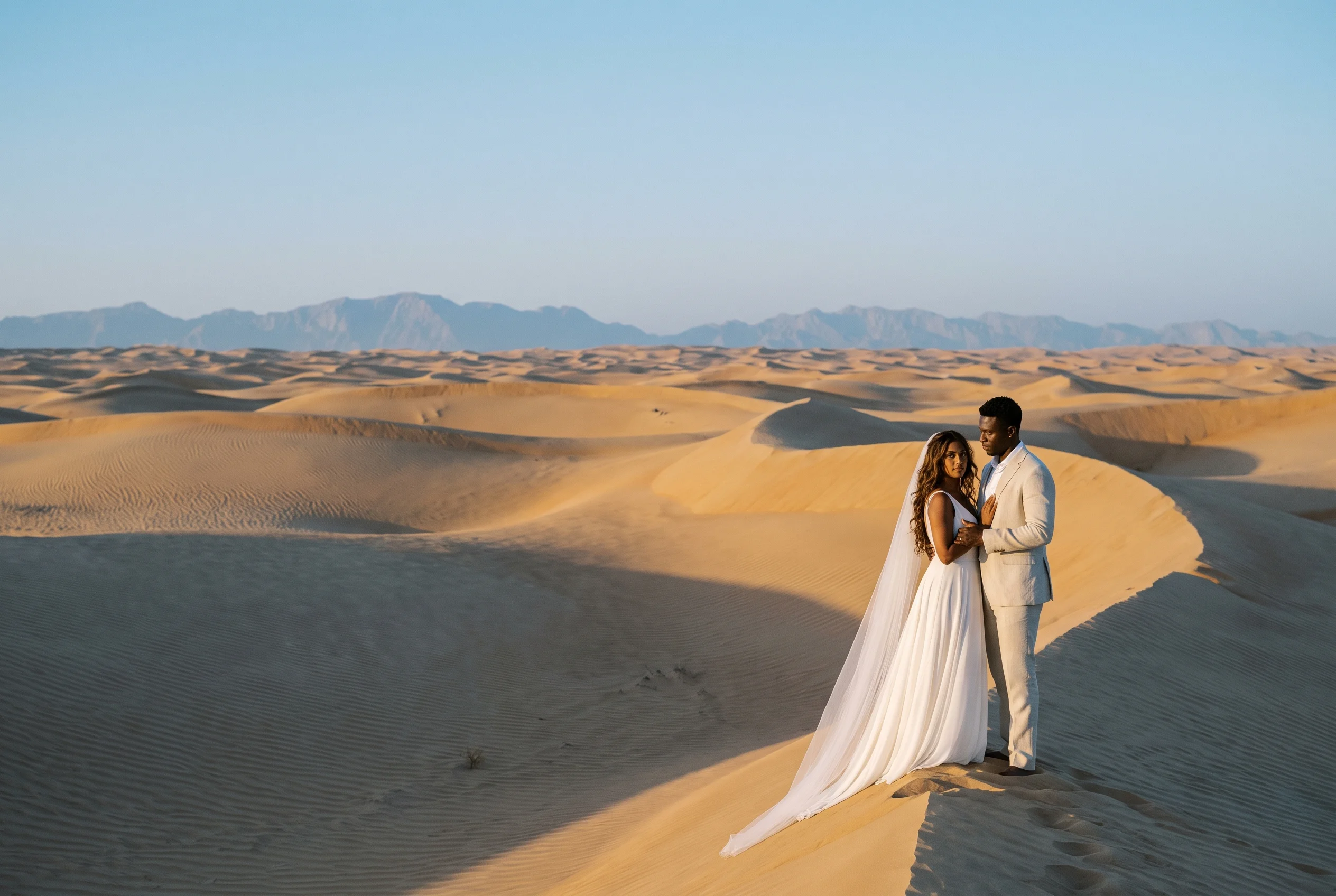
The Dubai Desert Conservation Reserve is a 225-square-kilometre protected area 45 minutes from the city centre, where the dunes are undisturbed and the sand is a deep, warm gold. The dunes here are large — 20 to 50 metres high — with sharp ridgelines that catch the first light like the edge of a blade. The sand is soft and wind-rippled, and at dawn, before the heat shimmer begins, the air is clear enough to see 20 kilometres to the Hajar Mountains.
The move is to be on a dune ridgeline at the moment the sun clears the eastern horizon. The light rakes across the dune face, turning the sand from grey to gold to amber in the space of five minutes, and the wind ripples on the surface cast micro-shadows that give the sand a texture like fabric. The couple, placed on the ridgeline with the dune dropping away behind them, reads as a portrait on the edge of a landscape that is elemental — just sand, light, and sky. The sand reflects warm light upward from every angle, which fills every shadow and produces a quality of light that is warm, omnidirectional, and impossible to replicate in a studio.
The hour that matters: The first 30 minutes after sunrise, approximately 6:15 AM in winter. By 7:30 AM, the heat shimmer begins and the air goes soft. By 9 AM, the light is harsh and the sand is blinding. A 4x4 vehicle is required to reach the interior dunes — hire a desert guide who knows the reserve and can position you on the right ridgeline before dawn.
Dubai Marina — The Skyline at Blue Hour
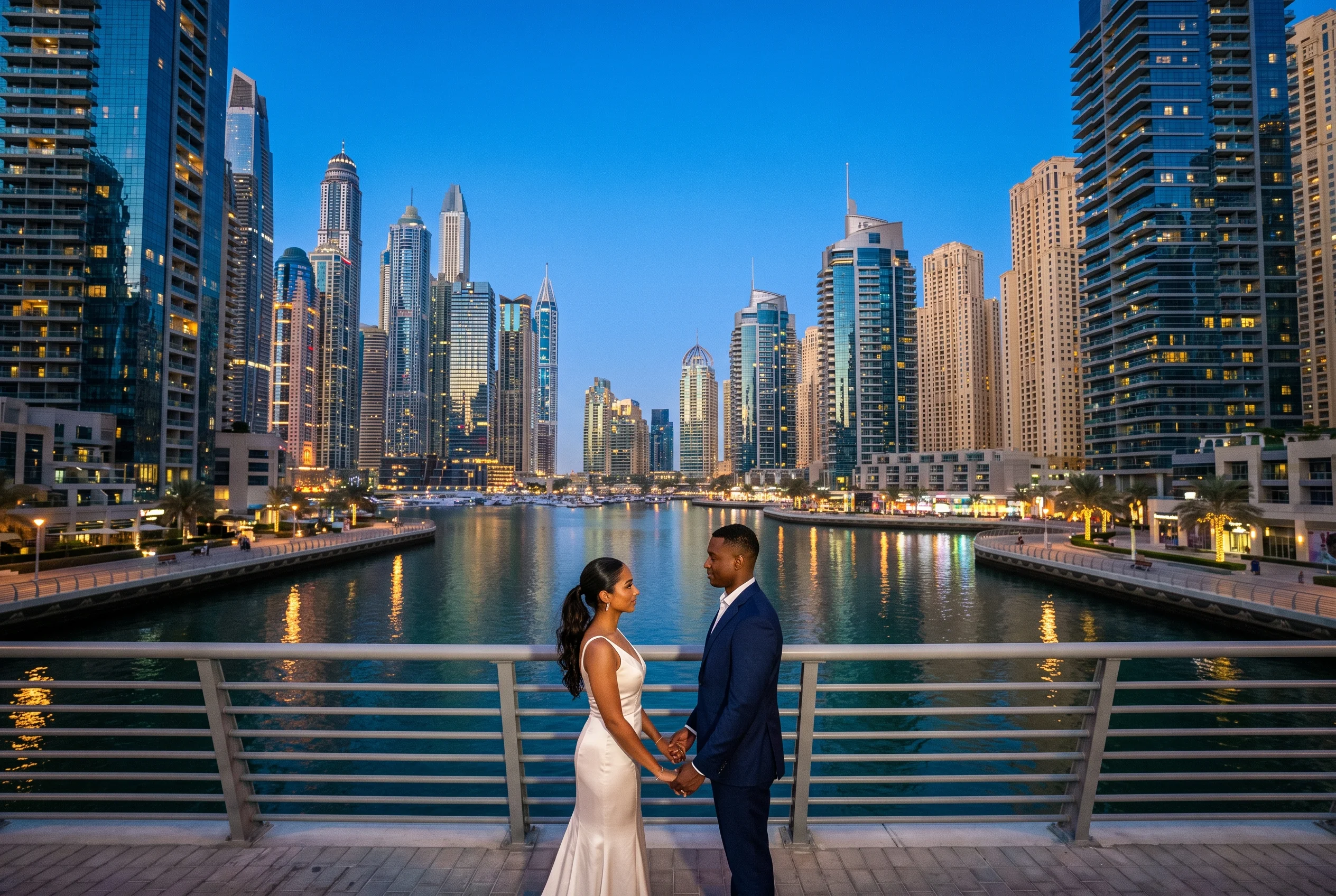
Dubai Marina is the canal district lined with 70+ residential towers, and at blue hour it is the most futuristic urban landscape in the world. The towers are glass — blue, green, and silver — and at blue hour they are lit from within, their warm interior lights contrasting with the cobalt sky and the cool reflections on the canal water. The Marina Walk, the pedestrian promenade along the water, is the camera position.
The portrait move is to work the Marina Walk at the window when the sky is full cobalt and the tower lights are at full brightness. The canal water mirrors the towers, doubling the skyline, and the pedestrian bridge provides an elevated position that puts the couple above the waterline with the towers rising behind them. The colour-temperature contrast between the warm tower lights and the cool sky is the cinematic quality that makes this frame feel like a still from a science fiction film. The couple, placed on the bridge with the canal and the towers behind them, reads as a portrait in a city that looks designed for exactly this frame.
The Palm Jumeirah — The Crescent at Sunset
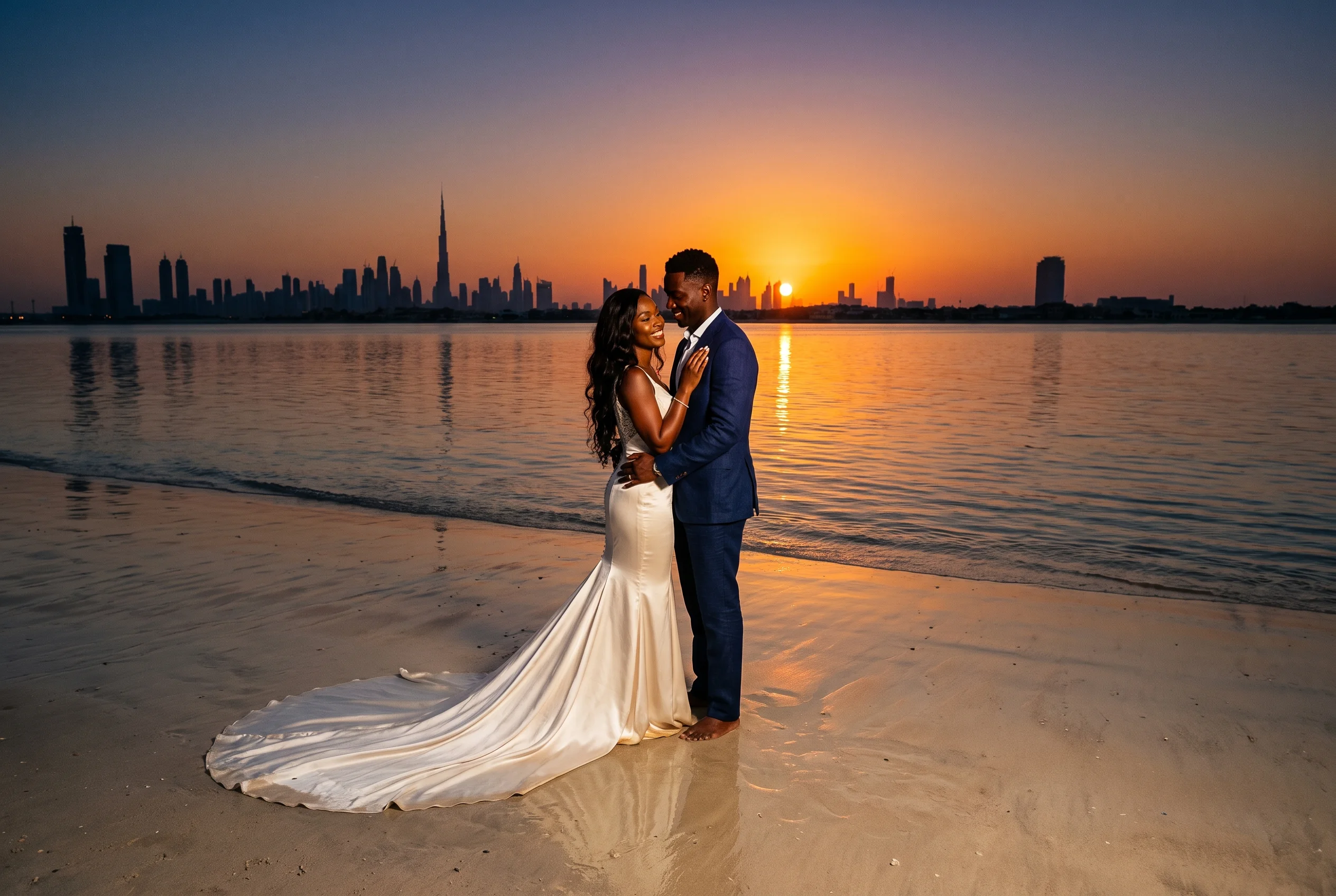
The Palm Jumeirah is the artificial island shaped like a palm tree, and its crescent — the outer breakwater — is a 12-kilometre arc of sand and rock that protects the island from the open gulf. The crescent faces west, which means the sunset drops into the Arabian Gulf directly behind the Dubai skyline, and the combination of sand, sea, and the most dramatic cityscape on earth is unique to this location.
The portrait move is to work the western end of the crescent at the last hour before sunset, when the sun drops toward the gulf and the light rakes across the sand and the water. The couple, placed on the crescent beach with the Dubai skyline across the water behind them, reads as a portrait that contains two Dubais — the natural (sand, sea, sunset) and the built (the skyline of Burj Khalifa and the towers). The light is warm and directional, and the wet sand at the waterline mirrors the sunset and the skyline. The crescent is accessible by car via the monorail bridge, and the western end is the least developed section.
Al Fahidi — The Historic District
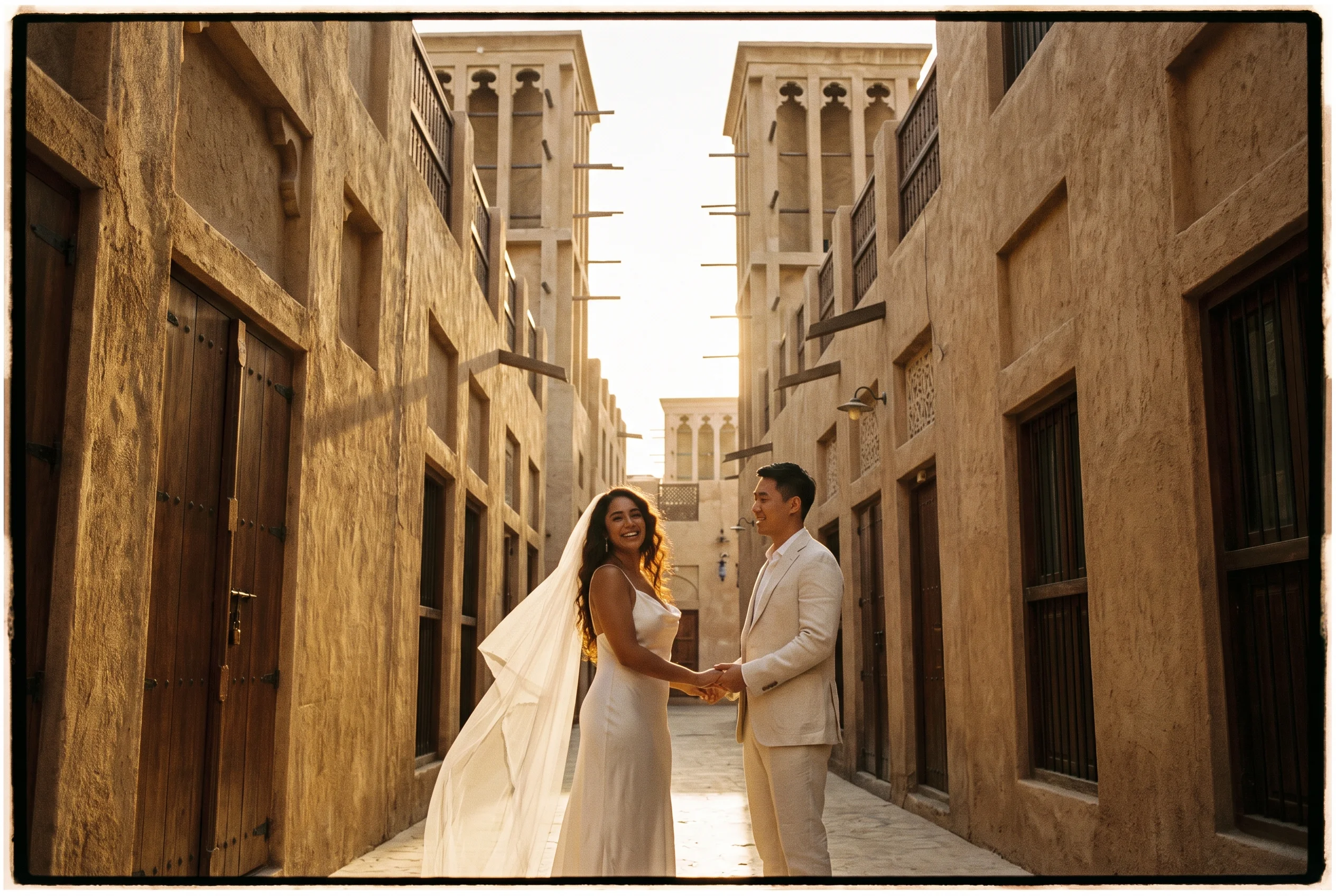
Al Fahidi is the oldest neighbourhood in Dubai — a grid of narrow lanes lined with traditional coral-stone houses with wind towers, the pre-air-conditioning cooling system that is the architectural signature of the Gulf. The district is a contrast to everything else in Dubai: low-rise, earth-toned, and quiet, with walls of warm ochre and doors of teak. The light in the lanes is filtered — the narrow walls create shadow corridors with shafts of direct sun cutting through at angles that change every 15 minutes.
The portrait move is to work the lanes in the late afternoon, when the western sun sends shafts of warm light between the buildings and the wind towers cast long shadows across the walls. The couple, placed in a lane with the wind towers rising behind them and the warm ochre walls on both sides, reads as a portrait in a Dubai that existed before the towers — a side of the city that most visitors never see. The coral stone catches warm light beautifully, and the narrow lanes create a natural softbox effect, bouncing warm light from wall to wall.
Miracle Garden — The Floral Architecture
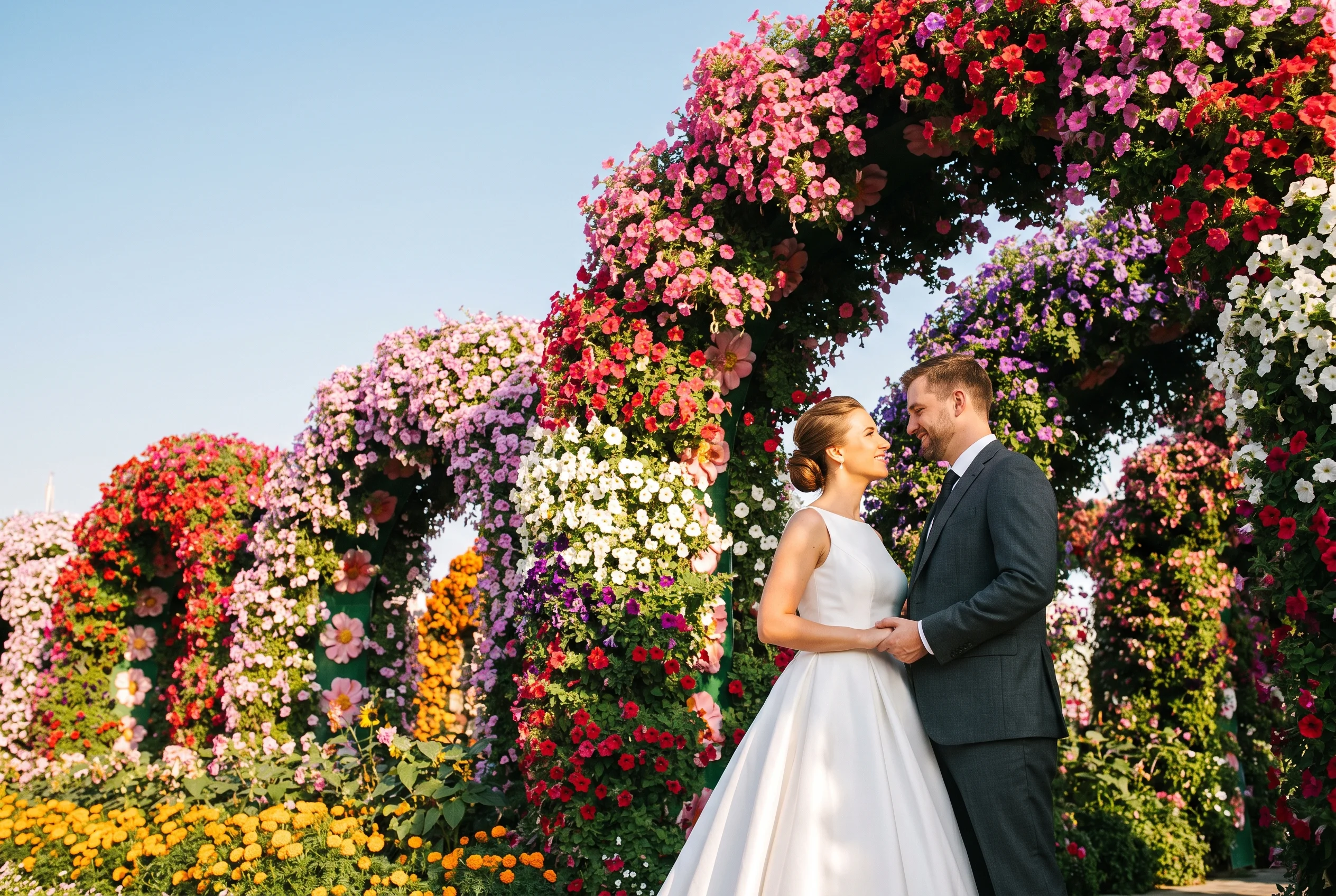
Dubai Miracle Garden is a 72,000-square-metre garden in the desert, where 150 million flowers are arranged in architectural formations — floral arches, flower-covered towers, peacock topiaries, and an Emirates A380 replica made entirely of petunias. It is the most surreal landscape in Dubai — a garden that should not exist in a desert, and the visual impact is a colour saturation that no other location produces.
The portrait move is to work the floral archways and the structured garden sections at mid-morning, when the sun is high enough to illuminate the flowers directly and the colour saturation is at its maximum. The couple, placed in a floral archway with the structured flower walls behind them, reads as a portrait in a setting that is fantastical — the colour palette is unlike any natural landscape, and the structured geometry of the garden design provides a formality that wild gardens cannot. The light is direct and warm, but the flowers provide reflected colour that fills every shadow with warmth.
Frequently Asked Questions
Can we do wedding photos in the Dubai Desert Conservation Reserve?
Yes, but a permit from the Dubai Desert Conservation Reserve is required for professional photography. Most desert resorts (Al Maha, Bab al Shams) can arrange access to private dune areas within or adjacent to the reserve. A 4x4 vehicle is mandatory — the dunes are not accessible by sedan. Most couples hire a desert safari operator who knows the reserve and can position them before dawn.
Is the Palm Jumeirah crescent accessible to the public?
The crescent is accessible by car via the Palm Monorail, and the beaches on the western end are public. The eastern end is occupied by the Atlantis resort. Parking is limited — most couples hire a car and driver for the session. The crescent beach is narrow, so check tide times for the widest sand at sunset.
When is Miracle Garden open?
Miracle Garden operates from early November through late April. It is closed during the summer months because the heat makes the flowers unsustainable. The garden is at its most vibrant in November and December, when the flowers are freshly planted. By March, the heat has begun to affect the blooms. Check the official website for exact dates, as they vary by year.
You don't need a 4x4 to reach these frames. Pictaway's atelier crafts cinematic wedding portraits set in Dubai's most iconic locations — from the desert dunes at dawn to the Marina skyline at blue hour — uploaded in moments, delivered in 24 hours. Explore Dubai wedding portraits.
Your Dubai wedding portraits — delivered in 24 hours
Get started